This weeks challenge for 52 Ancestors in 52 Weeks is Service. I chose Harvey Laverne Hartje (1921-1999). Harvey was in the Navy during WWII, he was my husband’s dad. I have to give full disclosure, I know very little about the structure and details involved in military life so hopefully I won’t mess up describing what I have found.

Before joining the Navy, Harvey was involved in the Civilian Conservation Corp. Harvey’s family in northern North Dakota had been hit hard with the economy of the time. They had lost the farm, they had moved, they had trouble finding work, and he was only 19. I was able to get some information about his work with the CCC through NARA. His job with them was Kitchen police. He worked in Larimore, North Dakota from 4 Oct 1939 to 3 Apr 1940. I found this description in the North Dakota Studies website.
“The Civilian Conservation Corps (CCC) was a program for young unmarried men. Some of these men were still in their teens, but others were in their twenties and unable to find regular work. Many of the CCC boys from North Dakota had grown up on farms, but their labor on the family farm had lost value. The CCC gave them a place to live, a job, education and training, and a paycheck. Of their $30 monthly pay, $25 was sent to their parents. Work on the CCC helped both the young men and their families.” you can find more here.
It looks like he had classes in typing, english, spelling, mess management, hygiene, manners, and citizenship. His job training classes were in K.P. and Safety. He was described as “Above average young man, Excellent.” His vocational interest was electrical engineering. Previous jobs included potato picking, beet work, farm work and combining. I’m not exactly sure what Kitchen police involved. I tried to find more and found this picture on North Country at Work of a kitchen police worker hauling coal. I’m guessing it was whatever needed to be accomplished in the kitchen.
Harvey worked at Turtle River State Park in Larimore, North Dakota. I was given his company number, 4727, and the town. When I searched for the town plus CCC this article about Turtle River came up. The CCC was there during the period he worked and it mentions his company. The CCC was meant to be a temporary organization and when the war broke out it began to shut down sites.

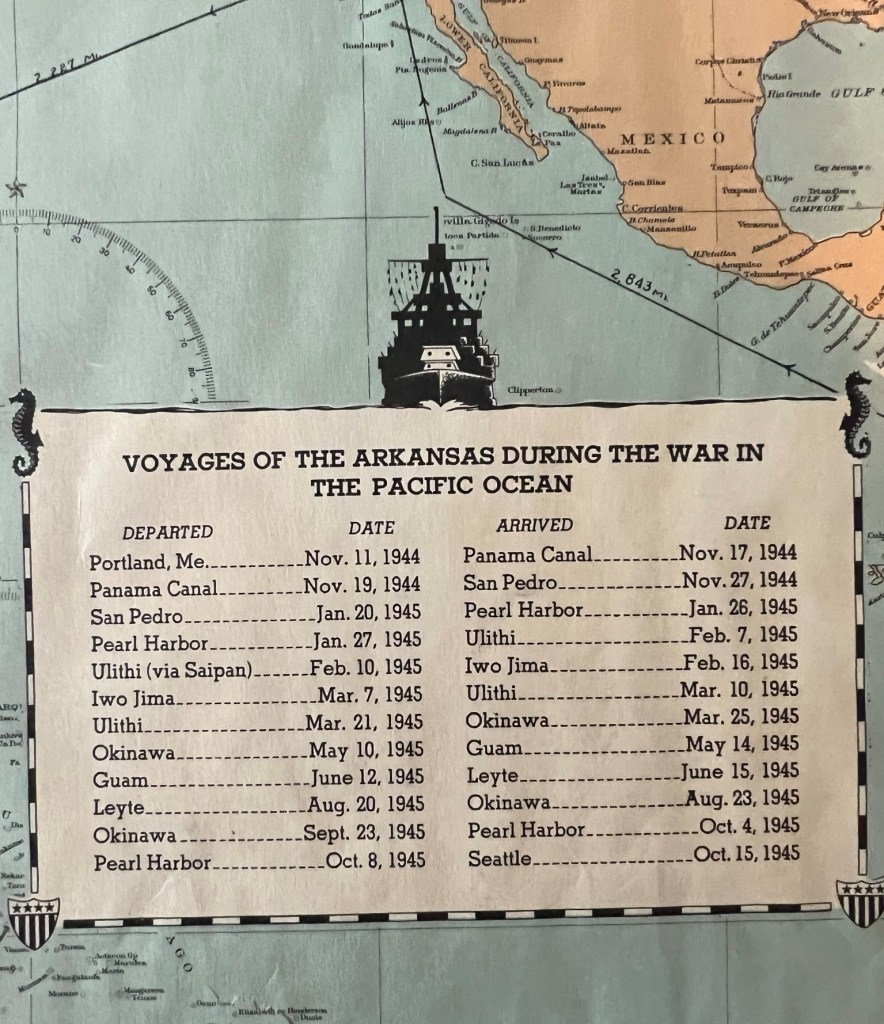
Harvey enlisted in the Navy 13 Nov 1940. Not positive what he did between the two but we are guessing he was working for various farmers wherever he could. The photo above is from a book Harvey owned and now belongs to my husband. It’s more or less a year book for the U.S.S. Arkansas. Most of the information I will be posting is from this book. I have found quite a bit on Fold3 about his service. They have Muster Rolls and Report of Changes for the various ships he was on. They even have photos of some of the ships. This photo is the Arkansas from his book.

I discovered through the records on Fold3 that Harvey was on a hospital ship from February to March of 1942. None of his children knew of any injury from the war so I have sent for his records through NARA to try to find out why he was on the U.S.S. Relief. He was also on a ship called U.S.S. Wyoming for a short time in 1942. It looks like he was on the Arkansas until the end of the war and after he was on a ship called the U.S.S. Suncock for a time. His discharge date was 15 Dec 1946. For this post we will focus on the Arkansas and his travels through the Pacific.
I wanted to include the Forward from the book because it shows the good, the bad and the ugly in this short account. The book had some moisture problems over the years so the pages are a little rippled but hopefully you can still read what he has to say.

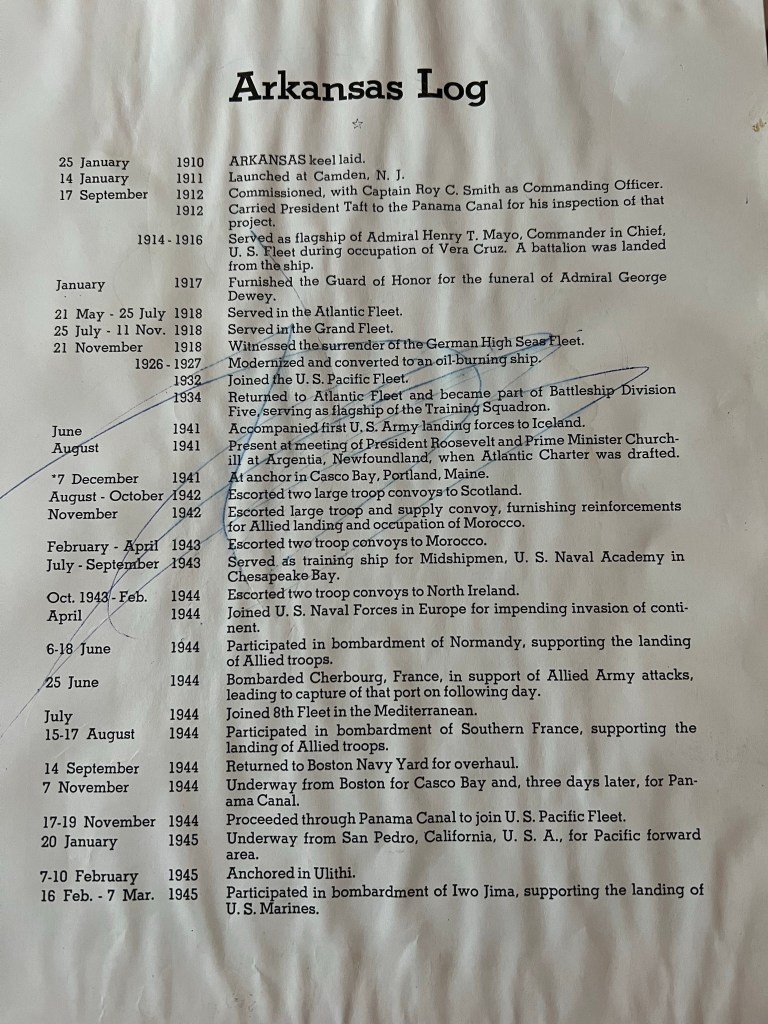
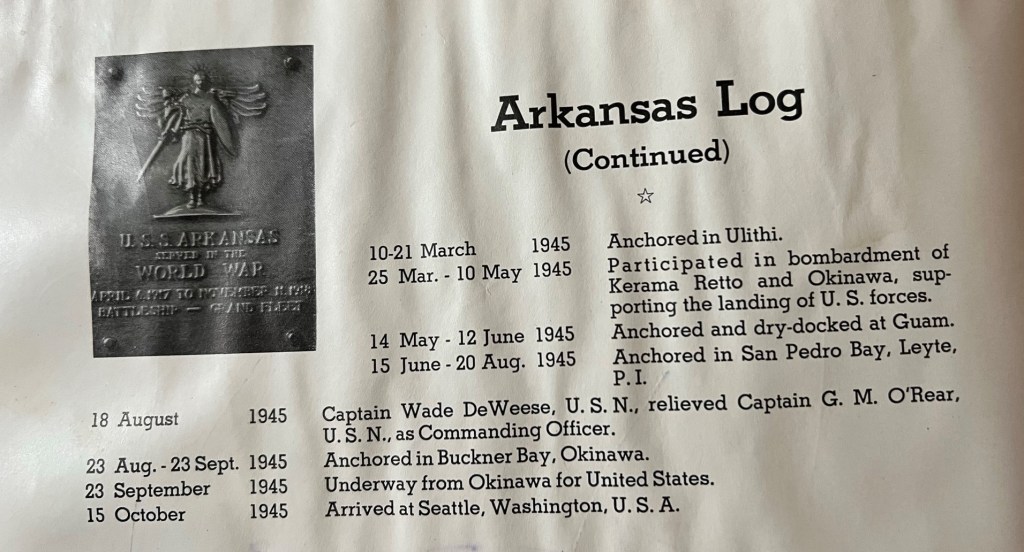
On the next pages there was a log that briefly described the history of the Arkansas beginning in 1910.
This is a photo of of the 8B Division. Harvey is the third one on the left right in the front row.

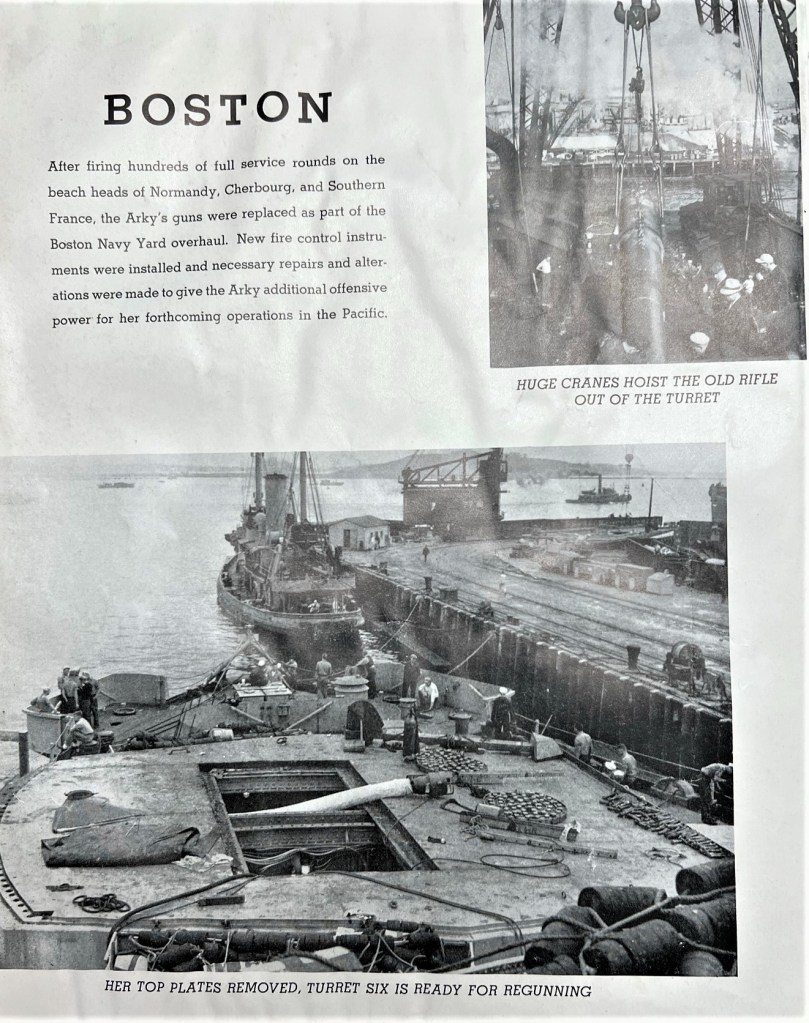
The next section was full of photos from the many different ports of call. My husband asked his dad once which stop was his favorite from his years in service. Harvey said New York. That wasn’t part of this trip but it surprised me, I was expecting one of the more exotic stops. I considered his answer and realized New York would have been a peacetime stop for them so it made a lot of sense from that point of view. Boston was where they began their journey. Some of the stops had more pages of photos than others. I am only including one for each stop.
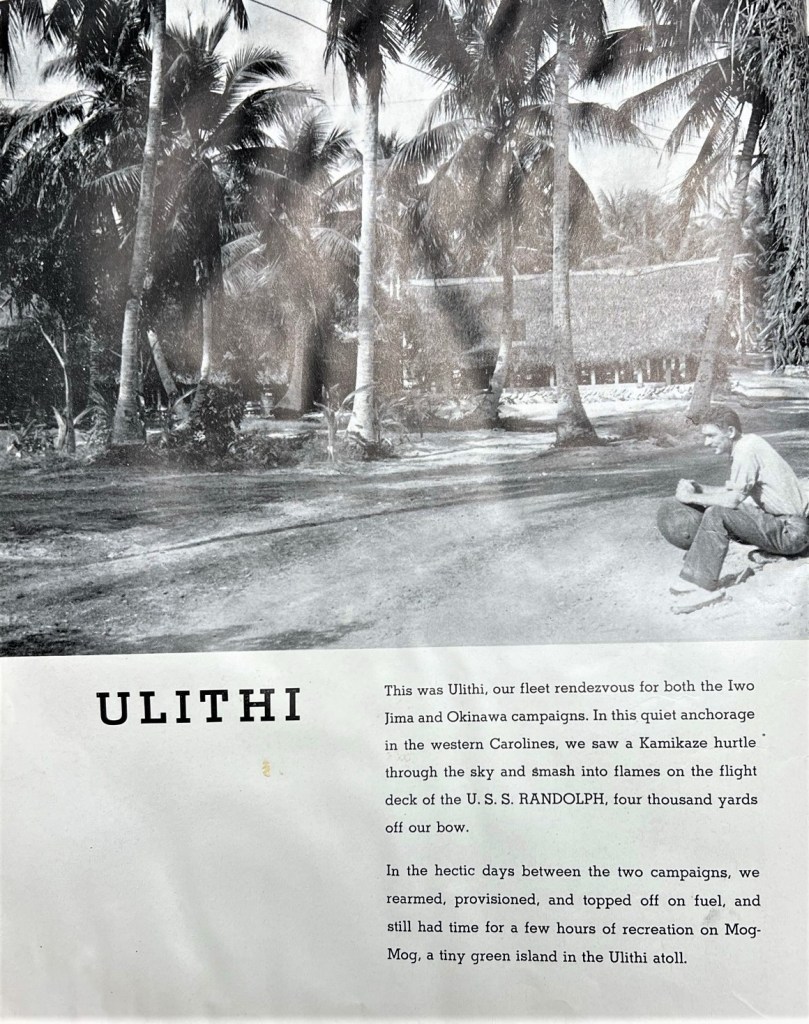
I had to look up their next Port of Call because I had never heard of it. I’m sure anyone who knows anything about geography and or the Navy is shuddering right now. If by any chance you are like me here is a little more information about this very important speck of land that became the largest navy base of WWII. Ulithi was the next Port of Call for the U.S.S. Arkansas.
The next Port of Call was Guam. They must have been there for a longer stop as there are pages of photos. They enjoyed shows, beaches, town life and music.

Leyte Gulf is where they were when they learned the first news of the surrender on August 10th. The photo at the bottom of the page shows the rockets, flares and searchlights the beach and ships sent up when they heard the news.

The next Port of Call listed is Okinawa Gunto. There are many sites that detail how important this battle was at the end of WWII. For those of you who are interested in reading more in depth about the battle here are a couple of the sites I found, The History of War and History dot com.

Nagasaki was the next Port in the book, I didn’t include all the stops. Pearl Harbor followed in the book.
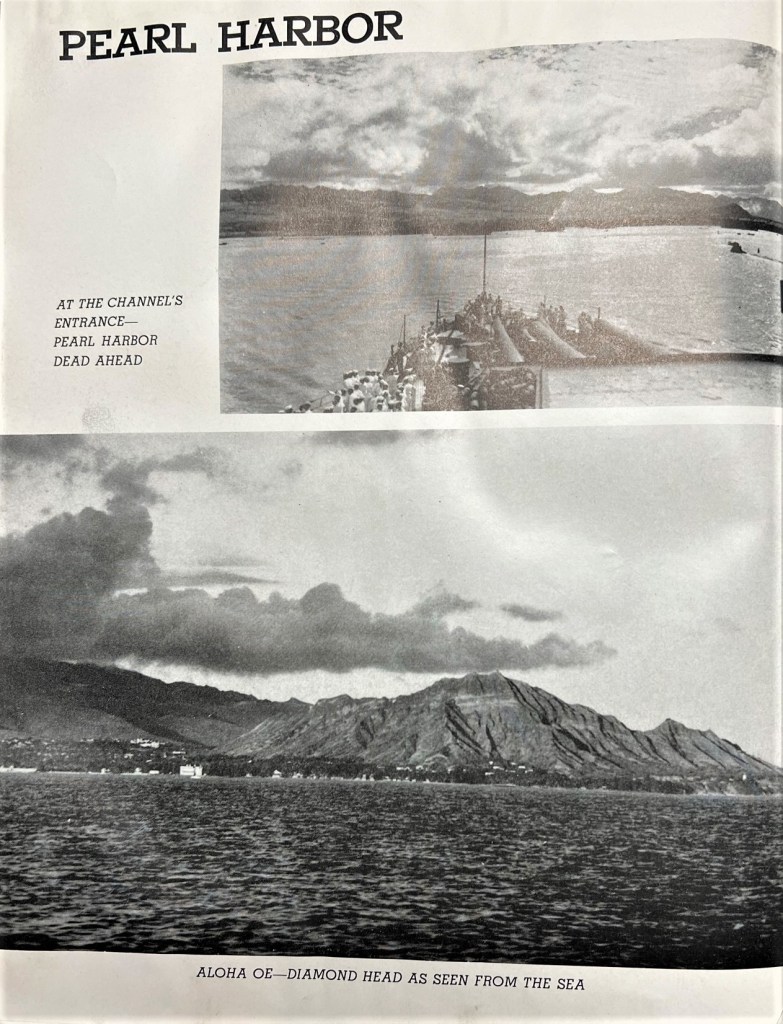
I had to include the second page for Pearl Harbor. Waikiki Beach has changed a little since 1945.

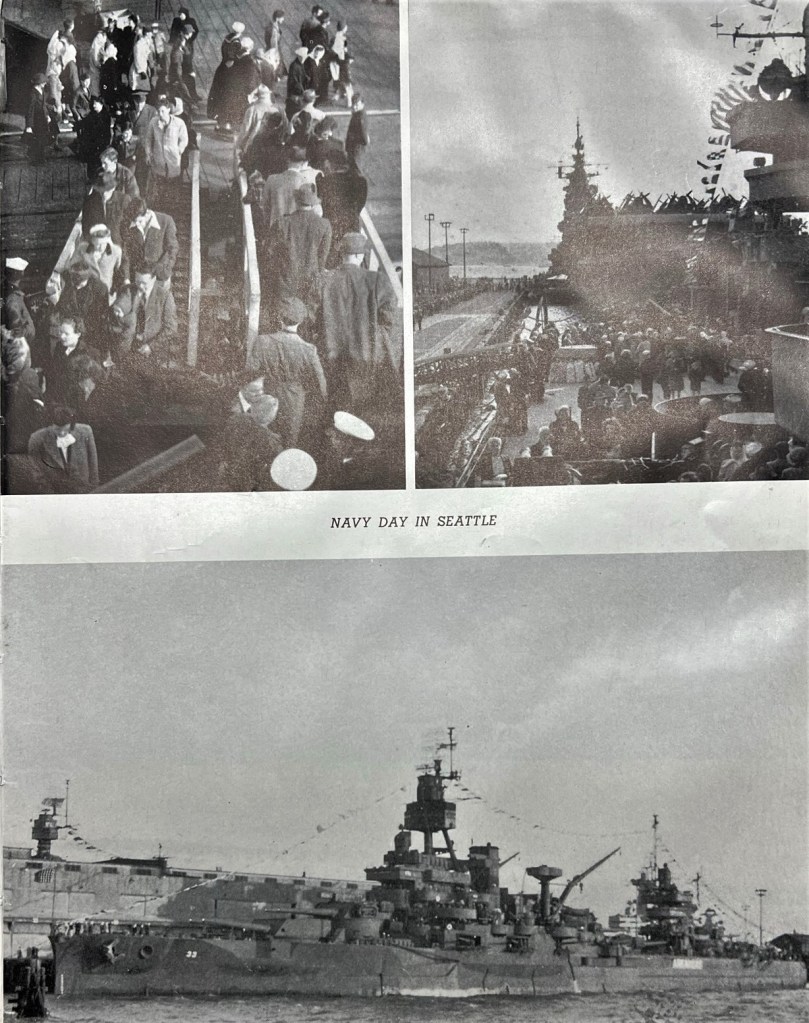
The end of the voyages had them return to the United States via Seattle. That must have felt really good to all those hard working sailors.
There are a lot of photos of everyday life on the ship including haircuts, laundry, mail call, holiday routines, dentist, church, mess hall and even someone having an emergency appendectomy. The most smiles were in the mail call photo.
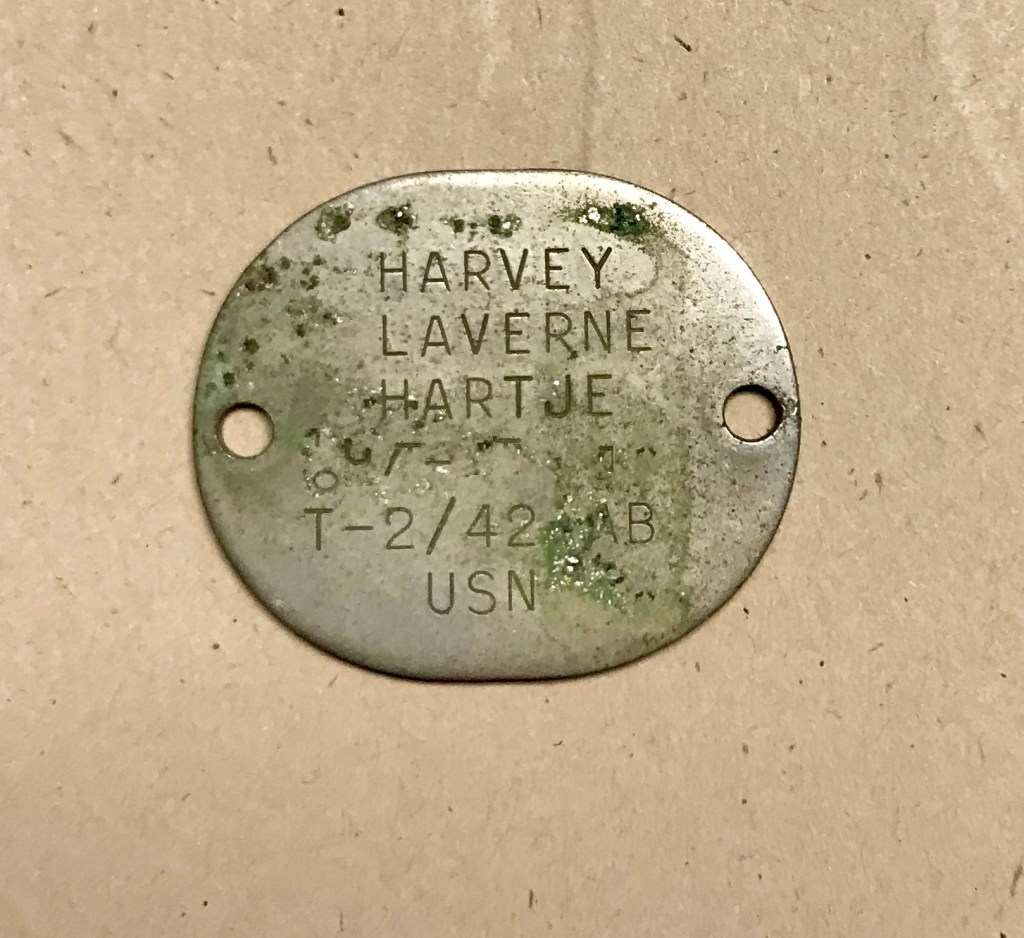
A story about Harvey Hartje wouldn’t be complete without a thank you to the gentleman who returned Harvey’s military tags to our family. When I first began researching my husbands family I was contacted by someone who had found Harvey’s military tag in his fathers memento’s. He was so kind to take the time to look us up and send a message and to send the tag back to us. We can’t thank him enough for this kind effort. (I blurred out his number on the tag)

Harvey is the one in front of the two officers in this photo. There are many groups of photos and surprisingly I found a relative of mine while looking through all the names. I see a couple more familiar names as well so I will have to look and see if they were in the Navy during WWII.

You can see they had many stops in the Atlantic, quite a few in New York which was Harvey’s favorite. His brother was also in the Navy during WWII and I wonder if they were ever in the same place at the same time?

Harvey is buried in the North Dakota Veterans Cemetery in Mandan, North Dakota. I hope this gave you a little picture into the service life of Harvey Laverne Hartje. Did you have any veterans in your family? Were you fortunate enough to have a memory book like ours? We have much to be thankful for in this country, our veterans are at the top of the list.
 My Tree in the Forest