“There are lots of ways you could approach this theme: teachers, yearbook photos, tales of being a good (or bad) student. You could also highlight an ancestor who got their education at the “School of Hard Knocks.” prompt from Amy Johnson Crow for Week 4 of 52 Ancestors in 52 Weeks.
I chose to write about a female relative of my husband this week. She intrigued me when I first came across this tiny blurb from The Fargo Forum and Daily Republican or the Courier Democrat, 1907.

At the time I found it I didn’t know if she was a relative of my husband but figured it was likely because of her last name and where she was from. I was just beginning my research so I didn’t save this with all the details. I’m sure it would have been in one of the above mentioned newspapers but haven’t been able to find it again to get the page number and exact date but I know it was 1907.
First things first, she is my husbands first cousin 2X removed. So, she is a relative, but what does that mean. Her father and my husbands great grandfather are brothers. Annie Hartje’s parents were John Jacob Hartje (1859-1906) and Pauline Cecelia Nietzke (1866-1939), also known as Polly. Jacob was the oldest child of Hein Hartje (1825-1879) and Rebecke Schuett (1837-1922), Jacob was 7 years old when they came to America and first settled in Minnesota. Sometime after his fathers death Jacob and the majority of his family moved to North Dakota, Jacob settled in St Thomas. My husband’s great grandfather was Peter Hartje, he was the fourth son of Hein and Rebecke. Peter was only 6 months old when they traveled to America from Hannover.
Anna Marie Hartje was born 22 October 1884 in St Thomas, Pembina County, North Dakota. She was the first child born to Jacob and Polly. She had 11 siblings. They were a prominent family in the area. Her father died in 1906 at the age of 47, which must have been a devastating loss to the family.

Anna or Annie as she was known would have been 22 when her father died. She was most likely a huge help to her mother at this time. Her youngest brother was born only a month before her father died. According to the 1900 U.S. Census for St Thomas Annie’s grandparents were both living with her family along with two servants. I just looked quickly to see if her grandparents (Polly’s parents) were still alive the year Jake passed away and it looks like her grandmother died in January 1906. That is a lot of turmoil for one household.
They were fortunately well off at the time of Jake’s death. I looked up what his worth would be in today’s terms, here is what I found. “$40,000 in 1906 is equivalent in purchasing power to about $1,319,097.78 today, an increase of $1,279,097.78 over 117 years. The dollar had an average inflation rate of 3.03% per year between 1906 and today, producing a cumulative price increase of 3,197.74%.” from the CPI Inflation Calculator.
We found his tombstone when we took our trip to North Dakota and it was obvious he was well liked and well off since his stone towered over all of the others in the Cemetery.

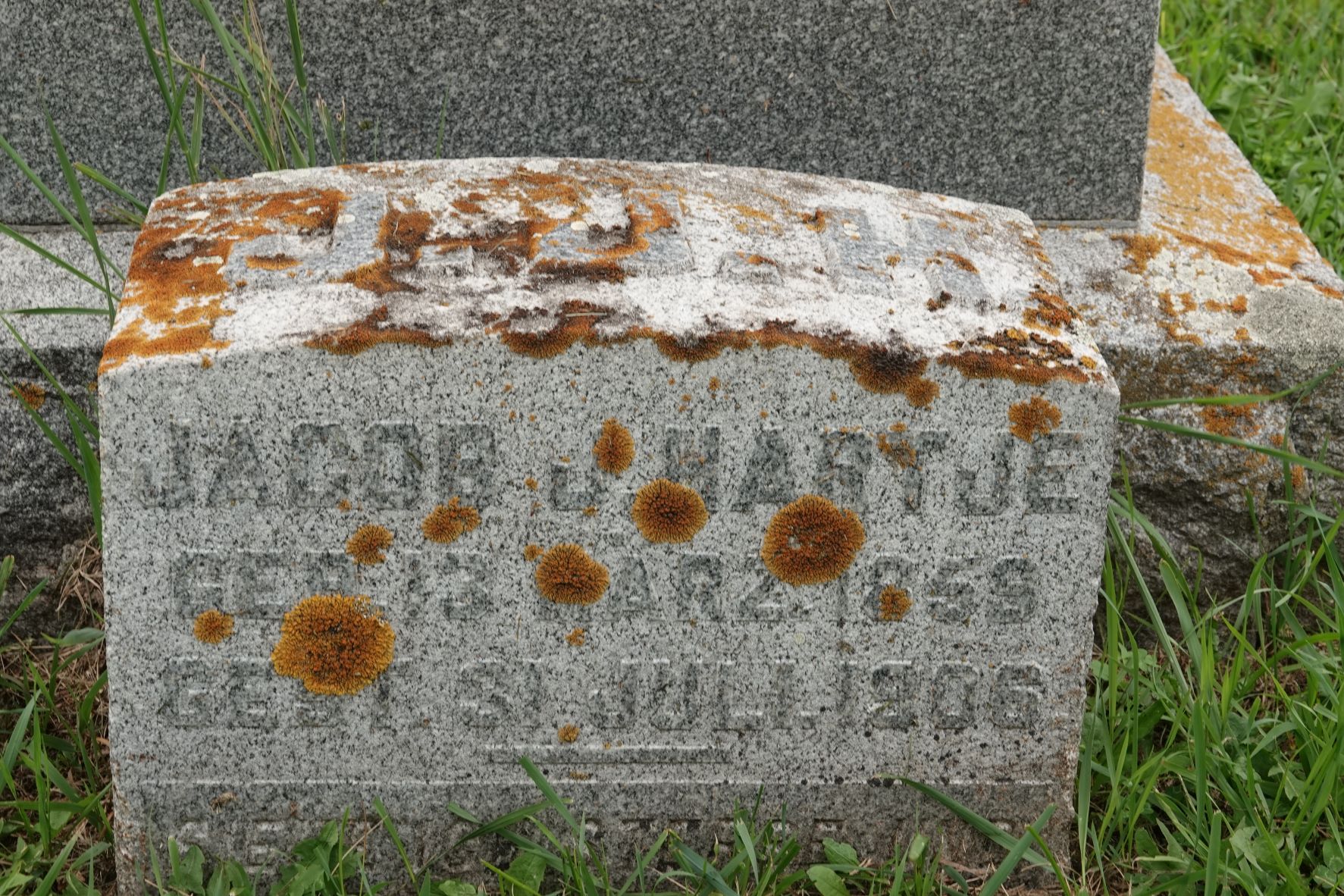
The smaller stone is on the backside of the tall stone. I’m sure it was intended to be a family plot. Polly eventually moved to and passed away in Seattle, Washington so she is not buried here.
Now that we know a little of Annie’s history we are back to the question of what prompted a 22 year old woman to go to college in 1907? I was wondering just how many women in North Dakota at the time went to college at all. I found some surprising answers.
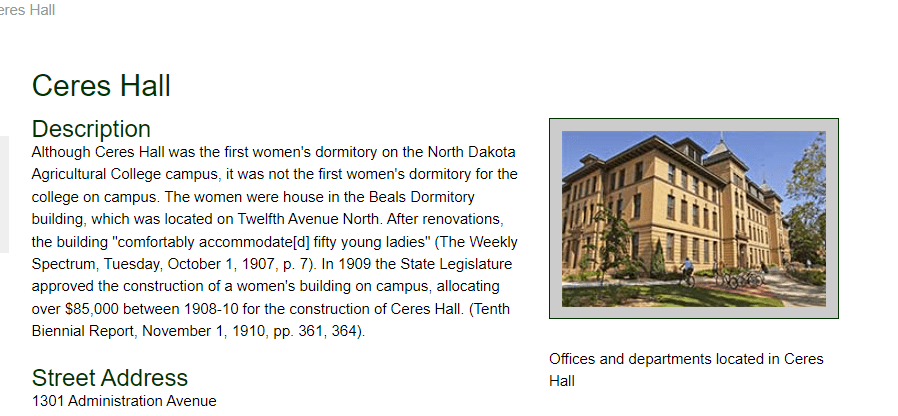
There was one building where 50 women who were going to college at North Dakota State University could live in 1907. Of course I than wondered how many men were enrolled at the same time. I came across a History of North Dakota State University by David S. Buchanon written in 2019. He had this photo included in his paper, the photo is from the University Archives. It was called North Dakota Agricultural College at the time and was a little controversial when it was first opened. The city leaders thought a college based on agricultural studies was a waste of time.

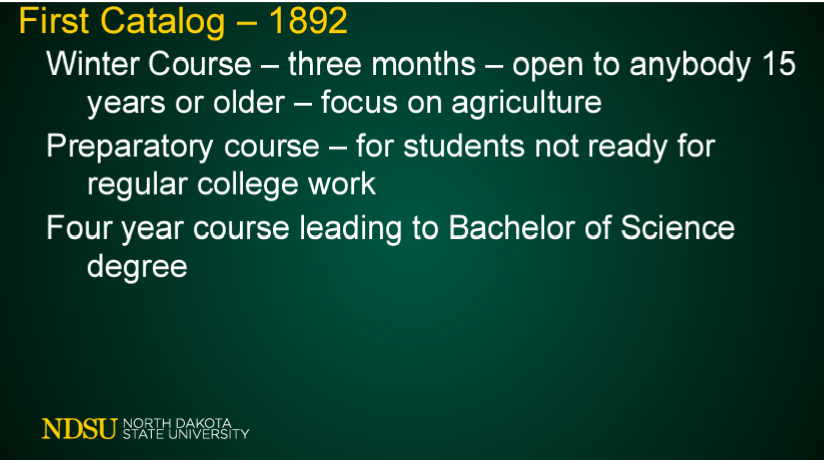
Looking at this I once more had questions. Why are there so few graduating when it opened in 1888-89. Turns out when it first opened it was not a state college of agriculture, that happened in 1900, so this must have been the first graduating class from the college. There are 5 women and 3 men! Completely unexpected. It appears people could take short courses for agricultural study and preparatory work. I may have to go back and try to find out who these women were and what they went on to do in their lives.
By 1910 it appears Annie is no longer in school but perhaps her schooling helped her get this job. She is a clerk at the Farmer’s store. In the 1910 U.S. Census Annie is living as a boarder with another family in St Thomas.

In this 1913 article she is moving to a new job in Langdon, North Dakota. I am assuming she might actually move to Langdon as well since that would be quite a distance from St Thomas.

I have not been able to find her in the North Dakota State Census records. I think her next move was to Minnesota. I found an Anne Hartje age 35 living as a lodger in New Ulm, Minnesota. She is a saleslady in a Dry Goods store. She was born in North Dakota and her parents are both from Hannover, which all fits for this Annie. She is living with a family named Ratzlaff. I don’t have any idea what prompted this move but I do think this is Annie.
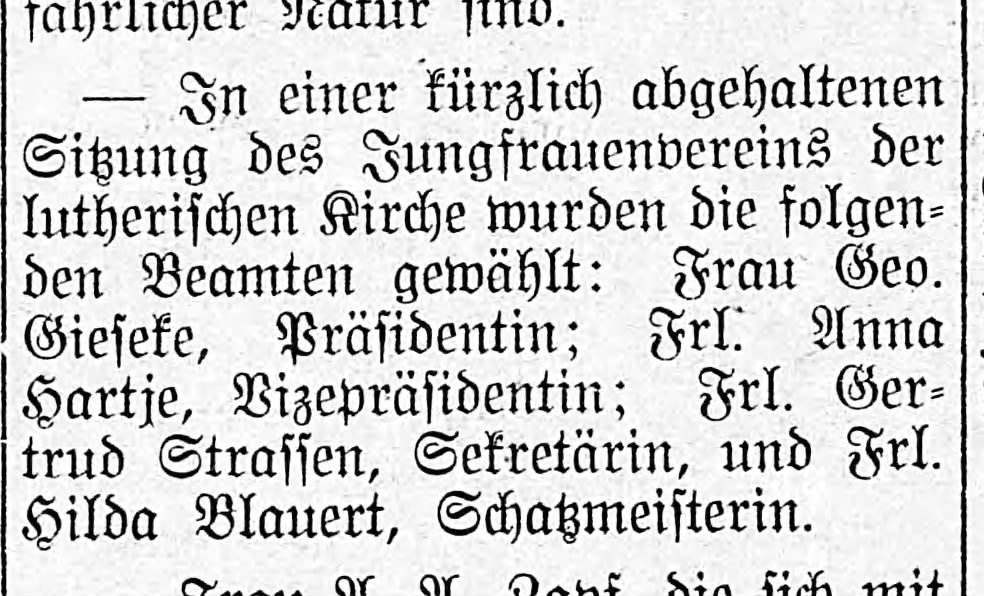
I was excited when I discovered her name in a German newspaper from New Ulm. I thought I might be able to translate using my new skills. Ha! I discovered newspaper script is different from handwritten script and some of these words didn’t come up in my class. I did figure out it was something held at the Lutheran Church and the following became chosen officials. Luckily I also found it in an English newspaper from New Ulm because the big long word in the second line was one I didn’t know and I tried using google translate. It gave me maiden cleanse. I was hoping that wasn’t right.

Sometime before 1930 Annie made another move. She is living with her mom and two of her sisters in Seattle, Washington. A number of people in my husbands family moved to Seattle or that area of the country but I always wonder what prompted this change. I’ll have to keep exploring this part of the family because I am guessing there were other family members living near by. Annie is now working as a sales lady in a clothing store. Annie is 45.
Annie’s mother died in 1939. I think they lived together until her mom died but not sure yet, I need to check directories and see if Washington state has census records from 1935. I don’t gather records as fast for relatives who are a little farther out on the branches.
In 1940 Annie is the head of her household. She is a proprietor and waitress of a tavern. The two men living with her may be related to each other as they have the same last name Depew. The older one, Pete Depew, is listed as Annie’s partner, he is a proprietor and waiter in a tavern. So is he her business partner, her life partner or both? It’s not really clear but I bet in 1940 it simply meant business partner. The other man is Lawrence Depew, so possibly a brother, he is about 8 years younger than Pete. Lawrence works as a lineman for the telephone company. No address is given but she is now living in Burien, Washington.

The most surprising thing about this census is, it says her education is H3. H3 means she went through 3 years of high school. So, now I am rethinking my whole premise for writing this post. Do I have the wrong Annie Hartje from St Thomas? I think I do have the right person but maybe she was exploring possibilities and taking some of the preparatory course work to see if college would be a good option for herself. I am still amazed that was an option for her at this time and really glad I learned more about what was available for women.
I have not found her yet in 1950 but I am assuming she was still in the same area. Annie died in 1966 and is buried beside her mother in Pacific Lutheran Cemetery, Seattle, Washington. You can find her on Find A Grave here. I have discovered in writing this post I need to clean up her family on Family Search and connect her family on Find A Grave. Always something more to help keep the family records straight no matter how far out on the branch they may be.
 My Tree in the Forest
One thought on “Week 4 2023 Education”