
Is there someone in your family tree who lived by themselves or would seek out time to be alone? Celebrate them this week by writing part of their story. Prompt from Amy Johnson Crow for Week 15 of 52 Ancestors in 52 Weeks.
I have to admit I have been stumped on this one. I asked my sisters if they had an idea what I should write about. Two immediately thought of the pandemic and one suggested writing about my sister who accomplished more than two lifetimes of work during the pandemic. She would be a good story for the blog, but for now I just write about those who have gone before us. So, we skipped back to the 1918 pandemic.
There was a lot happening in 1918. I focused on Belle Plaine, Iowa as that is where my dad’s parents were living at the time. One of the first articles I happened upon while looking through the Belle Plaine, Iowa library archives was about Cootie garments. This one intrigued me for several reasons. Did they think they could protect themselves from influenza with clothes? What did they look like? Who wore these? How were they made? and the list goes on.
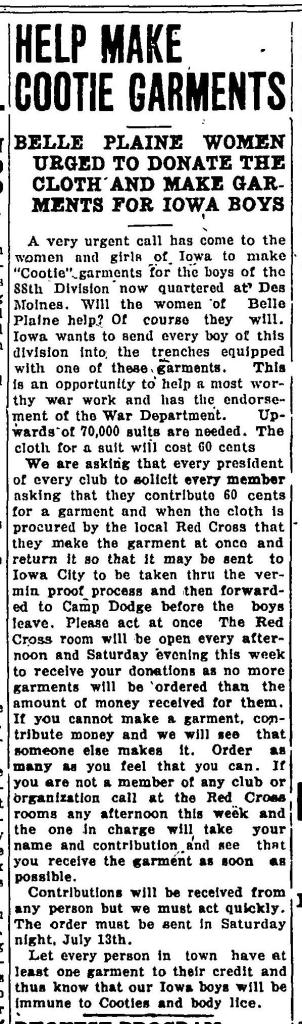
It wasn’t about the influenza pandemic at all. It was about helping the soldiers survive the ‘cooties and body lice’ in the trenches of WWI. I had to find out more because I realized my grandmother, Fredricka Siepmann/Cook, and my great grandmother, Katherine Kinney/Cook probably made some of these garments. My great grandmother was a seamstress by profession and I knew my grandmother could sew after watching her sew up a toy our dog had torn. The stitches outlasted the toy, they were so tiny! I have to wonder what chemical was applied to the fabric and did anyone ever check for adverse effects among the garment makers and wearers? This article tells a little more about the Cootie Garments. I tried to find a picture but unfortunately I didn’t find one. This pdf called The Great War US Army artifacts is full of photos and information if you are interested.

The next article I found was about the pandemic and the steps they were taking in Belle Plaine, Iowa and the surrounding communities. This article was about closing schools, churches, public gatherings and pool halls. “Cheerful compliance on the part of our citizens may save to us many lives.”

I couldn’t find any further articles on when everything actually opened again but for this small Iowa town things were going fairly well. The soldiers in WWI were not faring as well with the pandemic. The first reported case in the U.S. was at Fort Riley, Kansas. Not that far from where my family lived at this time. My grand uncle was a soldier in WWI and was more than likely exposed. “Of the US soldiers who died in Europe, half of them – 43,000- died from the Spanish flu.” At it’s peak 195,000 died in October alone.
The Pandemic and WWI were not the only problems facing my family at this time. My grand uncle, Frank Cook, returned from WWI with tuberculosis and died at only 46 as a result of this illness. This was a huge problem for that time period. This article is about the serious problem they had to care for these men and their families.

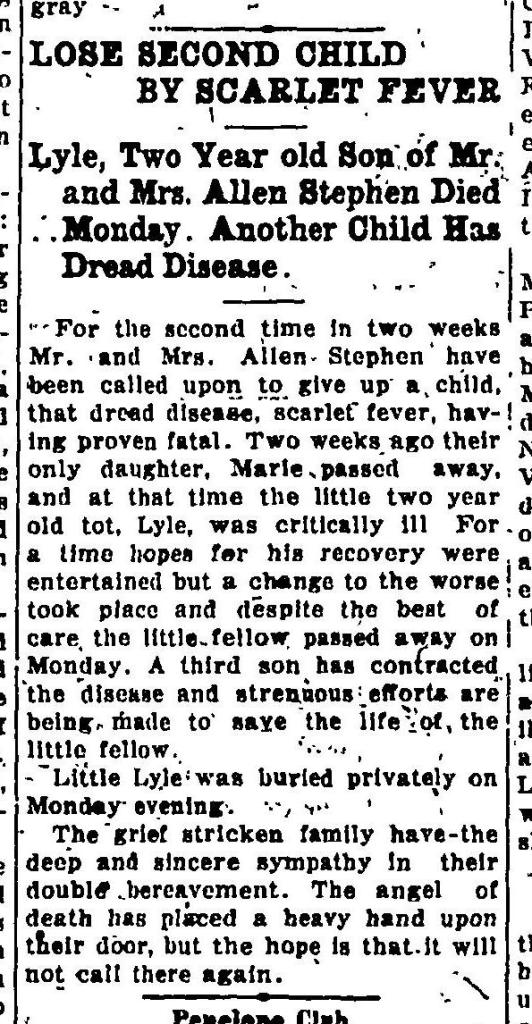
I also found an article about an outbreak of Scarlet fever and a family who were burying their second child to die within two weeks. Their third child was sick at home. This made me think of my Minson relatives in Ohio who had three children die of scarlet fever in a short time. So much to think about during this time period.
Another disease to worry about in 1918 was Typhoid fever. This article talks about suggestions from the State Board of Health on how to control this disease. 1918 sounds like a nightmare and I am very glad my family survived.

Belle Plaine was a farming community so farm issues also made the headlines. Diseases were a problem in the chickens and hogs at this time. Pest and blight struck the potatoes and other crops. It sounds like the end of times.
The Centers for Disease Control has a Pandemic Influenza Storybook. One of the stories is about Lloyd Nelson, a farm boy from Boone, Iowa who survived the pandemic when many on his troop ship headed to France did not. My family ended up in Boone, Iowa so this one stood out to me. I needed to end with a little more positive note. Maybe I can have a light hearted post for the next week.
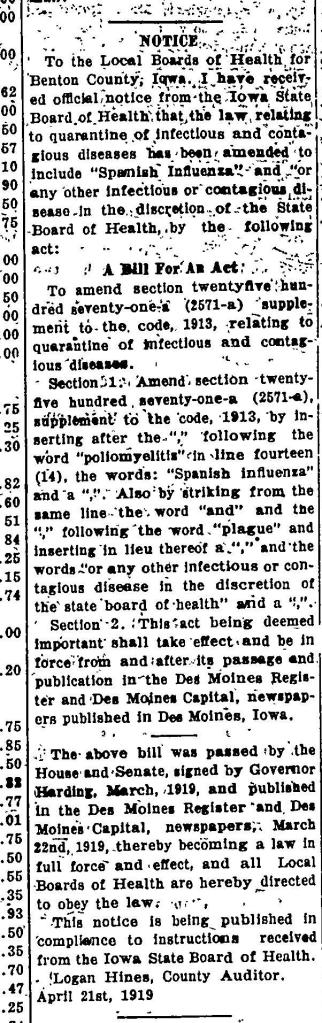
This final article is about the state legislature passing a bill to allow them more discretion in declaring a quarantine. Maybe that helped for the pandemic we just experienced.
 My Tree in the Forest