Week 16: 2023 Should Be A Movie!

What is family history without the stories? (It’s a bunch of cold, lonely facts, that’s what!) What story in your family should be up on the silver screen? Prompt given for Week 16 of 52 Ancestors in 52 Weeks by Amy Johnson Crow.
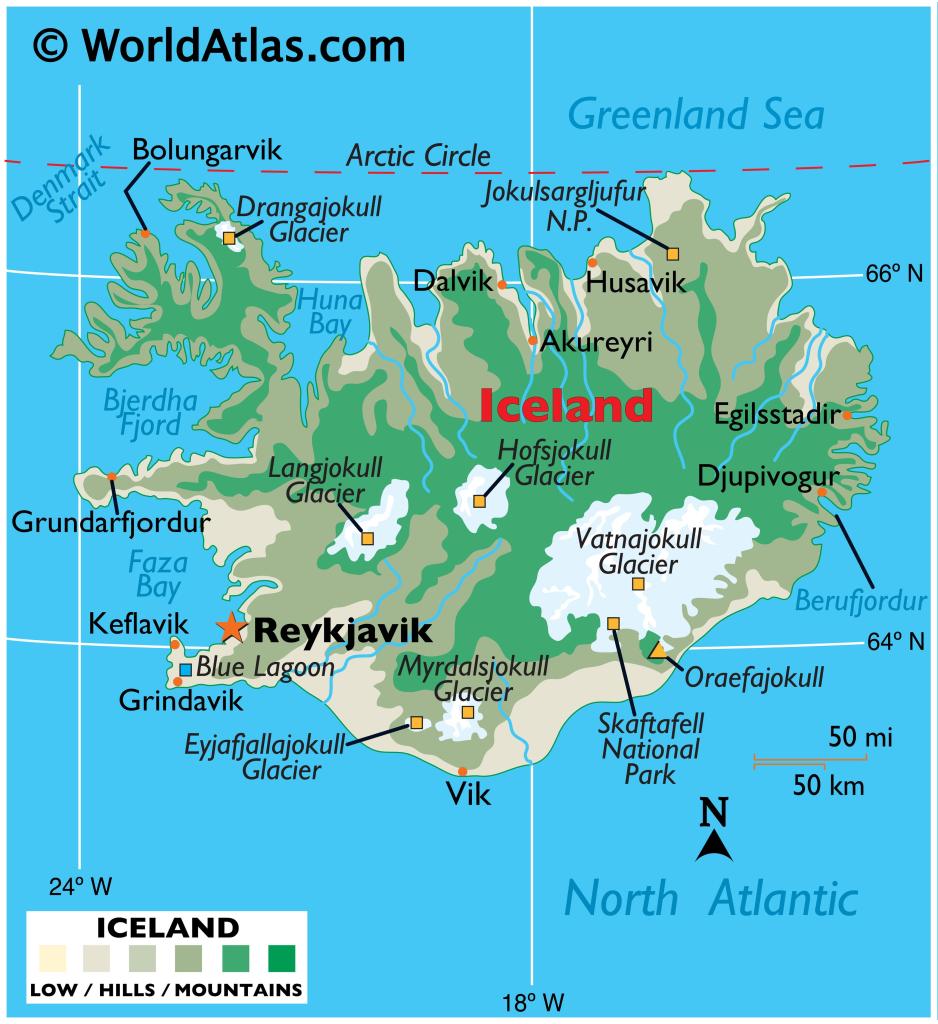
Icelandic map from WorldAtlas.com

Who wouldn’t love to see Iceland in a movie! I haven’t been there yet but the photos I see are amazing, so many waterfalls, and the northern lights! The journey my husbands ancestors took in order to build a better life for their family is nothing short of breathtaking. Akureyri, in the northern part of the island is where his family departed Iceland. The inlet to the west is where they lived before their journey began.

Thorfinnur Johannesson

Thorfinnur Johannesson was born 24 May 1838 in Hvammur, Holasokn, Hjaltadalur, Skagafjardarsysla. I believe Hvammur is the farm where he was born, Holasokn is the community name, Hjaltadalur is the parish and Skagafjardarsysla is the county. If you click here you can find a little information about the community including a short bit about his 11th great grandfather, Jon Arason, who was beheaded in 1550. This wikipedia page also contains a few images. I found a few images I am able to use in my post on Morguefile. This one looks similar to other photos I have seen depicting where the farm was located.
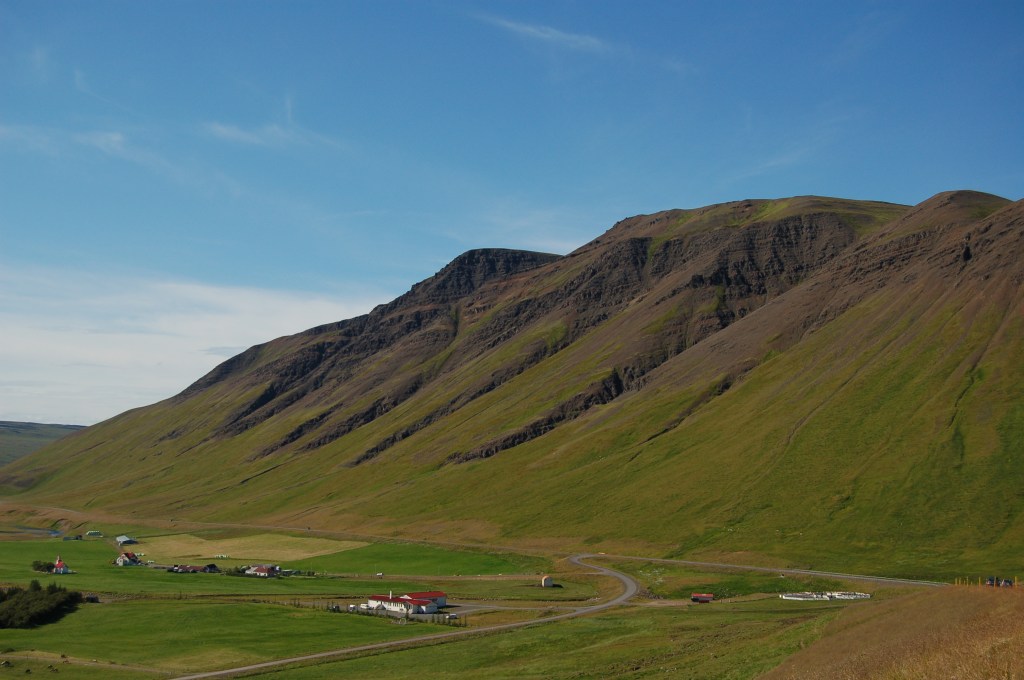
photo from Morguefile.com of Icleand

Thorfinnur married Elisabet Petursdottir in 1863. He was 25 and Elisabet was 24. I have found Thorfinnur in The National Archives of Iceland Census Database in 1860, 1870 and 1880. Elisabet was in the 1870 and 1880 Census with Thorfinnur. I think I also found Thorfinnur’s mother in the 1870 Census, she is living with one of her daughter’s and her family. In 1860 Thorfinnur was a worker (vinnumathur) on the farm of Jon Benidiktsson. It looks like there were seven workers on this farm which was more than most. I think Jon may have been a distant cousin.

From the National Archives of Iceland Census Database 1870.

In the 1870 Census Thorfinnur and Elisabet are subleasing a farm and have two of their daughters, Petrina and Kristin, living with them. In 1870 they actually have 4 children. I’ve been told that it was pretty common for children to live with other relatives who didn’t have children or had enough space for more children. I found their daughter Margret with a first cousin of Thorfinnur, listed as ‘tökubarn hjónanna’ or adopted child of the couple.

from the National Archives of Iceland Census Database 1870.

I haven’t figured out where their son Thorlakur was in 1870, he would have been 4 years old. I’m sure he was also living with a relative. The information I have regarding their emmigration says that Thorfinnur had been blind for 14 years when they left Iceland in 1882. That would have been 1868. I am guessing that played a part in their children living with other relatives. At 30 years of age Thorfinnur became blind. I can’t even imagine how difficult that must have been for a farmer, a father, a husband, anyone.

Petrina sadly dies in 1871. The story I heard is that she and her father were on a horse, herding sheep across a stream. I imagine Petrina was his eyes, and helping him navigate. She slipped into the water and drowned. That must have been heart breaking. 1871 also brought the birth of their fifth child, a daughter named Gudrun. Gudrun died in 1875. I don’t know if the volcanic eruption of Askja had anything to do with her death but it sounds like between the volcano and the earthquakes it was a difficult time. The ashfall was heavy enough to poison the land and kill livestock. You can read more here.
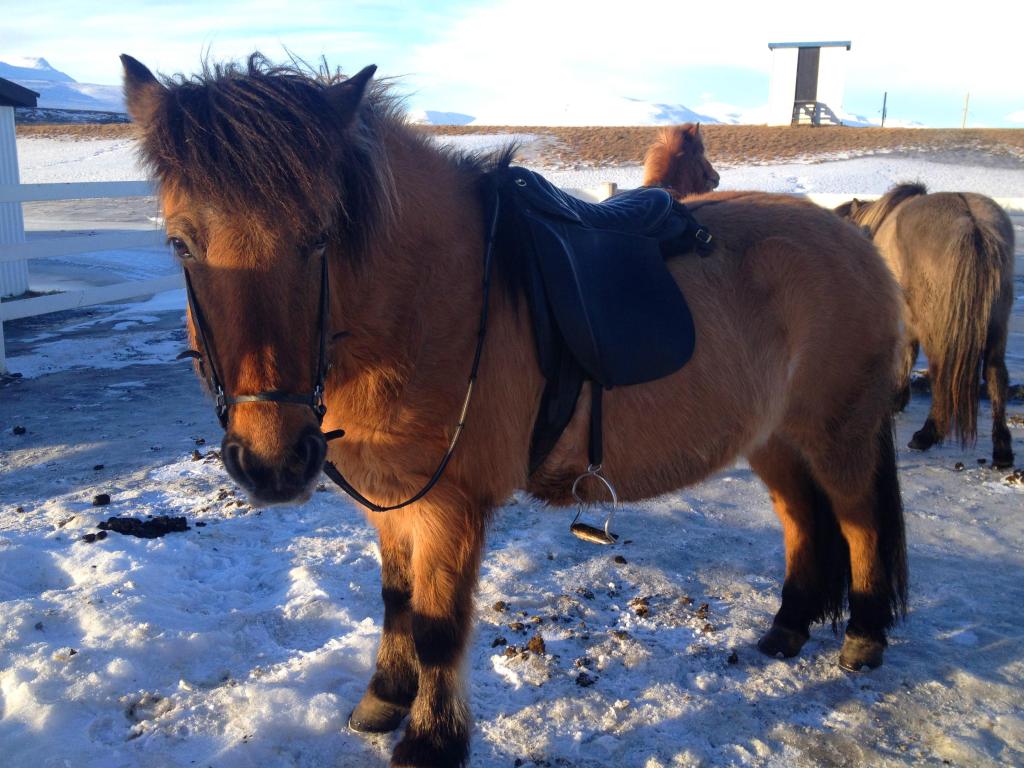
Icelandic horse, photo from Morguefile.com

Their sixth child Gudny was born in 1874. It must have been a little frightening to have an infant when the air was full of ash and probably food was scarce. Petur, their seventh child was born in 1875. I don’t know who he was adopted by, but according to the information about their emigration he and Margret did not come to America with the rest of the family as they had been adopted out.

Next arrival in the family is my husbands grandfather, Arni, who was born in 1877. The ninth child was Fridrik, who was born in 1881. The family emigrated in 1882 and there is a wonderful photo on the Icelandic Roots website of Thorfinnur, Elisabet, and three of their youngest children Gudny, Arni and Fridrik. I found a small image of it in a book in the Pembina County Museum. This is a story about theeir family.

From a book in the historical museum in Pembina County North Dakota

They traveled first to Ireland on the S.S. Camoen which was a cargo and passenger ferry that traveled frequently between Iceland and the UK. I haven’t found the name of the ship they took from Ireland to the U.S. I tried to find an image of the S.S. Camoens I could share, and wasn’t successful but this site has a lot of wonderful information and photos about Iceland.

They ended up in Mountain, North Dakota. This place had the highest number of Icelandic people in the entire U.S. so I am sure this was not an accidental arrival. They already had family and friends in the area. Mountain to this day has an Icelandic festival every August. My husband and I went a couple of years ago. When Thorfinnur and Elisabet arrived they lived on a hill, in a dugout by the creek, north of Mountain. In case you don’t know Mountain is about 30 miles from the Canadian border. A cousin of my husband sent us a story about how the Icelanders first came to America and traveled across the country rejecting place after place until they finally found a spot as desolate and cold as home. A little exagerated but still kind of funny.

Sod house in Iceland photo from Morguefile.com

I don’t know if this would have been similar to the house they lived in Iceland or what they built within a year of arriving in North Dakota but I am thinking it is close. They built a log cabin one half mile north of Mountain and moved in 1883. Their son Arni lived in this house later in his life. The picture below is a crop of a map I took a photo of at the Historical Society in Pembina County. You can see Arni’s property just north of Mountain.

Crop of a map of Thingvalla township in North Dakota showing Mountain, ND

Margret and Petur emigrated in 1893, 10 years after the rest of the family arrived. Maybe things were a little more settled by this time. When I think about making the trip from Iceland to Ireland to the U.S. it seems overwhelming to me. Add in the insecurity of poverty, blindness and an unknown future and I have so much respect for their bravery and strength. It all sounds like a movie waiting to be made to me. I’ll leave you with one last free photo from Morguefile, this one has the northern lights, who wouldn’t want to see them?

Northern lights in Iceland from Morguefile.com

Week 15: 2023 Solitude

Is there someone in your family tree who lived by themselves or would seek out time to be alone? Celebrate them this week by writing part of their story. Prompt from Amy Johnson Crow for Week 15 of 52 Ancestors in 52 Weeks.

I have to admit I have been stumped on this one. I asked my sisters if they had an idea what I should write about. Two immediately thought of the pandemic and one suggested writing about my sister who accomplished more than two lifetimes of work during the pandemic. She would be a good story for the blog, but for now I just write about those who have gone before us. So, we skipped back to the 1918 pandemic.

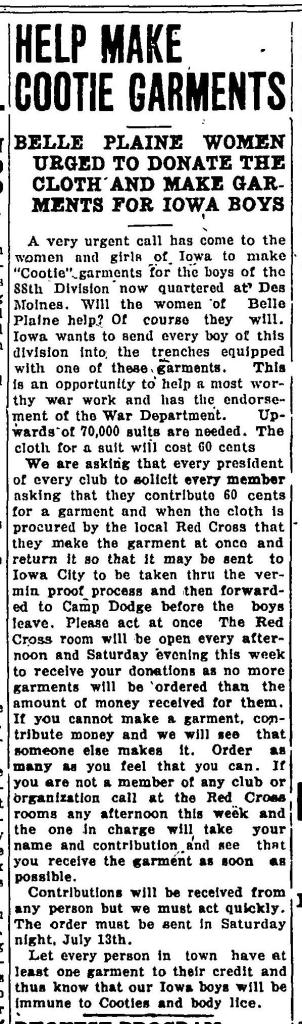
There was a lot happening in 1918. I focused on Belle Plaine, Iowa as that is where my dad’s parents were living at the time. One of the first articles I happened upon while looking through the Belle Plaine, Iowa library archives was about Cootie garments. This one intrigued me for several reasons. Did they think they could protect themselves from influenza with clothes? What did they look like? Who wore these? How were they made? and the list goes on.

Page 1, The Belle Plaine Advantage, Thurs, 11 Jul 1918

It wasn’t about the influenza pandemic at all. It was about helping the soldiers survive the ‘cooties and body lice’ in the trenches of WWI. I had to find out more because I realized my grandmother, Fredricka Siepmann/Cook, and my great grandmother, Katherine Kinney/Cook probably made some of these garments. My great grandmother was a seamstress by profession and I knew my grandmother could sew after watching her sew up a toy our dog had torn. The stitches outlasted the toy, they were so tiny! I have to wonder what chemical was applied to the fabric and did anyone ever check for adverse effects among the garment makers and wearers? This article tells a little more about the Cootie Garments. I tried to find a picture but unfortunately I didn’t find one. This pdf called The Great War US Army artifacts is full of photos and information if you are interested.

Page 1, The Belle Plaine Union, Thursday 17 Oct 1918

The next article I found was about the pandemic and the steps they were taking in Belle Plaine, Iowa and the surrounding communities. This article was about closing schools, churches, public gatherings and pool halls. “Cheerful compliance on the part of our citizens may save to us many lives.”

page 5 The Belle Plaine Union, Thursday, 31 Oct 1918

I couldn’t find any further articles on when everything actually opened again but for this small Iowa town things were going fairly well. The soldiers in WWI were not faring as well with the pandemic. The first reported case in the U.S. was at Fort Riley, Kansas. Not that far from where my family lived at this time. My grand uncle was a soldier in WWI and was more than likely exposed. “Of the US soldiers who died in Europe, half of them – 43,000- died from the Spanish flu.” At it’s peak 195,000 died in October alone.

The Pandemic and WWI were not the only problems facing my family at this time. My grand uncle, Frank Cook, returned from WWI with tuberculosis and died at only 46 as a result of this illness. This was a huge problem for that time period. This article is about the serious problem they had to care for these men and their families.

page 6, The Belle Plaine Union, Thursday, 13 Jun 1918

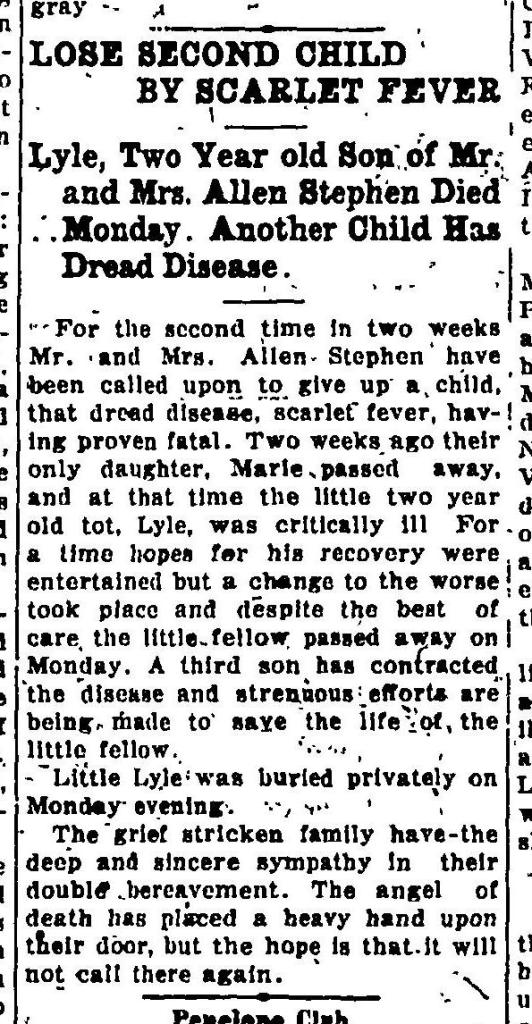
I also found an article about an outbreak of Scarlet fever and a family who were burying their second child to die within two weeks. Their third child was sick at home. This made me think of my Minson relatives in Ohio who had three children die of scarlet fever in a short time. So much to think about during this time period.

Page 1, The Belle Plaine Union, Thursday, 25 April 1918

Another disease to worry about in 1918 was Typhoid fever. This article talks about suggestions from the State Board of Health on how to control this disease. 1918 sounds like a nightmare and I am very glad my family survived.

Page 5, The Belle Plaine Union, Thursday, 3 Jan 1918

Belle Plaine was a farming community so farm issues also made the headlines. Diseases were a problem in the chickens and hogs at this time. Pest and blight struck the potatoes and other crops. It sounds like the end of times.

The Centers for Disease Control has a Pandemic Influenza Storybook. One of the stories is about Lloyd Nelson, a farm boy from Boone, Iowa who survived the pandemic when many on his troop ship headed to France did not. My family ended up in Boone, Iowa so this one stood out to me. I needed to end with a little more positive note. Maybe I can have a light hearted post for the next week.

Page 6 The Belle Plaine Union, Thursday, 1 May 1919

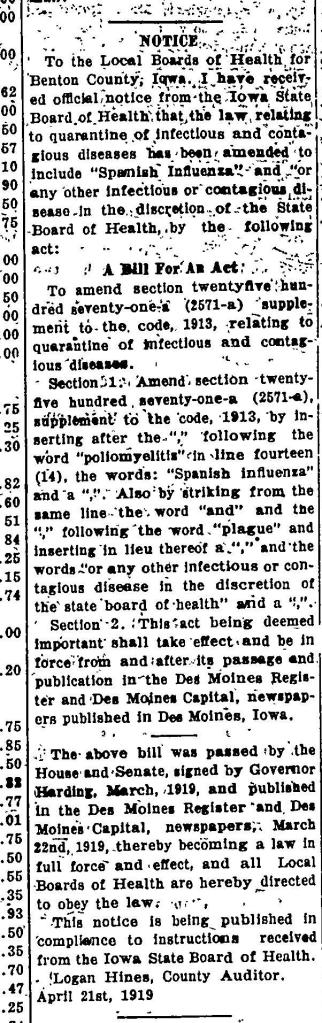
This final article is about the state legislature passing a bill to allow them more discretion in declaring a quarantine. Maybe that helped for the pandemic we just experienced.

Week 14: 2023 Begins with a Vowel

“Chances are there is someone in your family tree whose name begins with a vowel… or lived in a place that begins with a vowel… or had an occupation that begins with a vowel….” prompt from Amy Johnson Crow for Week 14 of 52 Ancestors in 52 Weeks. 

From family photo album Alexander Minson my 2nd gr grandfather.

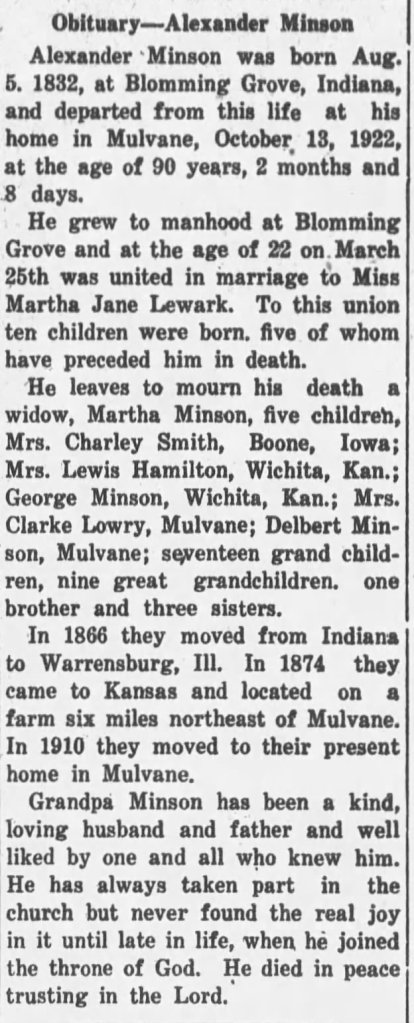
Alex was born in Indiana, so two vowels in one for this tale. He was born in Blooming Grove, Indiana August 5, 1932. I haven’t been able to find a birth record but did find a very detailed obituary, so we will start with the end in this case. Alex was living in Mulvane, Kansas when he died on October 13, 1922.

Obituary for Alexander Minson

The first actual record I have is the 1840 Census. In 1840 only the head of the household is listed by name. Everyone else is just a check mark under the appropropriate age range. Alex is listed as the first mark in the 5-10 year old male column after William Minson, who was his father.

1840 U.S. Census from Blooming Grove, Indiana

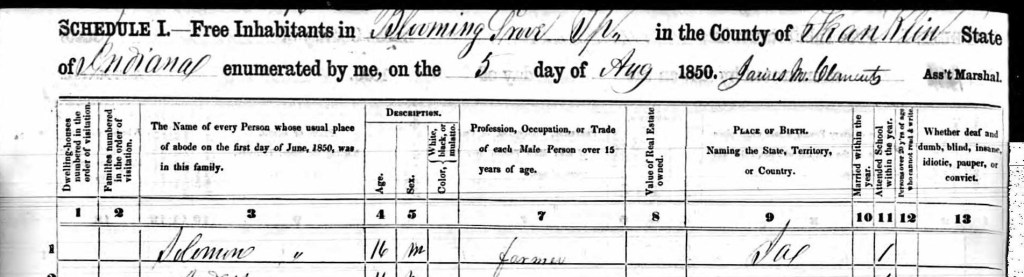
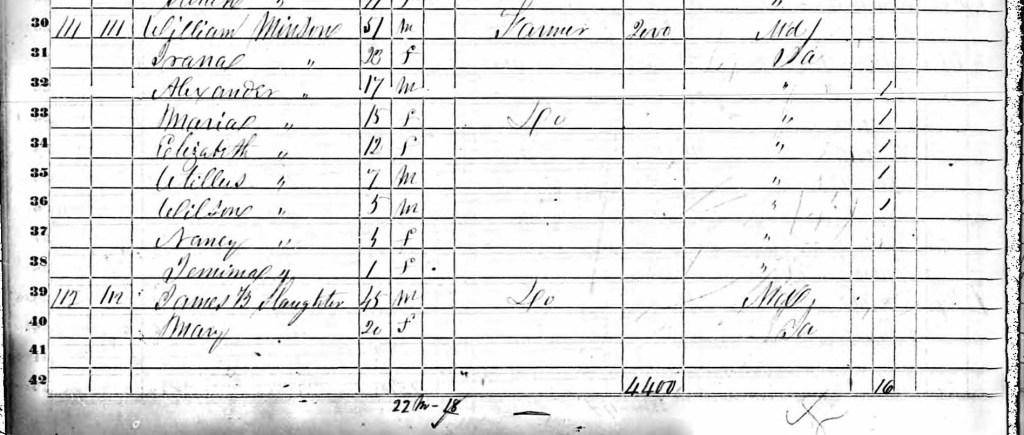
Alex’s mother, Catherine Castner, died in 1840. I think from the number of older females in this Census she was still living when the Census was taken and possibly some care takers lived with them as well. In 1841 William married his second wife, Irennah Price. She is found with William and Alex in the 1850 Census. Also in this Census are two of Alex’s three sisters and four half siblings. Alex is 17 in 1850 and the family is still located in Blooming Grove, Indiana.

1850 U.S. Census Blooming Grove, Indiana William Minson family

Alexander was attending school still at age 17, which honestly in my family is a big deal. It seems many others had to quit school early to help support the family. I’m not sure if he continued to live with his family for the next few years or moved on. In 1855 on the 25th of March, Alex married Martha J. Lewark in Rush County, Indiana. According to a cousin Alex and Martha had twin girls who died either at birth or soon after in 1855. Their next two children born in 1858 and 1860 both died in 1863 of scarlet fever. I can’t even imagine losing four children in such a short period of time.

My great grandmother, Melissa Alice Minson, was their fifth child and she was born in 1863, the same year they lost two of their other children to scarlet fever. I wonder if all of this is what pushed them to move. Their sixth child was born in Illinois. They had three more children while living in Illinois. Their final child was born in Mulvane, Kansas where they spent the remainder of their lives.

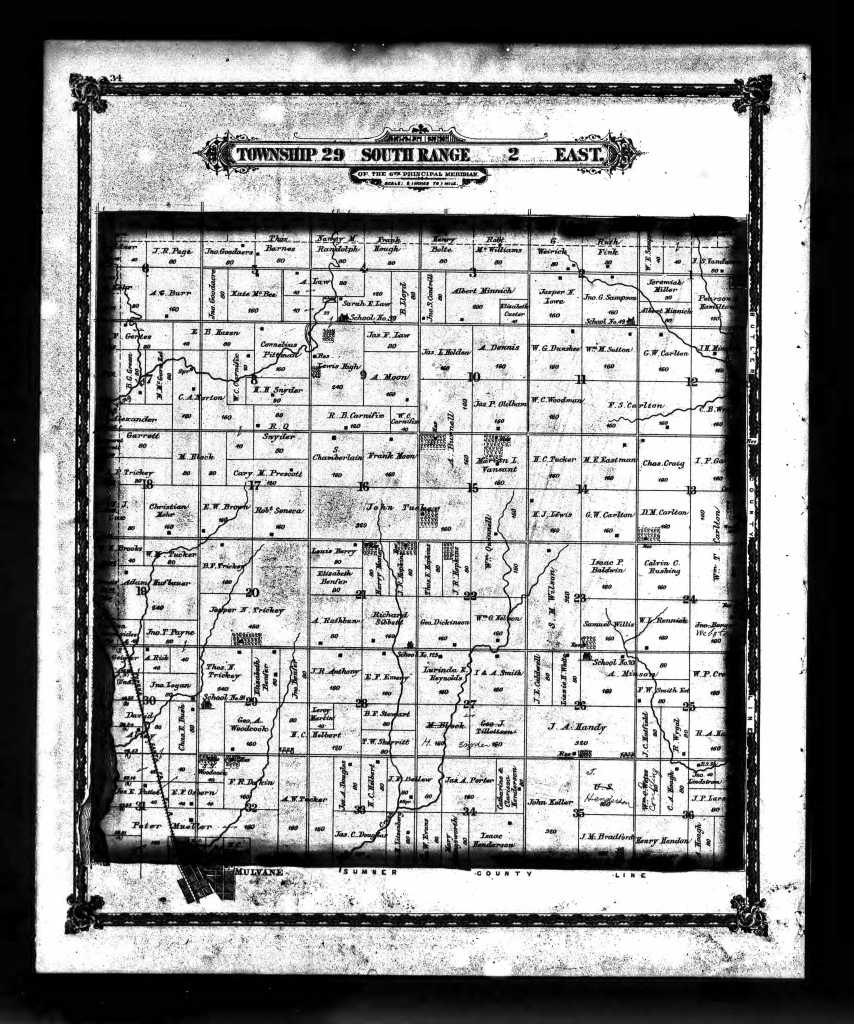
U.S., Indexed County Land Ownership Maps, 1860-1918 for A. Minson.

This map was a fun find. It not only shows where the Minson’s lived but also shows where the Smith’s lived. Ira Smith was also my second great grandfather and his son Charles William married Alex’s daughter Melissa Alice Minson. You can see they lived close together. The Smith’s did not live in Kansas for long so this meeting was an example of being in the right place at the right time.

crop of section from map above, A. Minson is on the right side of map and I & A Smith is a couple to the left.
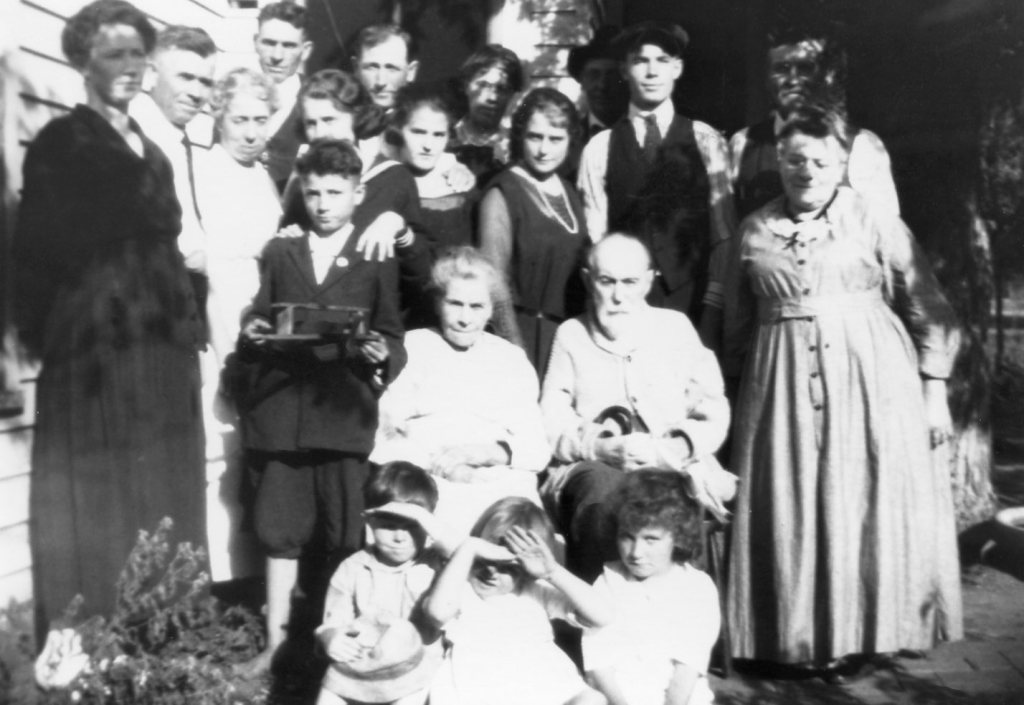
The family of Alex and Martha Minson from our family photo album.

Both Alex and Martha lived long lives. Alex was 90 when he passed away and Martha was 93. A birthday celebration was held for Martha on her 90th birthday. I think this photo is from that celebration. Martha and Alex are seated in the middle. Their daughter (Melissa) Alice and her husband Charles William Smith, my great grandparents, are standing on the right side of the photo. They would have been living in Iowa at this time and traveled to Kansas for the celebration.

90th birthday for Martha J. (Lewark) Minson

Two years later Alex passed away and the next year Martha followed. They lived a long and eventful life and it sounds like they landed on top with the many blessings of family and friends.

Week 13: 2023 Light A Candle

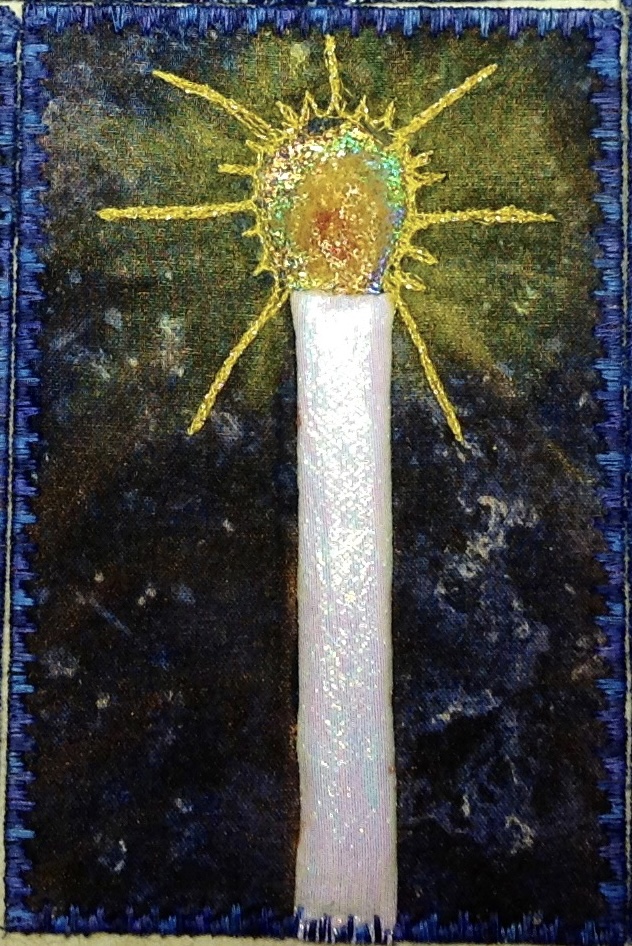
Candles are often lit in remembrance, in prayer, or when the power goes out for 5 days because of an ice storm. Prompt from Amy Johnson Crow for Week 13 of 52 Ancestors.

This post is in remembrance for those who served and in prayer for a brighter future.

Candle postcard created in remembrance of the mass shooting at Sandy Hook Elementary school in 2012. Please let us find a way to end these senseless deaths.

There are so many veterans in my family. I think they have been a part of every war in the U.S., both World Wars, the Vietnam War, the Wars in Iraq and Afghanistan and maybe some I haven’t found yet. I don’t know how I could possibly honor all of them in one single post. I know I am definitely privileged in that I haven’t ever lived in a place where a war was taking place. I can’t even imagine how difficult it would be. My heart goes out to those in Ukraine at this time.

Two of my grandpa Kirkwoods’ brothers, Alexander Kirkwood and Robert Kirkwood fought in WWI. One was gassed in the war and was disabled as a result and died at the age of 36. The other survived WWI but his house was blown up in WWII, killing him and his entire family, Julia (McGuire) Kirkwood and Donald Kirkwood. My grandpa Cooks’ brother, Frank Cook, also fought in WWI. He came back with tuberculosis and died at a young age.

My husbands dad, Harvey Hartje, and my dad, Richard Paul Cook, both were involved in WWII. Lucky for us they both returned. My husbands stepfather enlisted in 1947, we haven’t been able to find much about his service but he was in Egypt for a time. My brother and sister and brother in law are veterans of Vietnam. Another brother in law was in Iraq. A nephew was in Iraq and Afghanistan I believe.

If we go back in U.S. history I had ancestors in the Revolutionary War, The Mexican American War and the Civil War. This is just immediate family for all of these. I’ve never tried to count all of them in my tree, might have to look at making a list. I know I have many cousins who are included in these remembrances.

I am so grateful for the freedom I have today. I hope we can continue as a country to keep our freedom. The politics are turbulent and some want to take us backwards. We need to remember what brought about the wars of the past so we don’t repeat those mistakes now. My wish is an end to all war, is that a pipe dream or can we achieve it. Do your part to make the world a better place for everyone.

Week 12: 2023 Membership

“It isn’t unusual to find our ancestors as members of a group, such as churches, school alumni, veterans organizations, or fraternal societies. Have you found an ancestor who was as member of a group? Or maybe you’ve made a discovery by being a member of a genealogical or historical society.” prompt from Amy Johnson Crow for 52 Ancestors in 52 Weeks.

Scrapbook full of certificates from IOOF belonging to John Kirkwood.

My grandfather, John Robertson Kirkwood, was a member of the Independent Order of the Odd Fellows. I think he held every office available over the many years he was involved with this organization. The earliest I found in this scrapbook is dated 1913 and the oldest is 1962.

He went back and forth a couple of times from Scotland to the U.S., staying in the country after 1910. He wasn’t here long when he joined the IOOF.

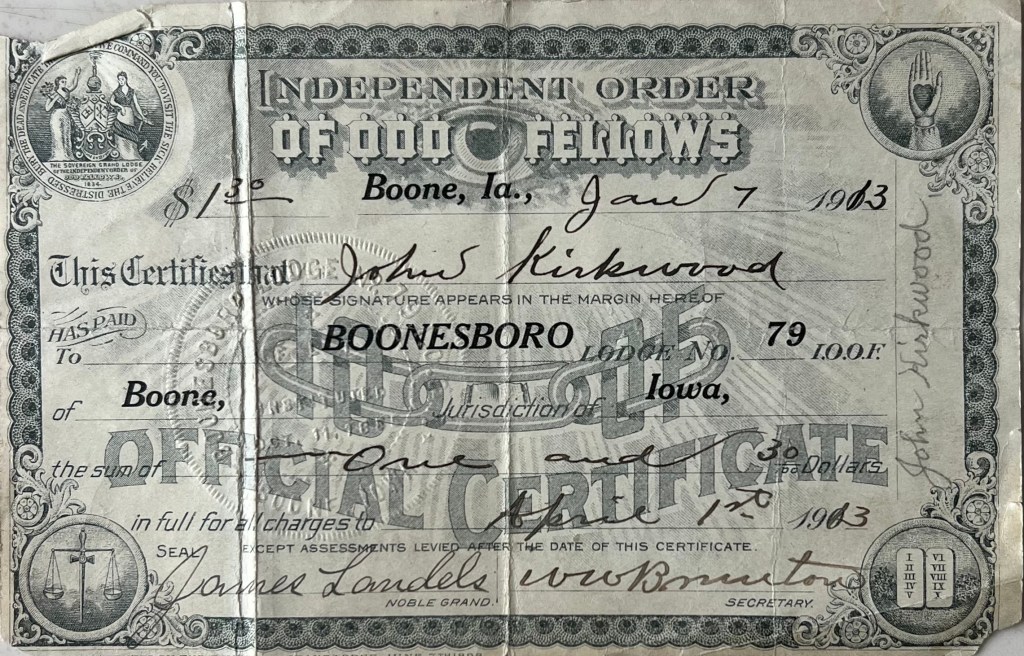
receipt for dues paid to IOOF in 1913.

This is the oldest receipt I could find. It is dated Jan 7th, 1913 to April 1st 1913. The fee was $1.30 for 3 months dues. The back of the receipt is interesting too.

Back of the 1913 receipt for IOOF dues.

It says, “This is the only legal receipt for dues and other charges and its use is required in all Lodges, Rebekah Lodges and Encampments. It is a proper credential for visiting in all Jurisdictions on the Continent of North America. Its use is limited to the date to which dues are shown to be paid. The holder shall prove identity and good standing in the manner prescribed by the Laws of the Order, and upon such proof, the presiding officer of the Lodge visited is authorized to communicate the A.T.P.W. If the visitor is a member in the Jurisdiction visited the presiding officer shall also communicate to him the Password of the current term. Payment of benefits or pecuniary aid is not authorized by this certificate. Official John B Goodman Grand Secretary”

I don’t know a great deal about the Oddfellows. I looked up what A.T.P.W. means, because I had no idea. It is Annual Traveling Password. That way they could go to meetings in other places. I found a little about the history of the I.O.O.F. in Boone in a book called History of Boone County Iowa, Vol 1 by Nathan Edward Goldthwait. You can view it for free on the Family Search site in their Books collections. It is a very interesting book for details about the history of Boone.

Lodge 79 began October 16, 1855, so it was fairly well established by the time my grandfather joined in 1913. My understanding is that it was a social and service organization, which is probably a very simplistic explanation. I kind of like all the mystery with passwords and I think they had uniforms and special award ribbons and sashes. I don’t know if anyone in our family has the sashes and ribbons tucked away somewhere. It would be fun to see pictures. I do vaguely remember someone saying Grandpa didn’t like all the fancy things, so maybe he didn’t get them?
Boone News Republican, March 29, 1922 pg 1. first half of article

Here is one of the first news articles I found about the Odd Fellows that mentioned my grandfather. This article says John Kirkwood was named secretary of Boonesboro Lodge No. 79. This one talks about one of their social events which was an annual picnic.

I don’t completely understand all the different levels of the Odd Fellows but I think the Lodge was the smallest local group. There were different degrees conferred on the Lodge members, Initiatory, Friendship, Brotherly Love and Truth. Each of these were associated with a color; white, pink, blue and scarlet. There were three Encampment degrees. Encampments were several Lodges who came together. The Encampment Degrees were Patriarchal (Faith), Golden Rule (Hope) and Royal Purple (Charity). The top degree was the Patriarchs Militant Degree, the Chevalier. I am guessing my grandfather had all of these different Degrees.

The Grand Order of the OddFellows began in England in 1730. The Independent Order of the OddFellows was the American Version. In 1842-43 there was a dispute as to whether or not American Lodges would be involved in decision making procedures. Some American Lodges split along racial lines and became an exclusively whites only membership and a separate governing system from the English Order. It was about ten years later the Lodge in Boone, Iowa began. The African American Lodges didn’t separate from England and remained part of the Grand United Order of Oddfellows headquartered in Philadelphia. I am not sure if the split remains today.

In 1851 the Independent Order of the OddFellows became the first Fraternal Organization to allow women. My grandmother was part of the Rebekahs, the female branch of the OddFellows. I don’t think she was quite as involved in the hierarchy of the organization as my grandfather was but she definitely did the charitable works.

You can google and find many articles about the OddFellows and Rebekahs and lots of their paraphenalia are for sale on the ebay. According to the article on Wikipedia these are their objectives:

  • To improve and elevate the character of mankind by promoting the principles of friendship, love, truth, faith, hope, charity and universal justice.[28]
  • To help make the world a better place to live by aiding each other in times of need and by organizing charitable projects and activities that would benefit the less fortunate, the youth, the elderly, the environment and the community in every way possible.
  • To promote good will and harmony amongst peoples and nations through the principle of universal fraternity, holding the belief that all men and women regardless of race, nationality, religion, social status, gender, rank and station are brothers and sisters.
  • To promote a wholesome fraternal experience without violence, vices and discrimination of every form.

Here are just a few of the certificates from grandpa’s scrapbook.

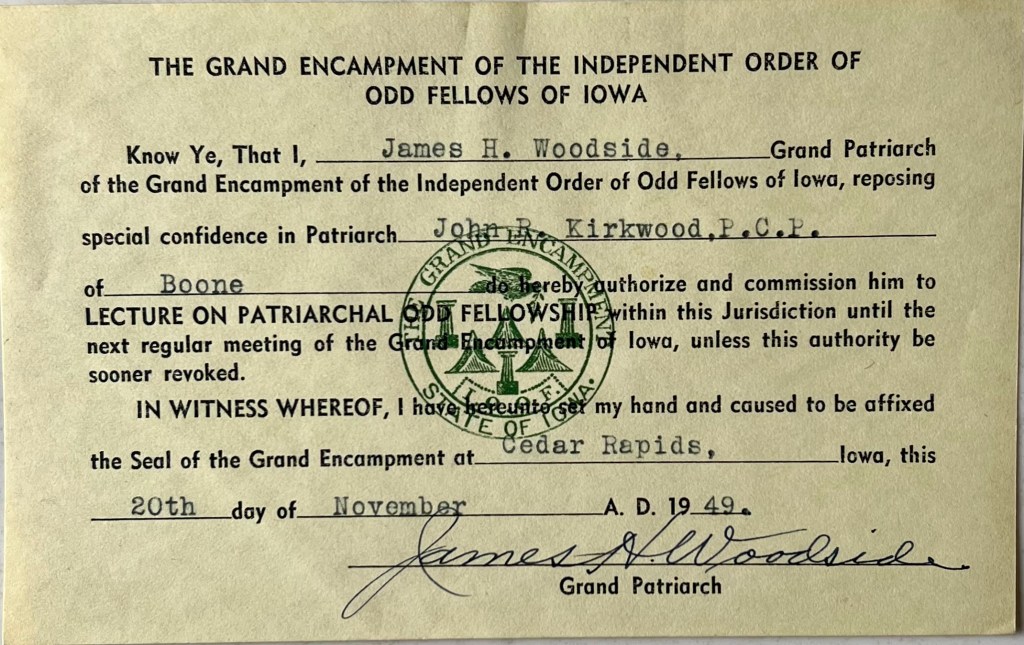
John Kirkwood was enlisted to Lecture on Patriarchal Odd Fellows at the Encampment in Cedar Rapids, Iowa in 1949.
John Kirkwood was authorized and commisioned to Instruct in the Unwritten Work of the degrees of the Subordinate Lodge in 1962.
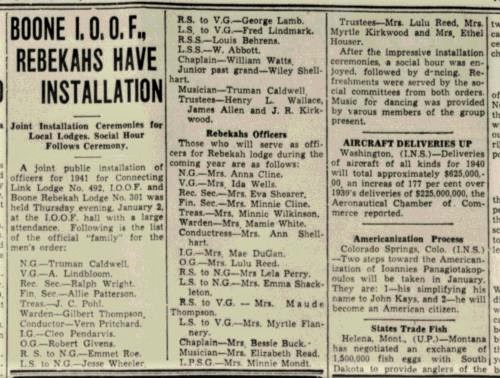
My grandparents, John and Myrtle Kirkwood were both installed as Trustees for the Oddfellows and Rebekahs. From the Boone News Republican January 9, 1941, pg 10.
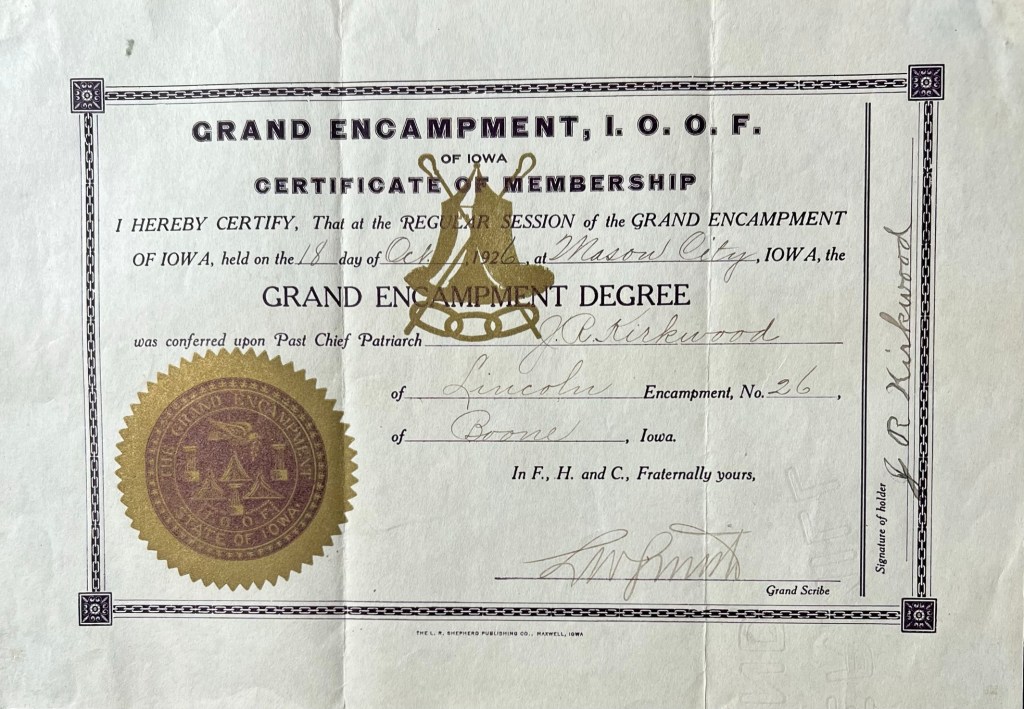
The Grand Encampment Degree was conferred upon Past Chief Patriarch J R Kirkwood on 18 Oct 1926. at Mason City, Iowa.
Certificate for Meritorious Service for the Order so he is entitled to possess and wear the Meritorious Service emblem, July 2, 1940. I wish I knew what he did to earn this award.

This site has photos and descriptions of many of the medals and awards.

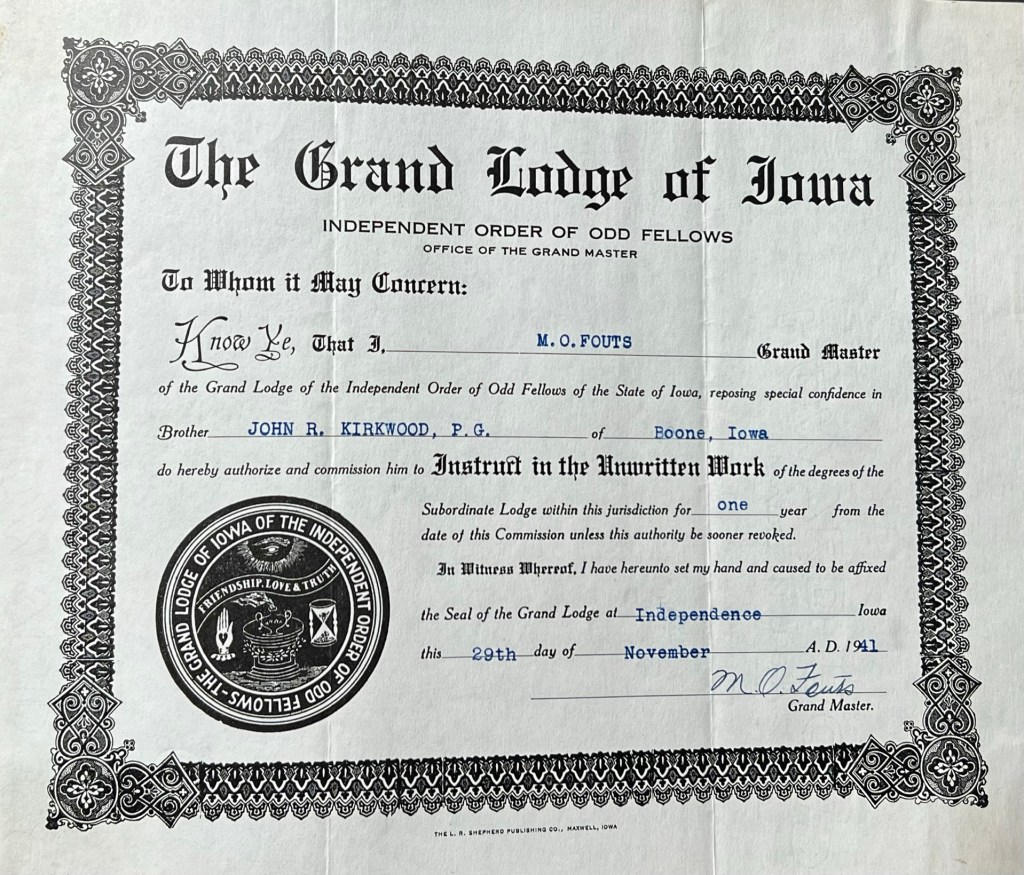
John Kirkwood is authorized and commissioned to Instruct in the Unwritten Work of the degrees of the Subordinate Lodge within the jurisdiction for one year. This one was in Independence, Iowa in 1941.
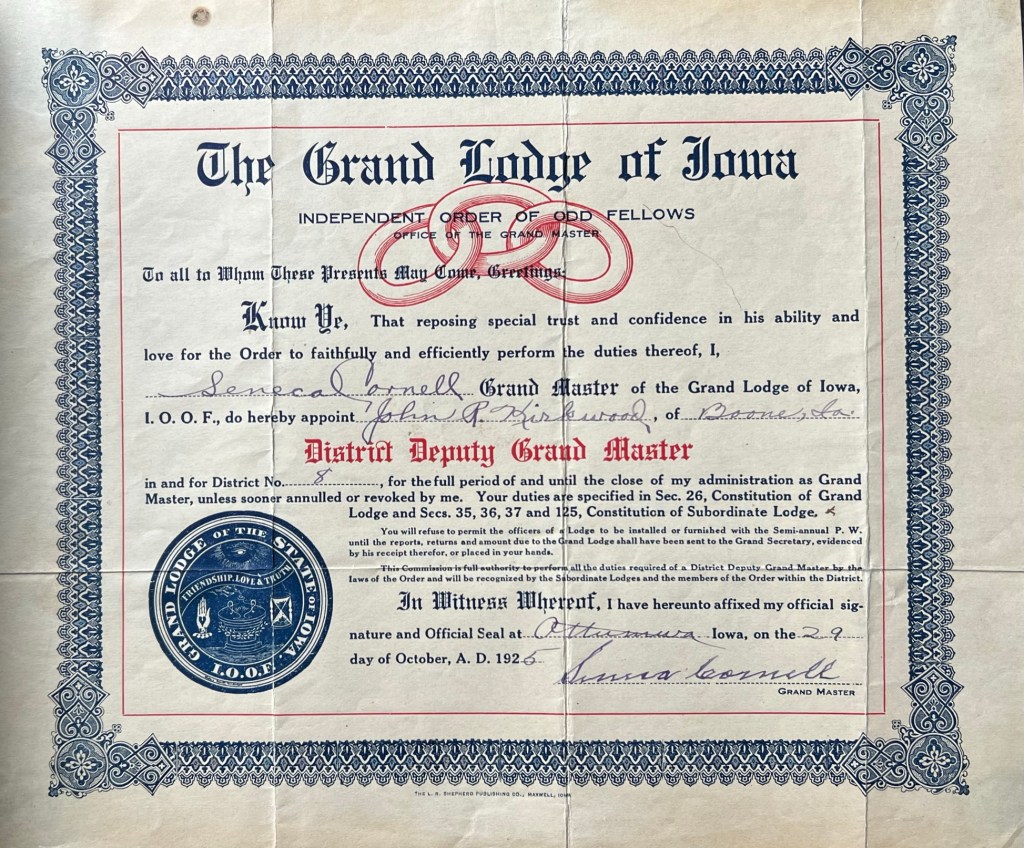
This is a big one! John R Kirkwood was appointed as District Deputy Grand Master for the district No. 8 in 1925.
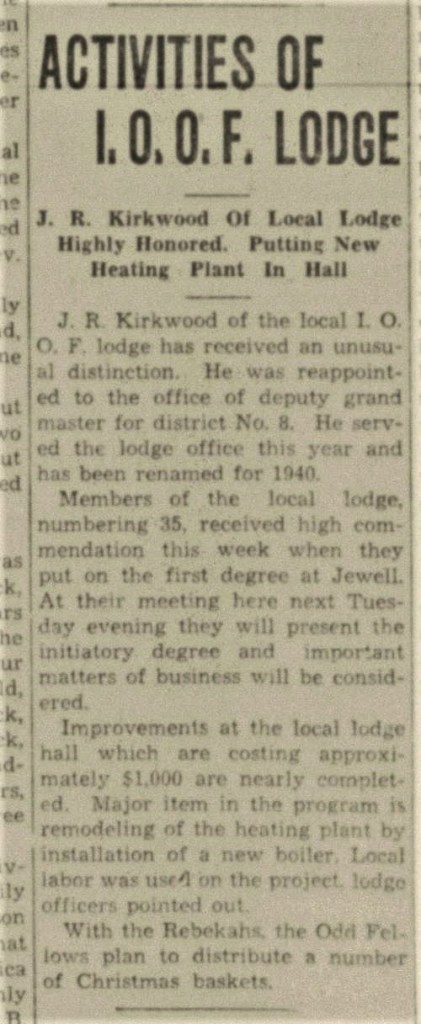
This article states he was elected to Deputy Grand Marshall for a second year in a row. This article is from the Boone News Republican, December 16, 1939, pg 2. So he held this position many times.
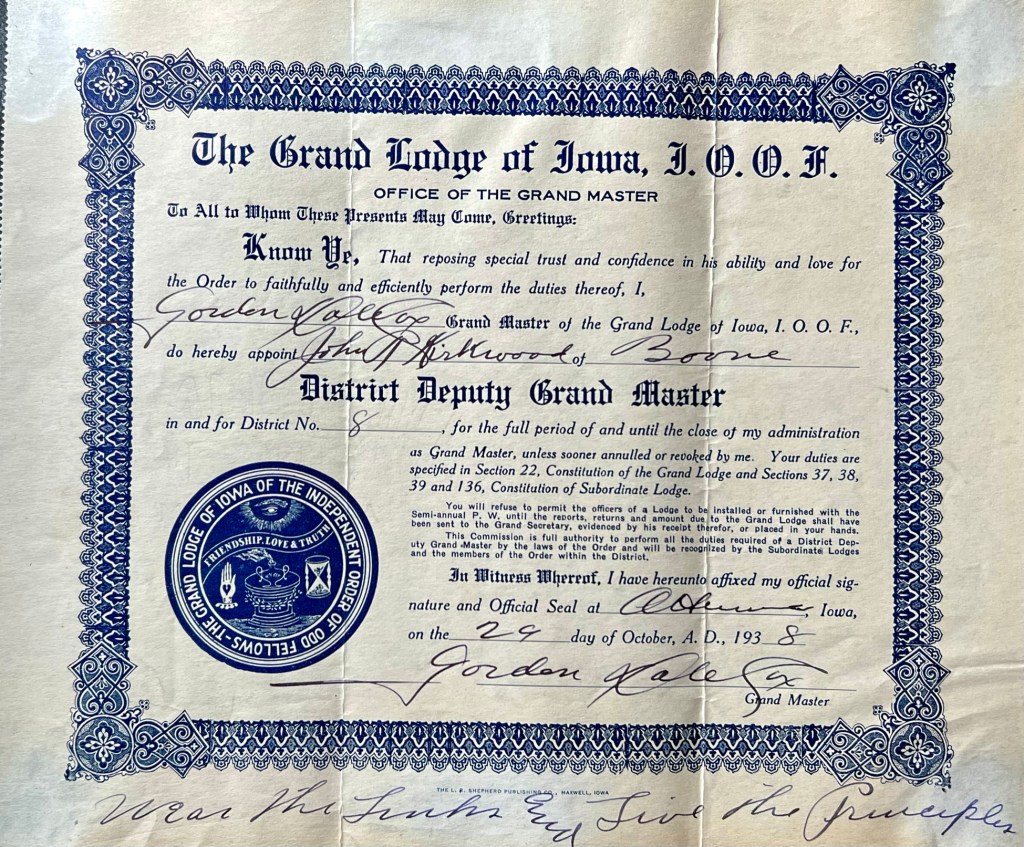
John R Kirkwood was appointed District Deputy Grand Master for District No. 8 in October 1938.
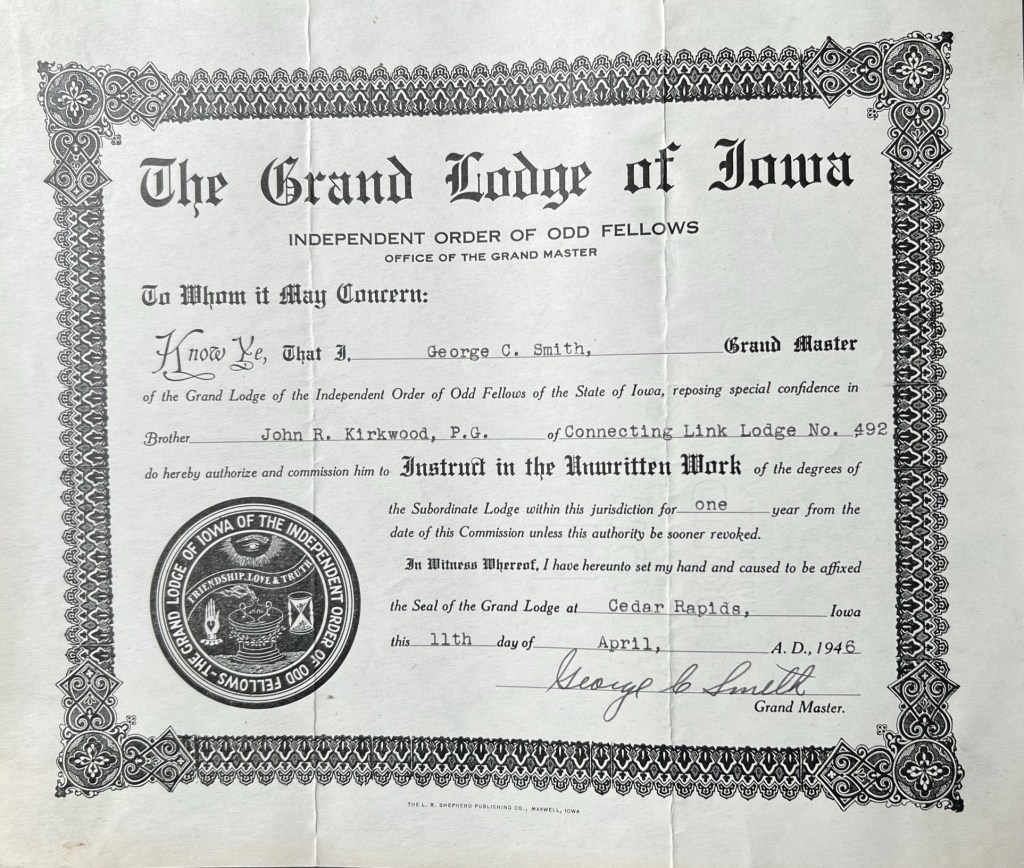
John R. Kirkwood P.G. of Connecting Link Lodge No. 492 authorized and commissioned to Instruct in the Unwritten Work of the degrees of the Subordinate Lodge. Cedar Rapids, Iowa April 11, 1946. The photo below was posted opposite this certificate so possibly the photo is the Lodge in Cedar Rapids.
John Kirkwood is on the left side, the fourth man you see, he is not wearing the regalia. I am not sure which group this is. I don’t see my grandma in the women. It was posted with the certificate above this photo which is from instructional work he did in Cedar Rapids, so possibly a photo with that group. If anyone recognizes someone please let me know.
One final older receipt. This one was for an encampment in 1927-28 The dues for this were $3.00.
The back of the above encampment receipt from 1927-28. It has a Telegraphic cipher and key that I find interesting but not quite sure how it was used.

There are many more certificates in this scrapbook. I tried to show a variety of them in this post. You can see this membership was very important to my grandfather. I wonder if initially it may have been memories of his homeland, or loneliness of moving to a new country that inspired him to join. I am glad he had this solid group to rely on during his life. He and my grandmother were also very involved in their church, they had a good solid community of friends.

Week 11: 2023 Lucky?

“Were any of your ancestors lucky? Maybe someone won the Georgia Land Lottery? Do you consider yourself lucky to have discovered a particular ancestor or document?” prompt from Amy Johnson Crow for 52 Ancestors in 52 Weeks.

I feel lucky just to be here when I learn about many of the situations my family have survived, or not survived. I haven’t found any who won anything spectacular, keep hoping that will be me one day.

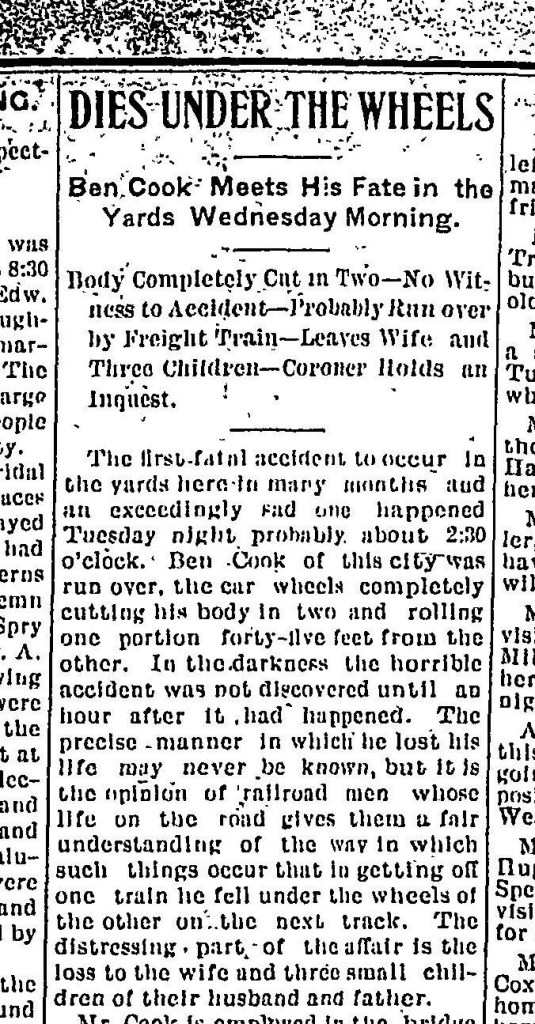
My great grandfather didn’t survive a gruesome train accident but luckily my grandfather was already 4 years and 8 months old. He was the youngest of the three Cook children, Maud, Frank and Bernard Roy.

Page 3 of Every Other Daily Union published in Belle Plaine, Iowa, Thursday, June 28, 1990

The wife of Ben Cook, Katie (Kinney) Cook was the daughter of Patrick Kinney from DeWitt, Iowa. Patrick Kinney also was involved in a train accident. It may seem like this post is the opposite of lucky, but it does illustrate my point, I am lucky just to exist. Katie was left out of this article but was named in other articles and census, etc.

from The Daily Times, Tuesday, Sept 20, 1904.

My grandfather, John Kirkwood, on the other side of my family was involved in a couple of mining accidents. This one was very serious and he was incredibly lucky to survive. It was reported in newspapers all around the state of Iowa. This one happened before my mom and her sister were born.

Boone News Republican, 1914

I don’t have a newspaper account of the next one but John’s wife, Myrtle (Smith) Kirkwood, her father was also involved in a mining accident. This one I learned about when I asked my mom about the following photo. She thought this was the mine where her grandfather, Charles William Smith, was working when he fell down a shaft and injured (maybe broke) his leg. She said he was unable to work for quite awhile so her mom quit high school and began working at the mining store.

from family photos, mine where Charles William Smith was injured near Boone, Iowa

Many of my ancestors had dangerous professions, took long and arduous journeys, and survived illnesses that others did not. They chose to leave their countries and try their luck in the United States. I think they wanted to work for a better life for themselves and their children. My grandfather, Bernard Roy Cook who was only 4 when his father died from a train accident also worked for the railroad. He chose a safer way and became an accountant.

clippings saved from the Boone News Republican, Bernard Roy is the one with glasses.

Whether you call it luck, God’s will, fate or something else entirely, I still feel very lucky just to be alive.

Week 10: 2023 Translation

“Would any of your ancestors have needed someone to translate for them? Have you had to work with records in a language other than your own? No matter the language, it’s a good time to write!” prompt from Amy Johnson Crow for week 10 of 52 Ancestors in 52 Weeks.
I skipped Week 9 for the time being. The theme for that week was Gone Too Soon. I had someone in mind to write about but wanted to get permission first. Life is unexpected and sometimes much to short.

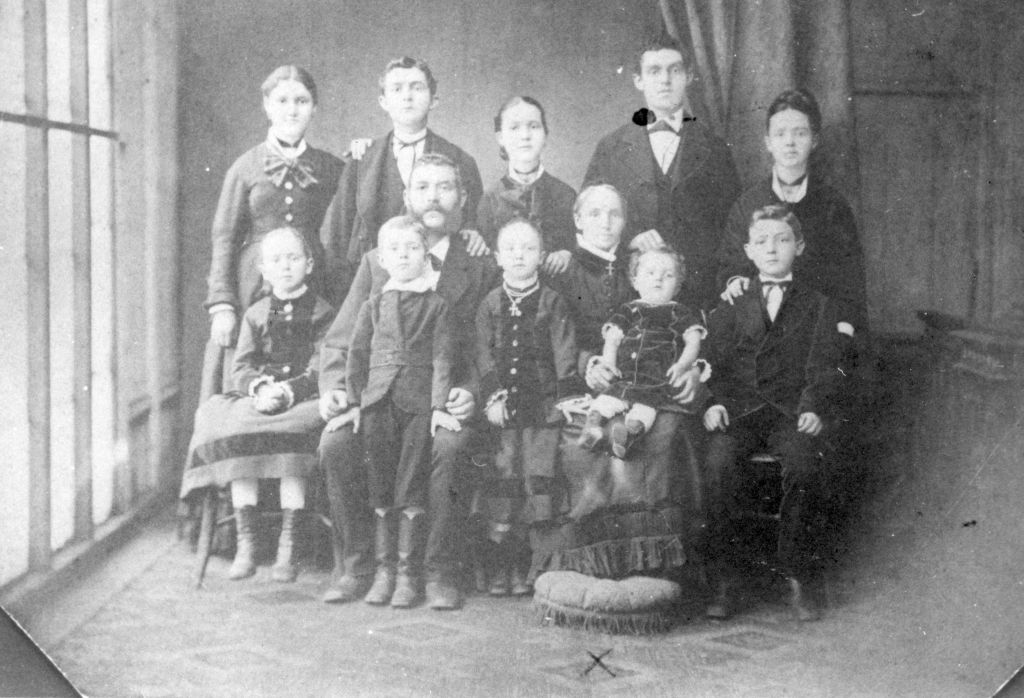
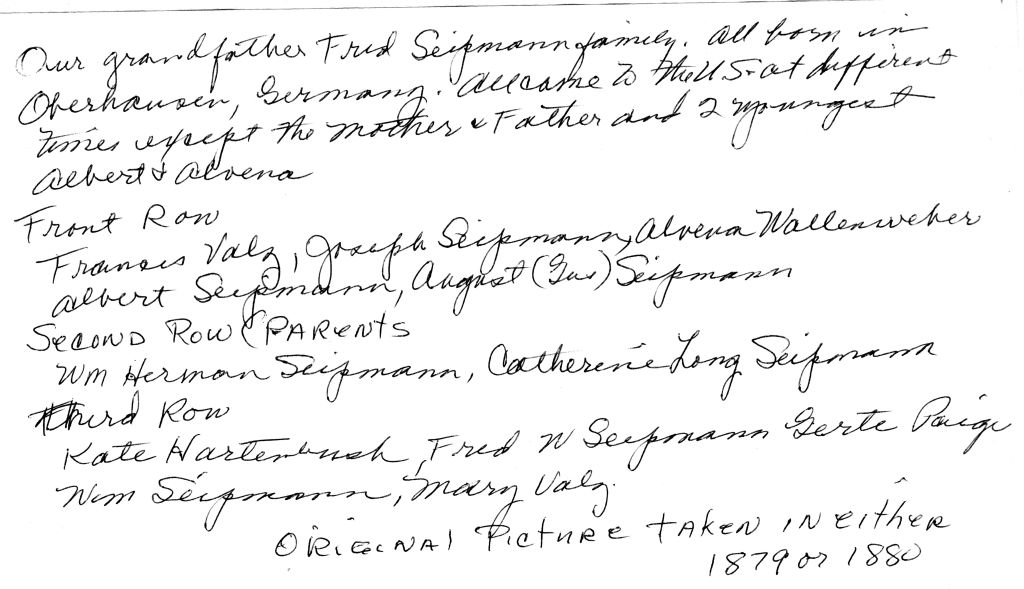
Wilhelm and Catharina Siepmann family from my dad’s photos. My great grandfather, Fred Siepmann, is the second one on the left in the back row.
So lucky to have this saved with names. It also gave me clues for marriages of the women in the family.

I am finding with my husband and my own ancestors, who were from Germany, often ended up in communities in the United States with other people from Germany. They had a German church, German newspaper and German neighbors. I would think all of this made the transition to a new country a bit easier. The Census at the times they first arrived didn’t state whether or not they spoke English but I am guessing they did not.

I wanted to be able to read at least enough of the the records I find to know I have the correct people, dates, and places. I took a class called “German for Genealogy” and another called “Reading German Handwriting.” Both of these classes are taught by Katherine Schober online through her website called Germanology Unlocked. They were very helpful to me. I know I will get better at reading the handwriting over time, right now it is still pretty difficult for me.

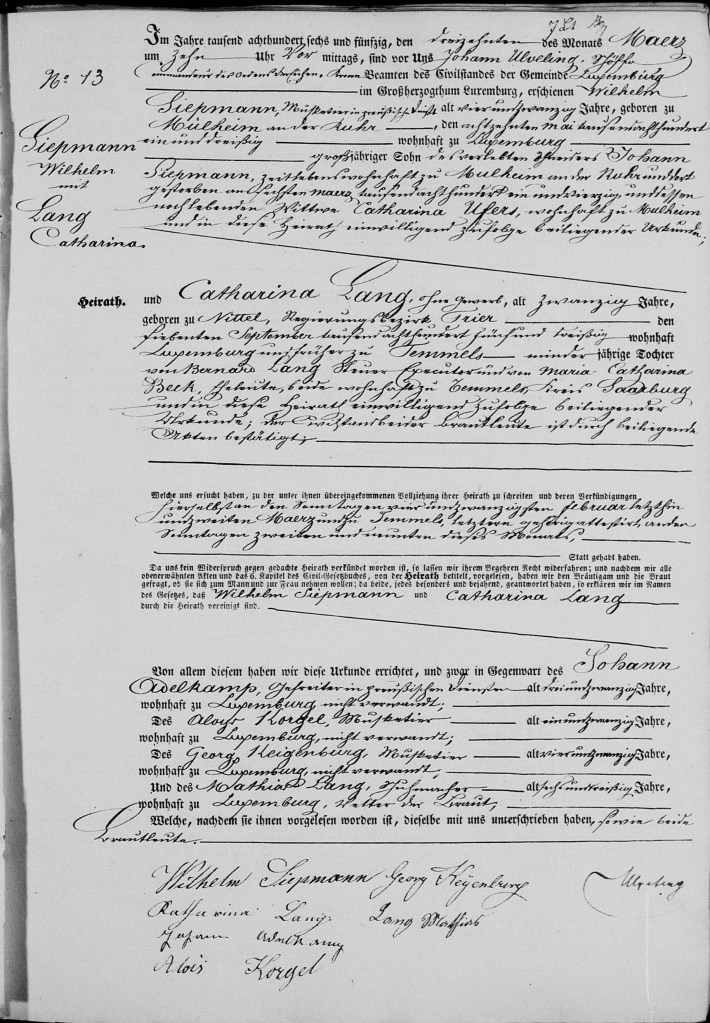
My first record I wanted to translate was a doozy. It had so much that was handwritten and it was quite long. I knew I would get some wonderful finds in this record. I found this in Wilhelm Siepmann’s records on Family Search. It had been added to document his marriage to Catharina Lang on Mar 13, 1856. I knew I could learn much more from this document.

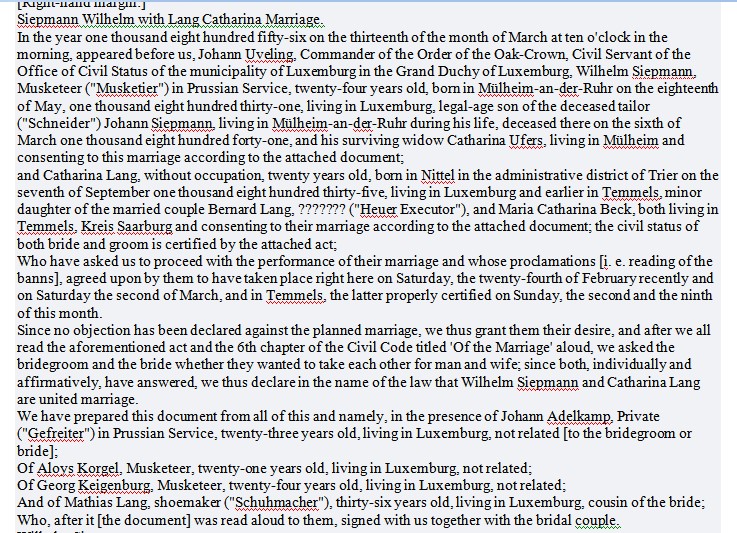
Marriage Document for Wilhelm Siepmann and Catharina Lang from Family Search. https://familysearch.org/ark:/61903/1:1:7HMN-VPMM I love that it has their signatures at the bottom.

I managed to read most of the first paragraph but it took me two days and I was impatient. It was hard on my eyes so I could only work for short periods. I asked in a German translation group for help because 1. I’m very slow at this 2. I couldn’t figure out some of the handwriting 3. I didn’t learn some of the words that are in this document and they weren’t in my dictionary 4. It was hard on my old eyes. I did blow it up and took it one line at a time. Here is what I managed to figure out before I got too impatient and asked for help.

My feeble attempt at translation.

Here is the translation from the group. Don’t get me wrong, I still plan to keep learning and practicing reading the handwriting and I think this will help me many times over. I have so many ancestors to research in this country. It was very exciting and fun to get this first win and to see the possibilities of what I will be able to learn in the future.

translation of the marriage document for Wilhelm Siepmann and Catharina Lang. Thank you Mona Logarbo in German Genealogy Translations!

It’s like a goldmine! So much information not only about my ancestors but about customs of the time, places where they lived, people they knew. I found this very exciting to learn that Wilhelm was a Musketeer and his father was a tailor. I hadn’t known Catharina was from Nittel, and had never heard of Nittel so now I have another place to research. Still trying to determine Bernard Lang’s occupation but I have confirmation of where they lived.

I look forward to many more translations in the future. Hoping to find more Siepmann, Koch, Lang, Beck, Ufer, Hartje, Abraham, Sommer and more.

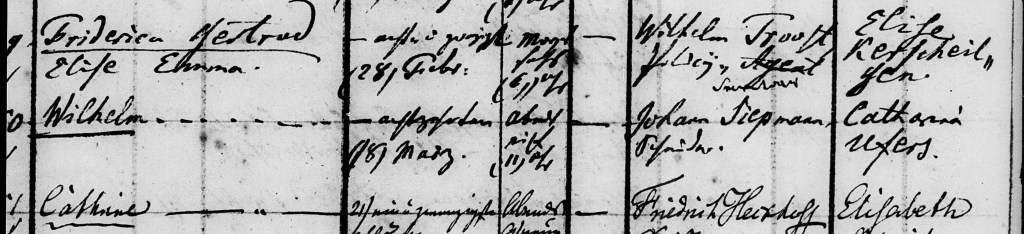
I also was looking for Wilhelm’s birth and death records. I think I have his birth record or actually his baptism but it states when he was born. The problem is it contradicts the marriage record.

I was confused when I looked for the record they had about his birth on Family Search. There are two pages for the record, the first page has the date, his name, his parents names; the second page has his witnesses, where it happened. In this particular catalog record they aren’t indexed. In the sources for Wilhelm it gave a link to the second page only. It is all in German and I didn’t realize there should be two pages, I should have from what I learned in my classes but I got excited and made assumptions.

The two pages are not even one after another in the record because they put in all the left hand pages and than all the right hand pages. After some false starts and getting some help the light bulb turned on in my brain again and I found his record.

this is the record that was linked and there was no Siepmann anywhere on this page. This has the witnesses names but I can’t quite read them.
Here is the first page of the record, Wilhelm and his parents are clearly seen here.

Johann is listed as a tailor just like the marriage record. I’m inclined to believe these are the same person and for some reason it says May(Mai) instead of March (Marz) on the marriage record. They both say the 18th and 1831. I’m told that people didn’t make a big deal out of birthdays like we do now, so maybe he really didn’t know exactly what month he was born. I’m still looking for his death record and next I’ll try to find Catharina’s records.

These are my beginning forays into translation. Hopefully I will only get better with time.

Week 8: 2023 I Can Identify

“Genealogy research is about identifying the correct people to attach to our family trees. Who have you worked hard to identify? Another way to interpret the theme would be to highlight someone like my grandfather, who could spot and correctly identify all kinds of mushrooms.” prompt for 52 Ancestors in 52 Weeks by Amy Johnson Crow Week 8 I Can Identify.

Platter inherited from my mother Helen (Kirkwood) Cook

At some point in time I pestered my mom to tell me stories about the items kept in the cupboard “not to be touched.” I grew up in a family with 8 children so I am sure she was keeping these memories safe from little clumsy hands. I thought she said this platter came from England with her 2nd great grandparents when they emigrated to the United States. Knowing myself, I probably heard England and ran with the rest of the story. If I didn’t have to document what is in my tree I would have many romantic tall tales with a tiny bit of truth thrown in the mix. My ‘I can identify story’ is about a platter and its origins.

My first moment of doubt came when I realized they arrived from England with seven children, the youngest was one year old. I can’t imagine keeping all of the children together on the trip and trying to protect heirlooms at the same time. According to the 1900 Census they arrived in 1850. I found them in the 1850 Census in Lee County, Iowa.

1850 U.S. Census, 29th District in Lee County, Iowa

It looks like it says Thomas is 38 in this Census, but in the 1850 Census he is 57, and 68 in the 1860. I believe he is actually 48 here. I am thinking the 11 year old daughter of Thomas and Mary, may be the family member who purchased this platter.

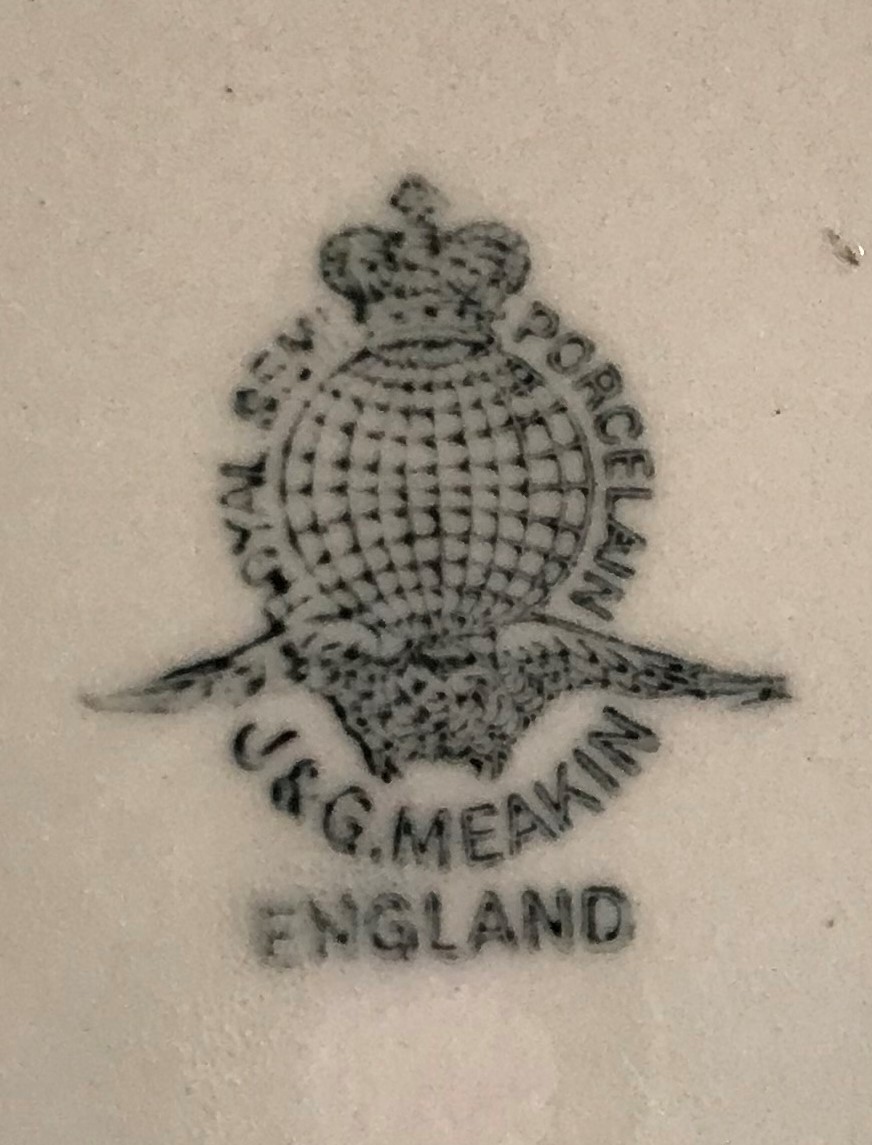
mark on the back of the platter

I asked in a genealogy group on Facebook if anyone knew where I could research this company and if anyone knew anything about it. Much to my disappointment the J. & G. Meakin company began in 1851, so clearly this was not brought to the U.S. when they emigrated. I had tried google image search but was not able to find an image just like this one. I did eventually stumble on a site that told the history of the company. The site had many marks from their pottery and china but none like this. I found an email for the writer of the site and sent him a query with photos about this platter. He was very helpful and answered my questions within a few days.

He answered all my questions with links included as to why his answers were true. I didn’t expect such a quick response and am very grateful for the kindness he exhibited in helping this stranger solve a mystery. In 1890 the McKinley Tariff Act required all imports to the U.S. to say the country of origin. That means this was most likely purchased in 1890 or later. Steve, the site owner, said this is a ‘generic transferware, typical of this period.’ J & G Meakin exported large amounts of ware to America. This mark with the representative American eagle under the globe would have been used for America.

‘Royal Semi Porcelain’ was a name used by a number of pottery companies for their ironstone ware. If you are like me and have never heard of ironstone before I have included a link that gives a description. They were looking for a substitute for porcelain that could be massed produced. It doesn’t contain any iron but it does sound like strong, sturdy ware doesn’t it? It has lasted all these years so there must be something to it.

Smith family dinner

We estimate this photo was taken between 1890-1895. I am wondering if this platter was used for the dinner.

Anna (Slater) Smith and Charles William Smith

Anna is the 11 year old girl from the 1850 Census. Do you think she remembered her time in England and felt nostalgic. It may have given her a connection to her parents who had passed away in 1875 and 1880. Charles William is my great grandfather and the oldest son of Anna and Ira Smith. As the oldest he would most likely have inherited this platter at the death of his parents.

Nettie Myrtle Smith

This is my grandmother in the family dinner photo. She was born in 1883 in Nebraska. I am thinking she is 8-13 years in this photo. What age do you think she is? So, if the platter is on this table it was purchased around 1891-1896. It could be it was purchased by my grandmother long after this photo was taken but I really think it is likely to have been purchased by Anna. That is my romantic twist to the story although I would have brought it along from England with their original voyage if I could. I guess I can’t definitively say who purchased this platter and how long it has been in my family but I think I am close to the truth.

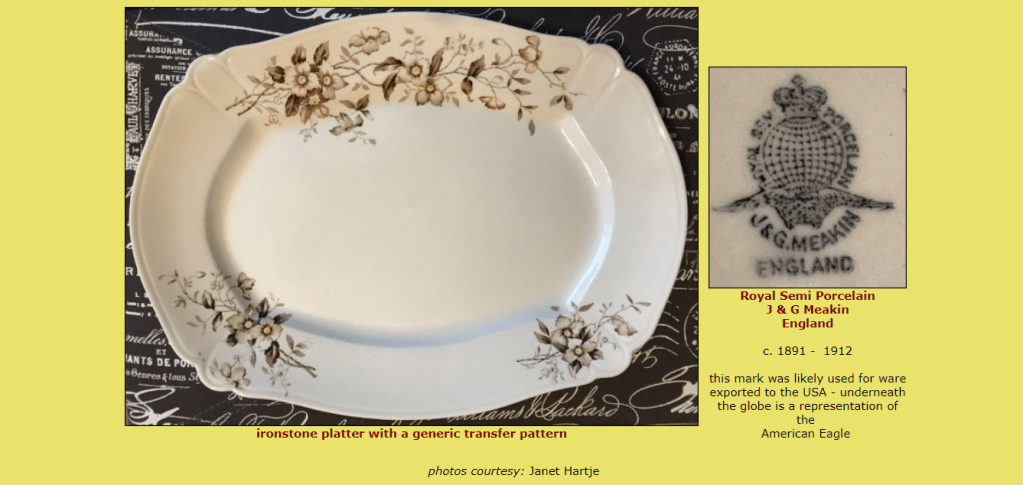
Here is a link to the Meakin Pottery site where I emailed Steve. It has many photos and history of the business. Very interesting to learn about this. Steve also included the pictures I sent on his site now as he didn’t have that mark (you have to scroll down to find it).

on the website for J & G Meakin

Week 7: 2023 Outcast

“Sadly, it isn’t uncommon to find someone who was set apart from their family or who was rejected by society. This week, you could give them back at least part of their story. You could also take a different angle and write about an object that was cast out, or maybe getting a cast off. Feel free to be creative!” prompt from Amy Johnson Crow for 52 Ancestors in 52 Weeks.

I had to reach back a long way for this story. When I first started researching my husbands Icelandic roots a cousin reached out to tell about some of his relatives. Turns out my husband’s 11th great grandfather was the last Catholic priest in Iceland. He ended up being beheaded for refusing to promote Lutheranism in Iceland. Sounds a little more than outcast but he certainly was rejected by the society of that time.

His name was Jón Arason and he was a Roman Catholic bishop and a poet. Jón lived from 1484-November 7, 1550. I found an extensive article about him on Wikipedia which has some very good sources. This is how my husband came to be a descendant, in case you were wondering, “Clerical celibacy was only practiced in medieval Iceland in the sense that priests did not marry their partners, and Jón Arason had at least nine children by his long-time partner Helga Sigurðardóttir, of whom six lived to adulthood.” direct quote from Wikipedia article about Jón Arason.

Jón Arason and two of his sons were captured at the Battle of Sauðafell. The sons names were Ari and Björn. Björn was the 10th great grandfather of my husband. Jón, Ari and Björn were all three beheaded ending the campaign for a Catholic Iceland. There is a statue of Jón in Eyjafjörður, Iceland and a memorial at the place of his execution in Skálholt, southern Iceland. When we get to Iceland we will have to look them up because honestly how many people actually know their 10th and 11th great grandparents let alone have a story to tell about them.

I found a number of references to Bishop Jón being a great poet. I hoped to find a copy of one of his poems. So far I haven’t had any luck with that. There have been books written about Jón and his story and how revered he was in Iceland. One says it is a fictitious account of his life, but I may have to see if I can track down the other book, maybe it will have a few of his poems.

There is a detailed post written on the Icelandic Roots blog by another relative of my husband. It is very well written and worth the read if you have time and interest. Here is a You Tube as well with a little bit of a robotic voice but good information. The surplice of Jón is in the National Museum of Iceland and is one of their treasures. This museum is on our bucket list of places to go in Iceland. According to this article Jón also introduced printing to Iceland. Here is one more article from The Journal of Medieval Studies about Jón.

He was well known, revered and well documented. He was also an outcast from the Danish royals of that time. Most of all he was my husbands 11th great grandfather which is amazing to me. The farthest I have on my tree is a sixth great grandfather and I only know his name. It’s kind of exciting to have a little celebrity in one of our trees.

Week 6: 2023 Social Media

“Have you found an ancestor via social media? How about the social column of an old newspaper? (Those were basically the Facebook of the day!) How about imagining what an ancestor would say on social media?” prompt given by Amy Johnson Crow for 52 Ancestors in 52 Weeks.

This photo is courtesy of a cousin on Ancestry. Thank you very much to my cousin!
Lyman Jackson Marshall or “Butch” and Helena Josephine Siepmann or “Nelle”

For this topic the person who immediately came to mind is my grand uncle Lyman Marshall (1897-1975). He was the husband of my grand aunt Nelle (Siepmann) Marshall (1897-1988). Nelle was my grandmothers sister. I have talked about Nelle and Lyman before in other posts. These two opened their home to everyone. At least three of Nelle’s sisters lived in the Marshall household at various times in their life. Some of this I know from social media i.e. the newspapers from their time.

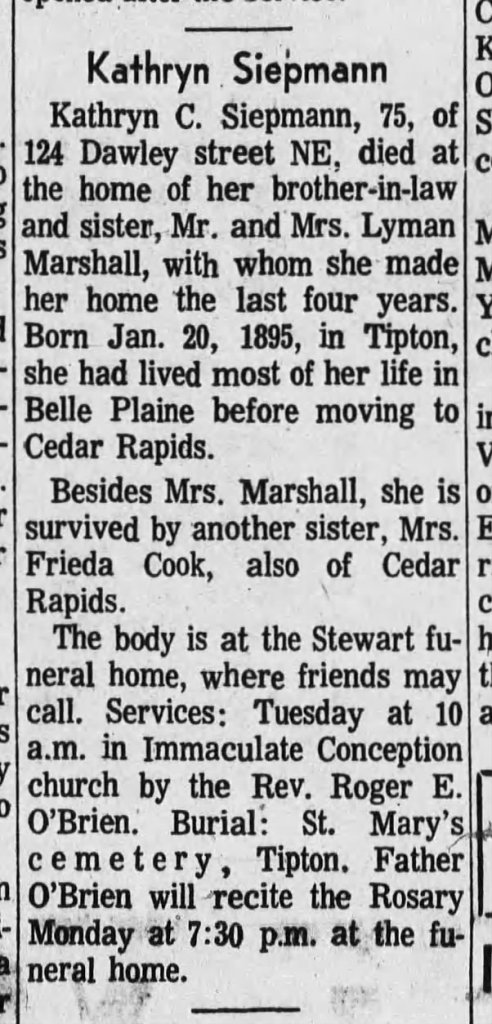
obituary for Kathryn Siepmann, Nelle’s sister.
from The Gazette, Cedar Rapids, IA 08 Jun 1970, Mon pg 3

I thought I might have to wait for the next Census or two to find out where Kathryn was living the last few years of her life. Now I know she lived with Nelle and Lyman for the last four years of her life. She had lived in Belle Plaine with her brother Fred and her mom Catherine. Her mom died in 1950 and her brother in 1966. I didn’t remember where Kathryn lived after they passed away. We went to visit them in Belle Plaine when I was young, we also visited Nelle and Lyman in Cedar Rapids.

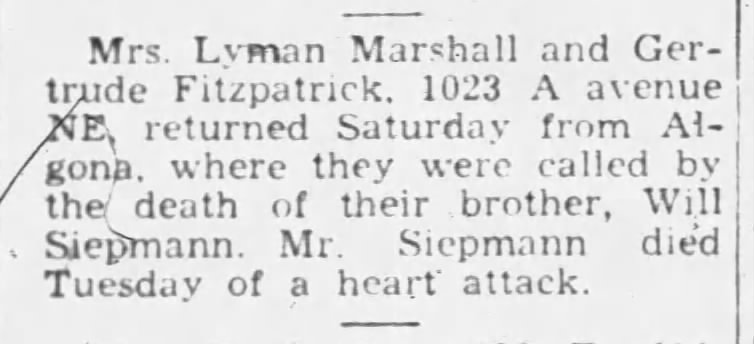
I have found births, weddings, deaths, social events, church events and military service all about their family in the local paper. All of these are gold mines for even more family. Such as this one from the time Nellle’s sister Gertrude was staying with Nelle and Lyman. It tells about them returning to the city after going to their brothers funeral. This told me where William was living at the time of his death and when so I could look for an obituary for him.

death of William Siepmann
from the Gazette, Cedar Rapids, Iowa, 5 Aug 1939, Sat pg 2
Uncle Lyman
Aunt Nelle

These two photos are how I remember Lyman and Nelle. A very loving couple and everyone was always welcome in their home. Lyman is the one who inspired me to write about the two of them for this post. When we went to visit Lyman would pull out a scrapbook he was making all about President Richard Nixon. He loved talking about Nixon and the many, many troubles he got himself involved in at the time. He would have an article from the paper telling about something Nixon had promised to do before he was elected, on the next page would be an article about what Nixon had actually done after he was elected. I truly wasn’t old enough to appreciate his Nixon talks at the time but looking back now I wish I had paid more attention. Lyman was a wise man.

When I talked with one of his descendants through Family Search and through Ancestry we both agreed that Lyman would have loved Facebook. I want to hear his thoughts about the political scene over the last eight or so years. He would have been on fire talking all of us through the misteps he saw.

I hope you are able to find many newspaper articles about the life of your family. I was surprised to find in 1918 they published a list of men who were called to service for that month in time. I knew this was done during the Vietnam War, I remember seeing and reading those. It just didn’t occur to me it would have started so long ago.