“We all make mistakes. This week, consider writing about a mistake that an ancestor made or that you’ve made in your research. (Like the time I looked for ages in the wrong county because I misread a family Bible record. Oops.)” this weeks prompt for 52 Ancestors in 52 Weeks by Amy Johnson Crow.
I make mistakes all the time, honestly. I’m human, not perfect. I try to fix them right away but sometimes I don’t notice immediately. Here is my latest mistake, maybe this will prevent you from making the same mistake.
Death certificates for some states are very easy to acquire but in others you need to sign away your first born child and mortgage your house to pay for it. Ok, maybe a slightly exagerated version of getting death records but the rules are different state by state. My husband happens to have ancestry in a state with stricter privacy laws.
I was trying to find a list of states that have restrictions like North Dakota and haven’t been able to find it. I’ve been told there are a few others but I haven’t come across them yet. As a direct descendant of the people I was researching we were entitled to the full certificate. The problem is you have to check the right box in order to get the full certificate. We must not have been paying close enough attention when requesting the lastest certificates. We ordered others and did it correctly but not this time.
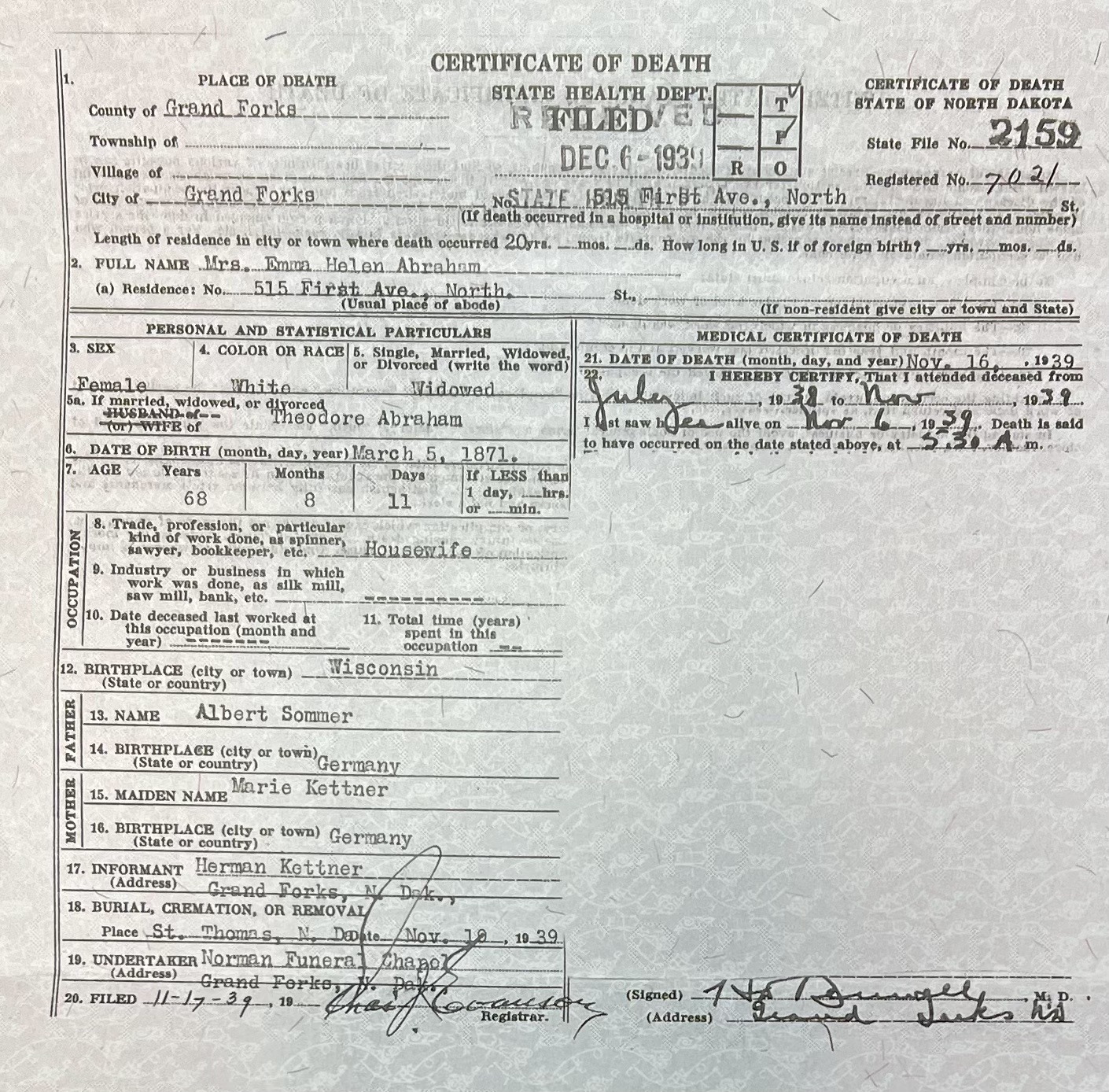
death certificate for Emma Sommer
This is what you get in North Dakota if you are not a direct descendant. The cause of death, notes, doctor etc are all blanked out. I’m not very clear why this is necessary for someone who died in 1939. I was looking for reasons behind this and found an entire paper entitled “Cornell Journal of Law and Public Policy.” I think it’s a little over the top but I like to dig for all the details so maybe my perspective is a little skewed.
I did get her husband’s name, parents names, the name of the informant, burial place and undertaker, as well as essential dates and address. You really can get a lot of information from a death certificate. Now we need to decide if it is worth paying the fee again to get the details of the cause of death. Some states make the certificates freely available online.
Now you know, if you see a death certificate online with the death details blanked out it is more than likely from North Dakota. Hopefully if you are a direct descendant of someone from North Dakota you will read the form carefully, check the correct box, provide what they need for verification and get the full certificate. That’s my latest oops! I’m sure it won’t be my last and it definitely wasn’t my first. Maybe this post will keep you from making the same mistake in your research.
“There are lots of ways you could approach this theme: teachers, yearbook photos, tales of being a good (or bad) student. You could also highlight an ancestor who got their education at the “School of Hard Knocks.” prompt from Amy Johnson Crow for Week 4 of 52 Ancestors in 52 Weeks.
I chose to write about a female relative of my husband this week. She intrigued me when I first came across this tiny blurb from The Fargo Forum and Daily Republican or the Courier Democrat, 1907.
At the time I found it I didn’t know if she was a relative of my husband but figured it was likely because of her last name and where she was from. I was just beginning my research so I didn’t save this with all the details. I’m sure it would have been in one of the above mentioned newspapers but haven’t been able to find it again to get the page number and exact date but I know it was 1907.
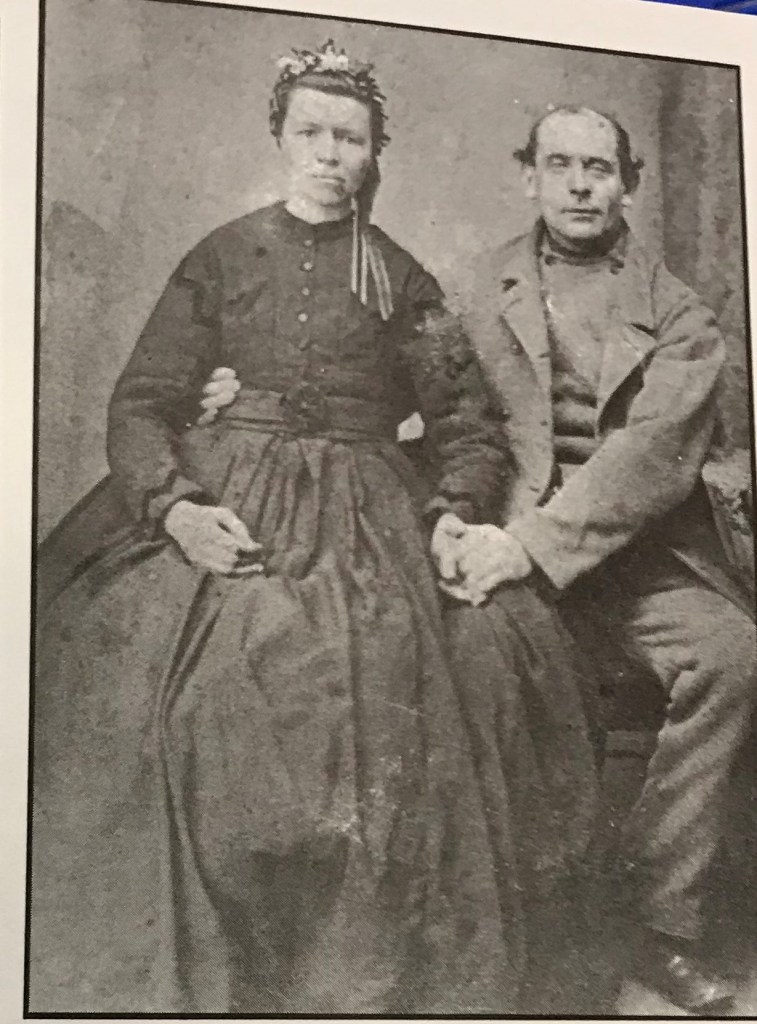
First things first, she is my husbands first cousin 2X removed. So, she is a relative, but what does that mean. Her father and my husbands great grandfather are brothers. Annie Hartje’s parents were John Jacob Hartje (1859-1906) and Pauline Cecelia Nietzke (1866-1939), also known as Polly. Jacob was the oldest child of Hein Hartje (1825-1879) and Rebecke Schuett (1837-1922), Jacob was 7 years old when they came to America and first settled in Minnesota. Sometime after his fathers death Jacob and the majority of his family moved to North Dakota, Jacob settled in St Thomas. My husband’s great grandfather was Peter Hartje, he was the fourth son of Hein and Rebecke. Peter was only 6 months old when they traveled to America from Hannover.
Anna Marie Hartje was born 22 October 1884 in St Thomas, Pembina County, North Dakota. She was the first child born to Jacob and Polly. She had 11 siblings. They were a prominent family in the area. Her father died in 1906 at the age of 47, which must have been a devastating loss to the family.
Evening Times, 4 Aug 1906, pg 8
Anna or Annie as she was known would have been 22 when her father died. She was most likely a huge help to her mother at this time. Her youngest brother was born only a month before her father died. According to the 1900 U.S. Census for St Thomas Annie’s grandparents were both living with her family along with two servants. I just looked quickly to see if her grandparents (Polly’s parents) were still alive the year Jake passed away and it looks like her grandmother died in January 1906. That is a lot of turmoil for one household.
They were fortunately well off at the time of Jake’s death. I looked up what his worth would be in today’s terms, here is what I found. “$40,000 in 1906 is equivalent in purchasing power to about $1,319,097.78 today, an increase of $1,279,097.78 over 117 years. The dollar had an average inflation rate of 3.03% per year between 1906 and today, producing a cumulative price increase of 3,197.74%.” from the CPI Inflation Calculator.
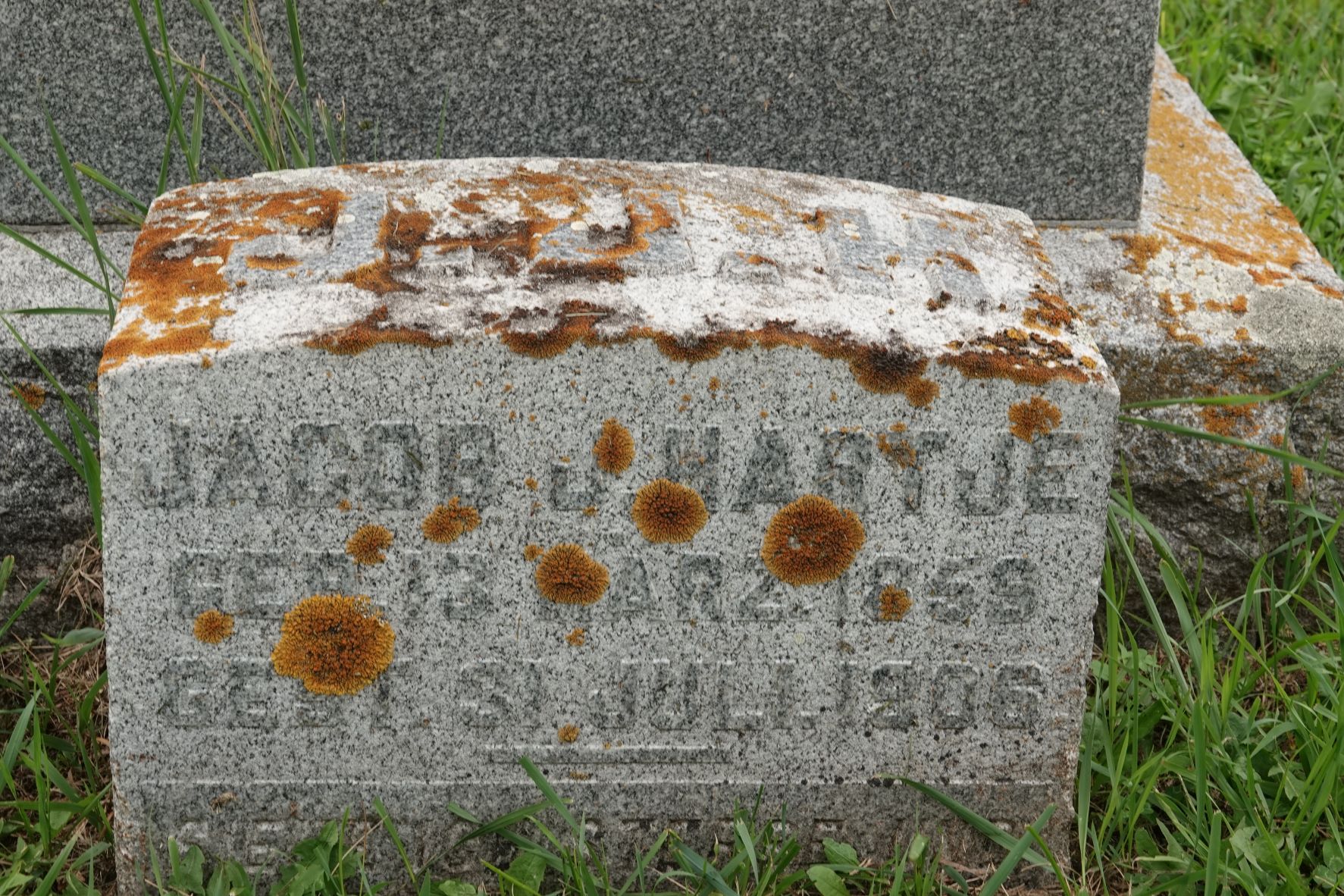
We found his tombstone when we took our trip to North Dakota and it was obvious he was well liked and well off since his stone towered over all of the others in the Cemetery.
The smaller stone is on the backside of the tall stone. I’m sure it was intended to be a family plot. Polly eventually moved to and passed away in Seattle, Washington so she is not buried here.
Now that we know a little of Annie’s history we are back to the question of what prompted a 22 year old woman to go to college in 1907? I was wondering just how many women in North Dakota at the time went to college at all. I found some surprising answers.
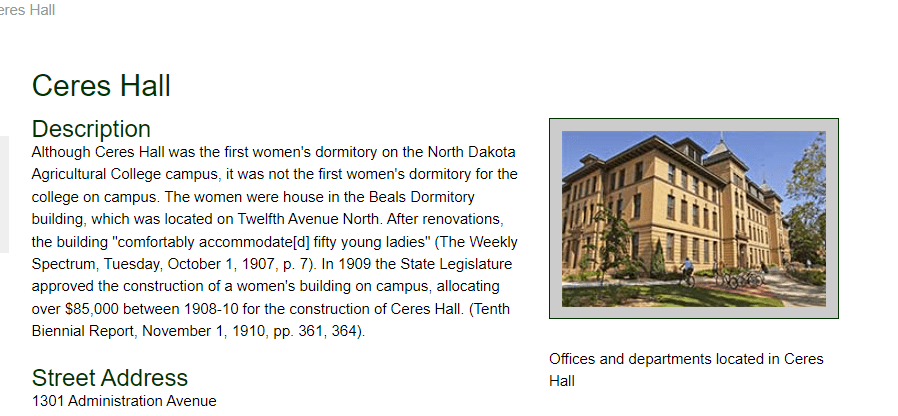
from North Dakota State University website
There was one building where 50 women who were going to college at North Dakota State University could live in 1907. Of course I than wondered how many men were enrolled at the same time. I came across a History of North Dakota State University by David S. Buchanon written in 2019. He had this photo included in his paper, the photo is from the University Archives. It was called North Dakota Agricultural College at the time and was a little controversial when it was first opened. The city leaders thought a college based on agricultural studies was a waste of time.
from History of North Dakota University by David S. Buchanon 1919
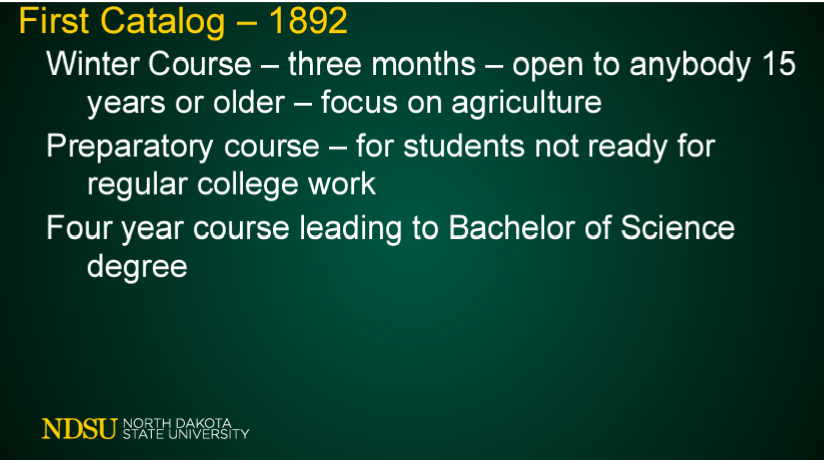
Looking at this I once more had questions. Why are there so few graduating when it opened in 1888-89. Turns out when it first opened it was not a state college of agriculture, that happened in 1900, so this must have been the first graduating class from the college. There are 5 women and 3 men! Completely unexpected. It appears people could take short courses for agricultural study and preparatory work. I may have to go back and try to find out who these women were and what they went on to do in their lives.
from History of North Dakota University by David S. Buchanon 1919
By 1910 it appears Annie is no longer in school but perhaps her schooling helped her get this job. She is a clerk at the Farmer’s store. In the 1910 U.S. Census Annie is living as a boarder with another family in St Thomas.
The Fargo Forum and Daily Republican 7 Nov. 1910, Mon pg 2
In this 1913 article she is moving to a new job in Langdon, North Dakota. I am assuming she might actually move to Langdon as well since that would be quite a distance from St Thomas.
The Fargo Forum and Daily Republican, 12 Aug 1913, Tues, pg 4.
I have not been able to find her in the North Dakota State Census records. I think her next move was to Minnesota. I found an Anne Hartje age 35 living as a lodger in New Ulm, Minnesota. She is a saleslady in a Dry Goods store. She was born in North Dakota and her parents are both from Hannover, which all fits for this Annie. She is living with a family named Ratzlaff. I don’t have any idea what prompted this move but I do think this is Annie.
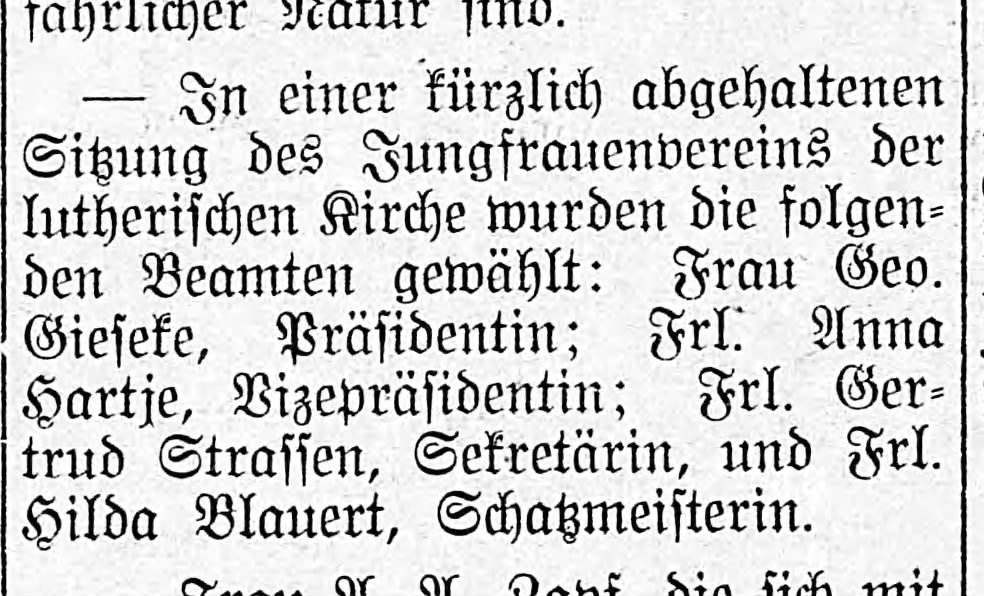
I was excited when I discovered her name in a German newspaper from New Ulm. I thought I might be able to translate using my new skills. Ha! I discovered newspaper script is different from handwritten script and some of these words didn’t come up in my class. I did figure out it was something held at the Lutheran Church and the following became chosen officials. Luckily I also found it in an English newspaper from New Ulm because the big long word in the second line was one I didn’t know and I tried using google translate. It gave me maiden cleanse. I was hoping that wasn’t right.
New Ulm Post, 31 Jan 1919, page 11
The New Ulm Review, 28 May 1919, Wed page 5.
Sometime before 1930 Annie made another move. She is living with her mom and two of her sisters in Seattle, Washington. A number of people in my husbands family moved to Seattle or that area of the country but I always wonder what prompted this change. I’ll have to keep exploring this part of the family because I am guessing there were other family members living near by. Annie is now working as a sales lady in a clothing store. Annie is 45.
Annie’s mother died in 1939. I think they lived together until her mom died but not sure yet, I need to check directories and see if Washington state has census records from 1935. I don’t gather records as fast for relatives who are a little farther out on the branches.
In 1940 Annie is the head of her household. She is a proprietor and waitress of a tavern. The two men living with her may be related to each other as they have the same last name Depew. The older one, Pete Depew, is listed as Annie’s partner, he is a proprietor and waiter in a tavern. So is he her business partner, her life partner or both? It’s not really clear but I bet in 1940 it simply meant business partner. The other man is Lawrence Depew, so possibly a brother, he is about 8 years younger than Pete. Lawrence works as a lineman for the telephone company. No address is given but she is now living in Burien, Washington.
1940 U.S. Census Burien Washington crop
The most surprising thing about this census is, it says her education is H3. H3 means she went through 3 years of high school. So, now I am rethinking my whole premise for writing this post. Do I have the wrong Annie Hartje from St Thomas? I think I do have the right person but maybe she was exploring possibilities and taking some of the preparatory course work to see if college would be a good option for herself. I am still amazed that was an option for her at this time and really glad I learned more about what was available for women.
I have not found her yet in 1950 but I am assuming she was still in the same area. Annie died in 1966 and is buried beside her mother in Pacific Lutheran Cemetery, Seattle, Washington. You can find her on Find A Grave here. I have discovered in writing this post I need to clean up her family on Family Search and connect her family on Find A Grave. Always something more to help keep the family records straight no matter how far out on the branch they may be.
“Have you ever found an ancestor in an unexpected location? What about finding a record someplace that surprised you? Or what about that one great-great-uncle who moved out West when everyone else in the family stayed put? This is a good week to write about them.” this is the prompt from Amy Johnson Crow for Week 3 of 52 Ancestors in 52 Weeks.
My grandfathers Aunt and Uncle who lived in the town where I grew up.
My husband and I were both surprised when I started researching. We were surprised because we had both been surrounded by more ancestors than we knew when we were growing up. I knew my cousins, children of my moms sister lived in the same town and we saw them frequently. I had no idea that both of my parents had other relatives in town. My mom’s dad had an aunt and uncle, Lizzie and Gavin Crowe, in Boone. They had as far as I have figured out nine children. Some moved away but several stayed in Boone, married and had children of their own. I was related to all of these people!
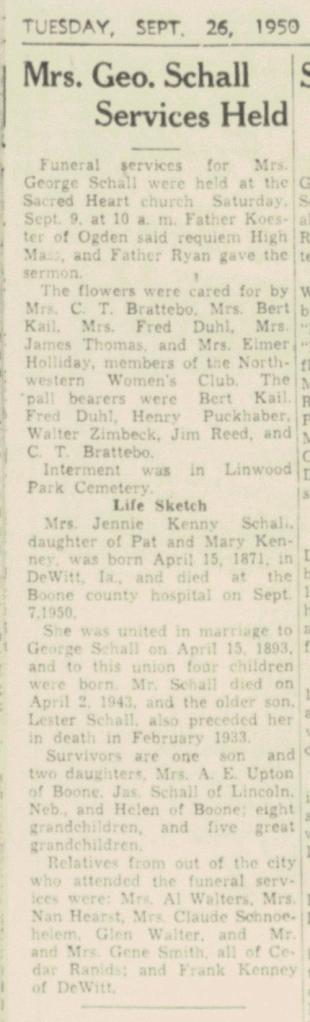
Jennie (Kinney) Schall, my dad’s grandmothers sister who lived in Boone.
I also had relatives on my dad’s side. My dad’s grandmother had a sister who lived in Boone after she was married. She had four children who grew up in Boone. They married and had children some stayed in Boone and some didn’t. It was amazing to me everytime I found someone else I had a connection to and never knew they existed.
John Slater was one of the brothers of my 2nd great grandmother on my mom’s side.
My second great grandmother on my mom’s side had at least one brother and one sister who lived in Boone. I haven’t traced them to the living people today but I know they were married and had children and it’s possible some of their descendants grew up alongside me. For some reason that just seems off kilter, like something wasn’t aligned right, although I imagine it happened frequently.
Hein and Rebecca Hartje had nine children, they each had 3-7 children of their own. Lot’s of cousins were born. They all lived in near by towns.
My husbands family had many cousins living in the same or near by towns. He vaguely knew they had some relatives out there but not to the extent we found. The Hartje families tended to be large, marry and have another large family. Some moved away but many were living within an hour or two drive of his home.
It wasn’t so much having relatives who were out of place, as a feeling that I didn’t know the place where they and I grew up. It was a little bit of cognitive dissonance but very fun to find new relatives where ever they appear.
“I’ve had this theme in almost every version of 52 Ancestors because, let’s face it, who can choose just one?! Plus, we should be telling the stories of those photos so they don’t get lost to time.” Week 2 prompt from Amy Johnson Crow for 52 Ancestors in 52 Weeks.
Smith family from our family photo collection
This photo seems very innovative for the time period. I know it is my great grandparents sitting in the chairs. Charles William Smith (1860-1936) and Melissa Alice Minson (1863-1932) were my great grandparents. They had four children Nettie Myrtle, Albert Vernon, Lelah May and Mary. Myrtle was my grandmother and we knew at some point she worked in a photo studio in Boone, Iowa. We all agree the one lying on the floor is my grand aunt Mary, she was the youngest in the family. I waffle with the one standing. It makes sense that it would be Myrtle as she was still living with the family. Looking at other photos with Lelah I sometimes think it could be her and maybe Myrtle got to try her hand at taking a photo. I often want to romanticize and add to the stories when really there isn’t anything more to add, for instance, maybe this was used as an advertisement for the photgrapher. When I was trying to find information about this photographer I saw most photographers displayed some of their photos just outside where they worked.
In the 1910 Census Nettie Myrtle is living with her family, except for Lelah who was married. She is listed as a milliner in this record. In the 1911 Boone City Directory N. Myrtle Smith is listed as a printer for Hughes Studio. She was boarding at the same address where her parents lived, 1319 15th Street. This one took a while to find as she is transcribed as X Myrtle Smith! I found her parents and wasn’t sure yet of the date she was married. Since she wasn’t listed with them I was assuming she was already married. I started looking for her married name and didn’t find her there either. Eventually I found their marriage and knew she was still single at the time of this directory.
Boone City Directory 1911
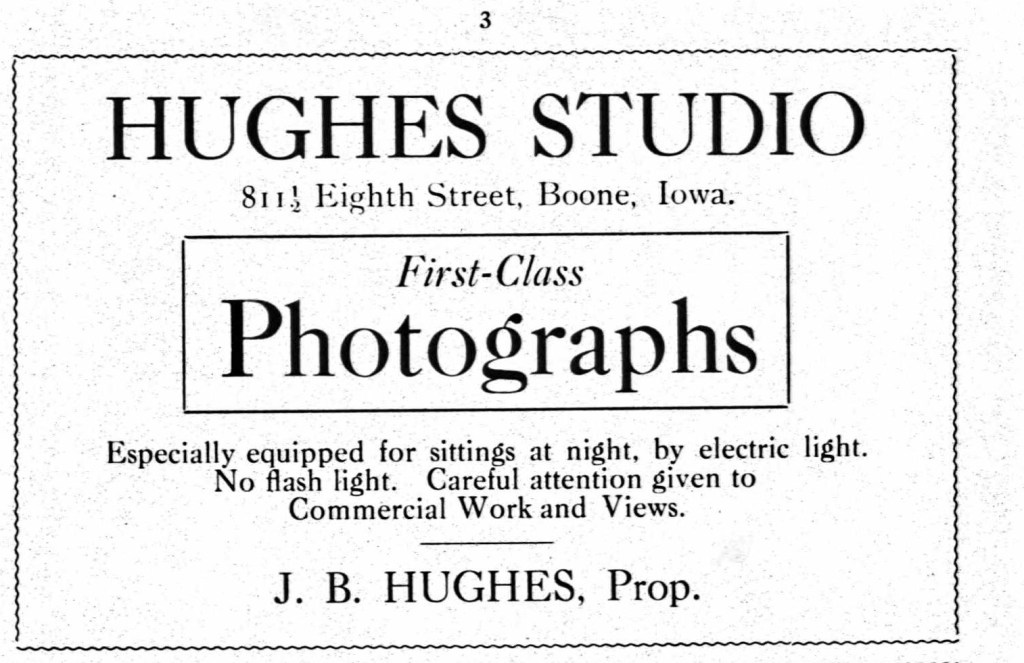
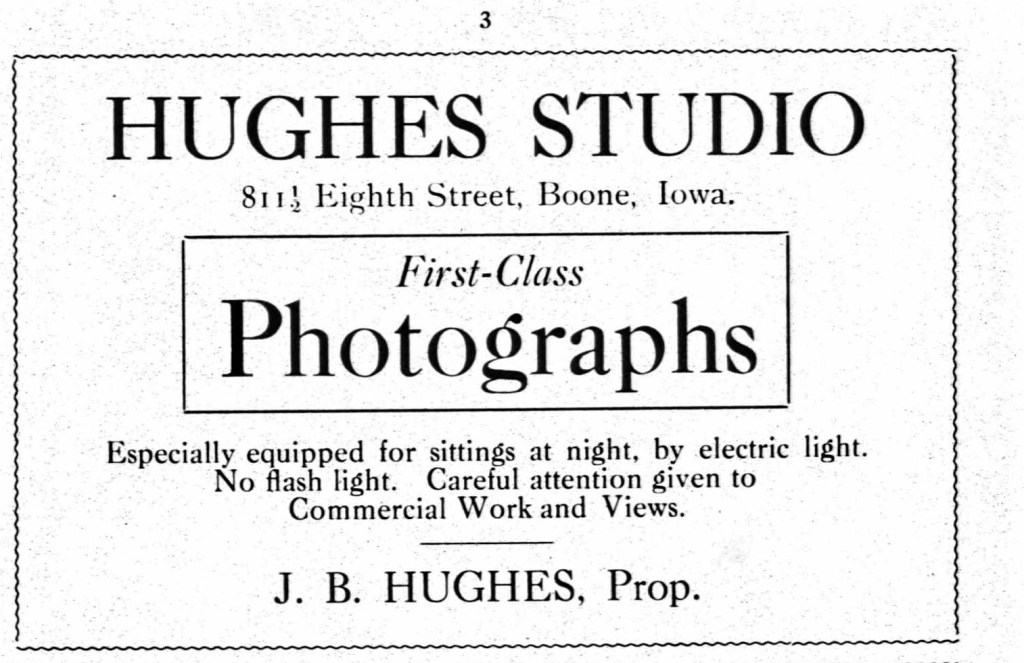
I found an advertisement for the photo studio in the same directory. It talks about the special lighting they had available so they could take pictures at night. I love the coloring of this photo and how they are all enjoying the fireplace. Or maybe it is just an illusion of a fireplace created with their special lights. I wasn’t able to find information about the photgrapher right now. I think I looked it up in the past and discovered he was only in Boone for a few years and than moved to California. I could be wrong though as I seem to have misplaced my notes.
Advertisement from the Boone City Directory, 1911
This is Lelah May(left) and Nettie Myrtle. In the end I think my sister is right but they are very similar when you are looking at an image that isn’t completely focused.
Do you have a favorite photo? Maybe yours is a photo of a place that brings back wonderful memories, or a record you worked very hard to find. It is very hard to just chose one favorite photo.
“Most of us have an ancestor who we’d like to meet (even if it’s to ask, “What are your parents’ names?”) This week, write about that ancestor or why you’d want to meet him or her. Feel free to be creative!” prompt from Amy Johnson Crow for Week 1 2023.
Grandma Kirkwood surrounded by her grandchildren.
It’s hard to chose just one ancestor but I will go with my mom’s mom. Nettie Myrtle (Smith) Kirkwood (1883-1952) was my grandmother but she died before I was born so I never met her. I have quite a few photos and a few stories from my sisters and my mom and she sounds like a wonderful person. My sisters say she was very snuggly and loving and gone much to soon. The picture above speaks to this description perfectly, a grandma loving all of her grandchildren.
Nettie Myrtle Smith
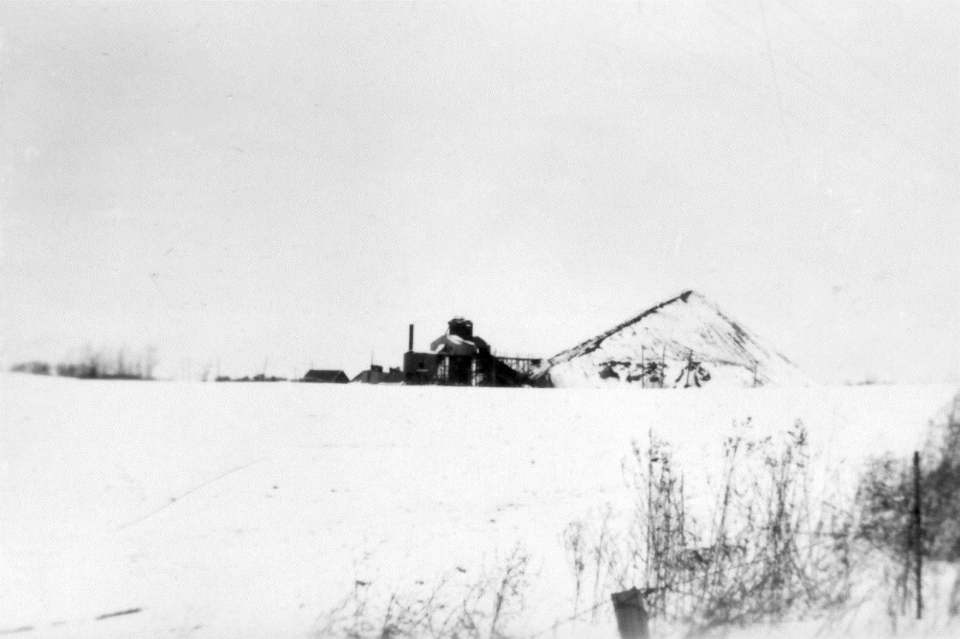
My mom thought this was the mine where Nettie Myrtle’s dad worked and injured his leg.
She was so much more than a grandmother. Not that being a grandmother isn’t enough but she did so many varied activities throughout her life, they help show the entire picture. Her dad had several occupations, one was working in the coal mines around Boone, Iowa. When my grandmother was in high school her father was injured in a mining accident. I don’t know anything about the accident except it injured one of his legs (as told by my mom). My grandmother quit school and began working in the mining store to help the family with money. This is more than likely where she met my grandfather although it would be quite a few years before they married. I’m guessing this might be where she began to learn nursing skills. The miners often were injured on the job and we know that she was considered a nurse with skills she learned in life.
Crop of the Boone, Iowa City Directory from 1911. Smith N. Myrtle worked as a printer for Hughes Studio.
Cropped from the 1911 Boone, Iowa City Directory.
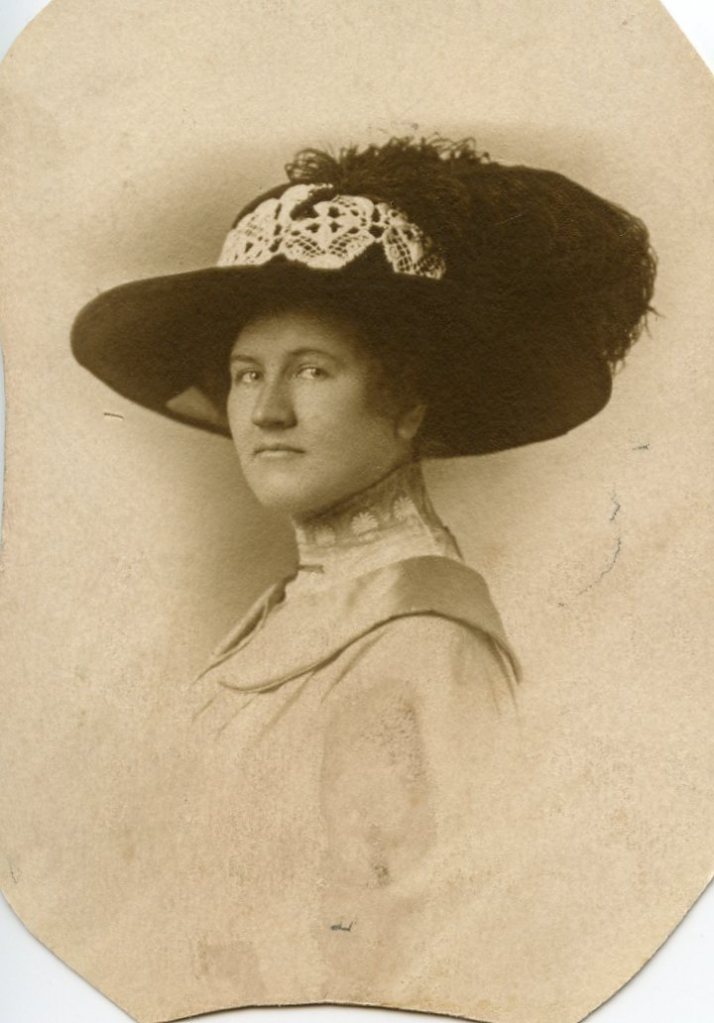
In 1911 my grandmother was 28 years old, it was two more years before she and my grandfather married. She was working as a printer for a local photographer. She also made hats. When I learned this a light bulb went off because we have so many photos of relatives wearing very elaborate hats. I would guess she combined these two skill sets. Here is one that she may have made.
Maybe one of her own hats?
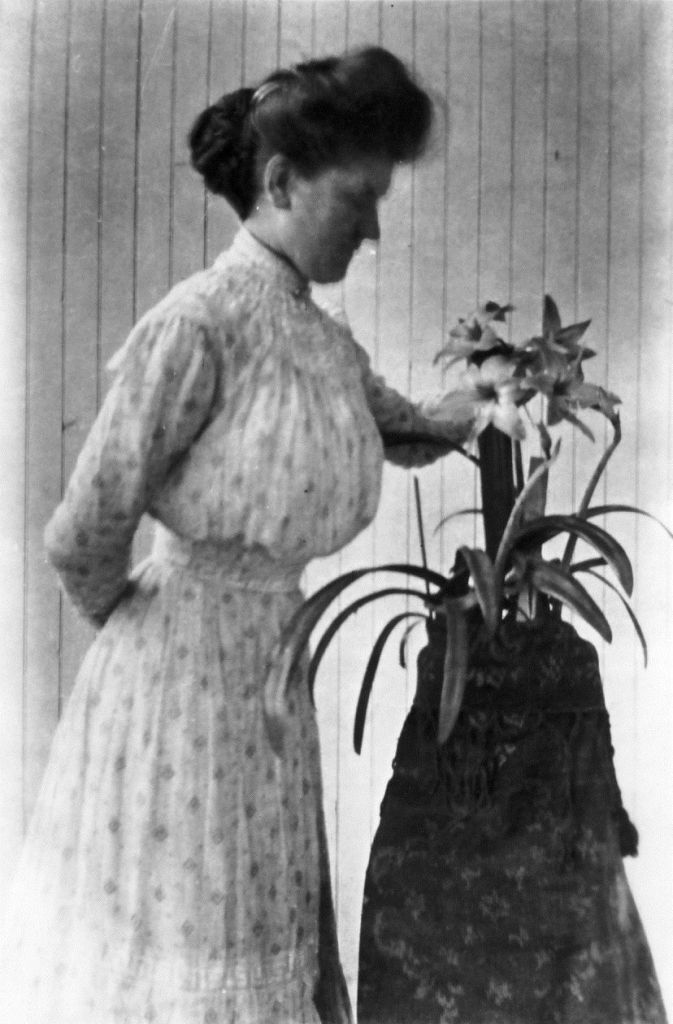
One of my favorite photos this may have been taken while she worked at the photo studio.
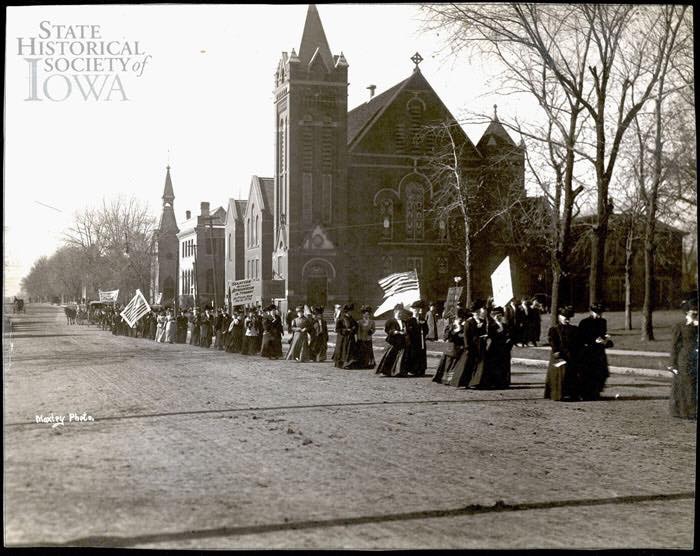
From family stories grandma was also a suffragette. She was no doubt involved in this parade in 1908.
clipped from the Boone News Republican.
from the Iowa State Historical Society, this photo is from the parade in Boone, Iowa
N. Myrtle Smith married my grandfather, John Robertson Kirkwood on 2 June 1913. We think this may have been taken about that time.
Possibly the wedding photo for my grandparents.
Myrtle was 30 when they married. She and my grandfather had two children. This is a photo of Myrtle and my mom who was the youngest. Not sure exactly when this was taken but three days after my mom was born there was a huge tornado in Boone that destroyed a large part of the community. This looks like it would have been during that time period. My mom said her mom was very afraid during storms as long as she could remember. Maybe it goes back to this time.
My grandmother and my mom, 1918, Boone, Iowa.
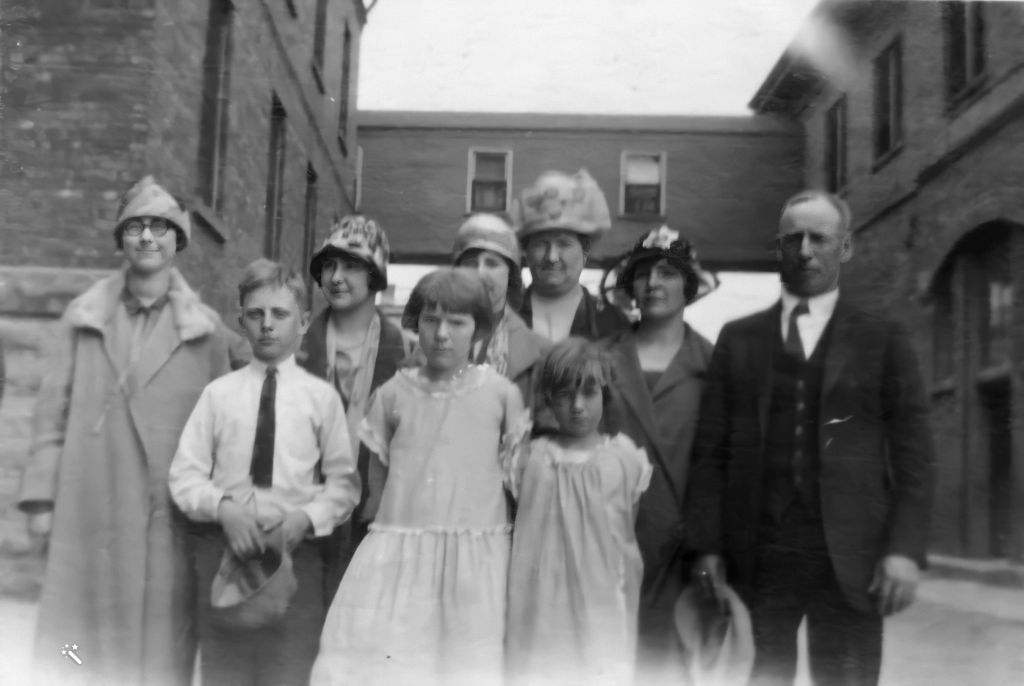
My grandmother did a lot of charitable work. My mom was a little jealous of the amount of time her mom gave to those in need. One of these charities involved the Rebekahs, the women’s part of the Order of the Oddfellows. I know she held at least one office with this group and she helped with the orphanage they had adopted in Mason City, Iowa. This photo is from one of the trips they took to the orphanage. Possibly more of her hat making skills?
Grandma is the tallest woman in the back. My mom and her sister are the two girls in the front.
Myrtle was involved in so many different clubs, which from what I can tell was pretty normal for the time period. One of them was simply called My Moms Club. There were others with unusual names but all made the society pages of the time.
Grandma’s Mom’s Club. She is the tallest and my aunt is behind her on the right, her granddaughter is in front of her.
This one is called the Club daughter’s. My mom and aunt are both in this one with one of their children each.
My sister remembers my grandmother combing and braiding her long auburn hair to put up on her head and get ready for the day. I don’t know of anyone else in the family with auburn hair so I wish I could have seen it. She seems like a very active, engaged, involved, loving human being and I would love to sit down and get to know her. Which relative would you chose?
You did it! Week 52! Who do you want to find more about in 2023? Now would be a good time to write up what you know (or what you think you know!) and consider what your next steps are. (Of course, feel free to interpret the theme in other ways!)
Emma (Sommer) (Kettner) Abraham
I was very excited to recieve two, new to me, death certificates on Christmas Eve. Merry Christmas to me! They are for my husbands great grandparents, Emma and Theodor Abraham. The best part is now I have his great great grandparents names. Emma’s parents are very clear and easy to read and they confirm what I had found for her already. Emma’s dad was Albert Sommer born in Germany. Emma’s mom was Marie Kettner who was also born in Germany.
Death certificate for Theodor Abraham
The death certificate for Theodor wasn’t quite as easy to read. I had trouble reading the names of his parents so I asked in the group “The Genealogy Squad” on Facebook. The people in this group were very helpful. Here is a close up of the parents names and it also says the birthplace of Theodor was Germany. Emma was the informant for this certificate so I think it is probably correct.
The majority decided Theodor’s fathers name was Martin Abraham. His mom wasn’t quite as easy to decipher but most were thinking Berta Serdo. They also thought both of them were born in Germany. Do you think it says Berta Serdo?
One person in the Facebook group loves to solve mysteries and she went on to find several documents related to the family of Martin and Berta Abraham. She found them living in Dodge County, Wisconsin. I have Emma’s birth place as Wisconsin so this fits with what I already knew. She also found Berta on Find A Grave. I have to prove that this is the correct family. There are a few contradictions, such as it says Berta was born in Poland. One of the Census records also says Poland but it has her name as Barbara. So I’m not positive this is the correct family yet but now I have names and a place to begin searching.
Who knows this may lead me to discover the connection between my husband’s family and my family. Our kids each have at least one DNA connection that is from both sides. So far we haven’t found any intersection between the two families but my Koch relatives were also living in this part of Wisconsin. We both have relatives from Germany so it may be it was even farther back but it’s fun to search for clues.
Learning all about Germany is my next goal for genealogy. I have a class to explore and many names of relatives from Germany. Koch, Siepmann, Lang, Beck, Ufers, Sommer, Kettner, Abraham, Hartje, Schutt, Lentz, Hochenlock, Hadler, and Blanck, are all names I have to find in Germany. I have some of the churches where they were married and/or their children were baptized so this gives me a starting point.
Wish me luck in my search efforts for both mine and my husband’s ancestry. It will be fun to see where this leads. Where will 2023 take you in your relative hunt?
“Religion played an important role in the lives of many of our ancestors. Write about how a person’s faith impacted their life, how an ancestor was involved with their church, or a discovery you’ve made in church records. Feel free to post your links and stories in the comments below.” prompt by Amy Johnson Crow for 52 Ancestors in 52 Weeks.
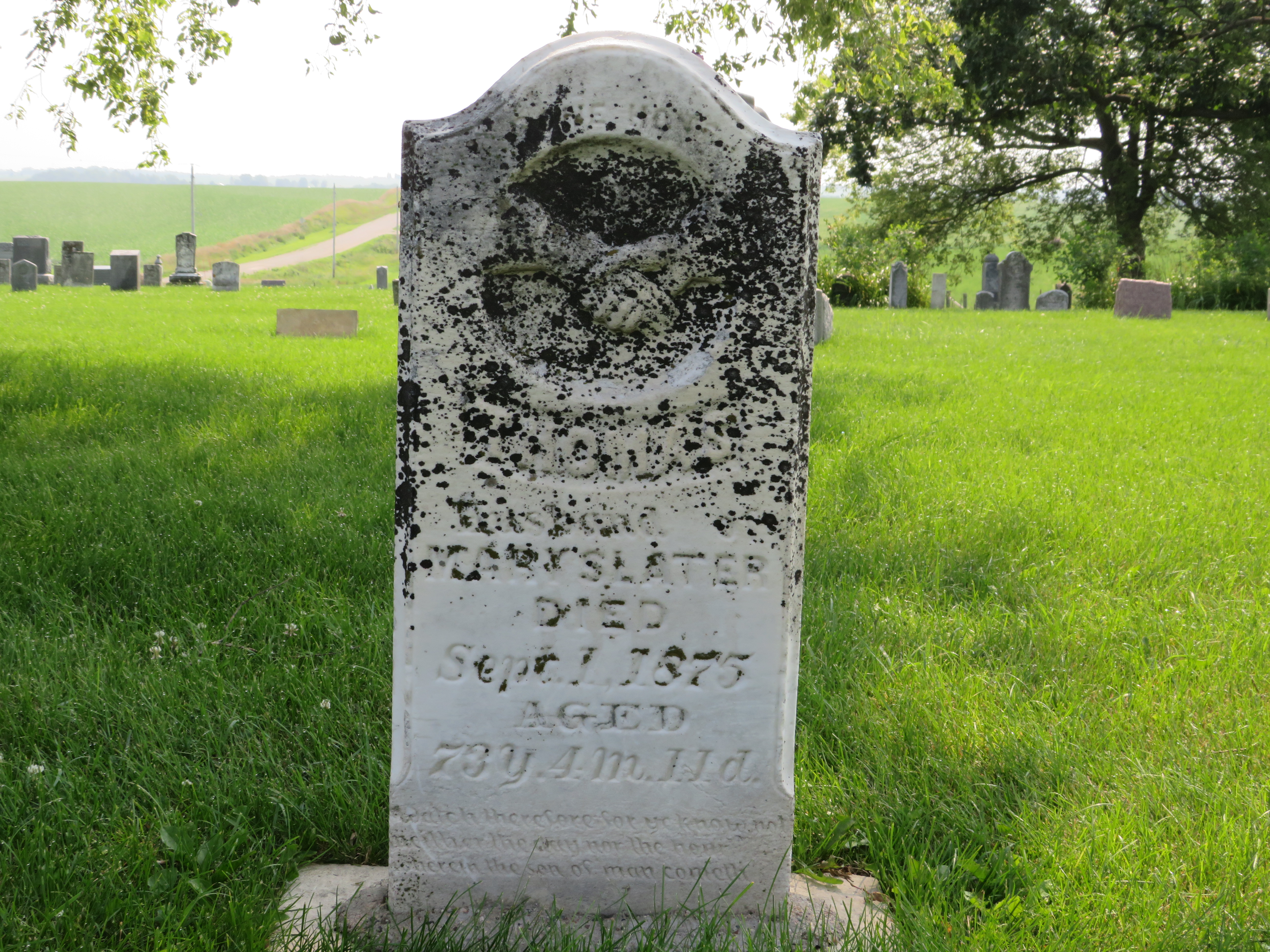
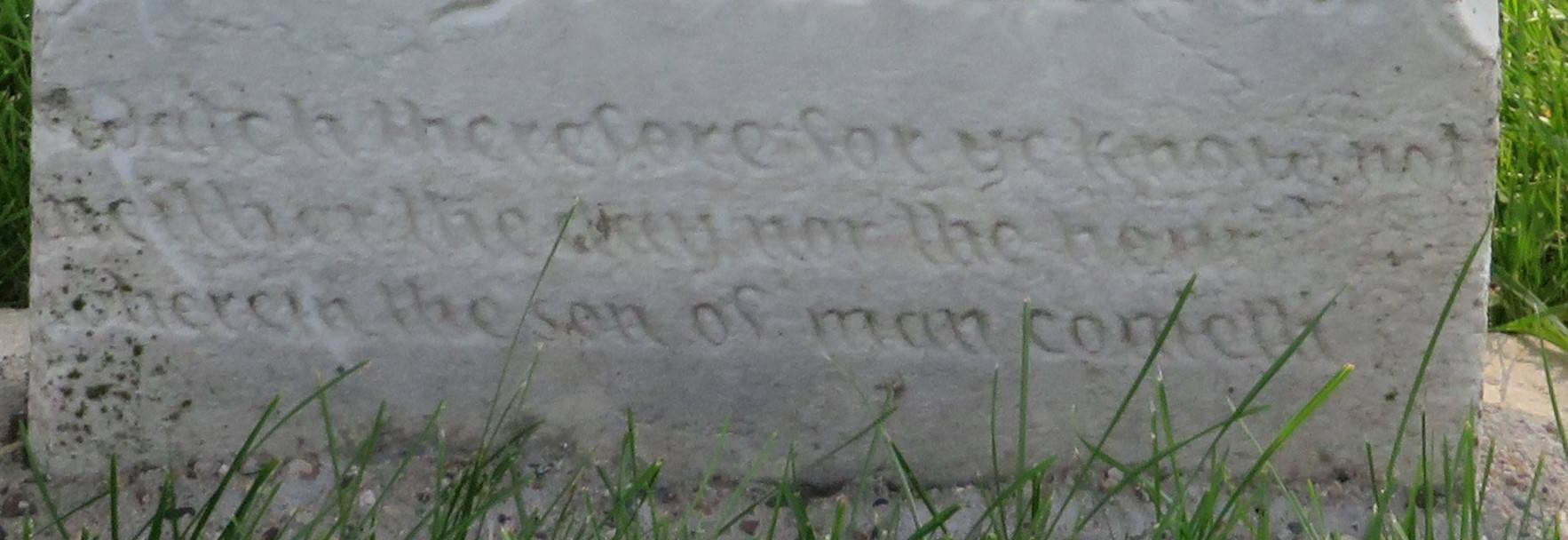
Just like many others, the faith of my ancestors helped get them through the hard times. Many of the tombstones we found attest to their faith in a higher power. This is one example, the tombstone of Thomas Slater, my third great grandfather.
Here is another, Rebecke (Schuett, Hartje) Henke, my husbands second great grandmother.
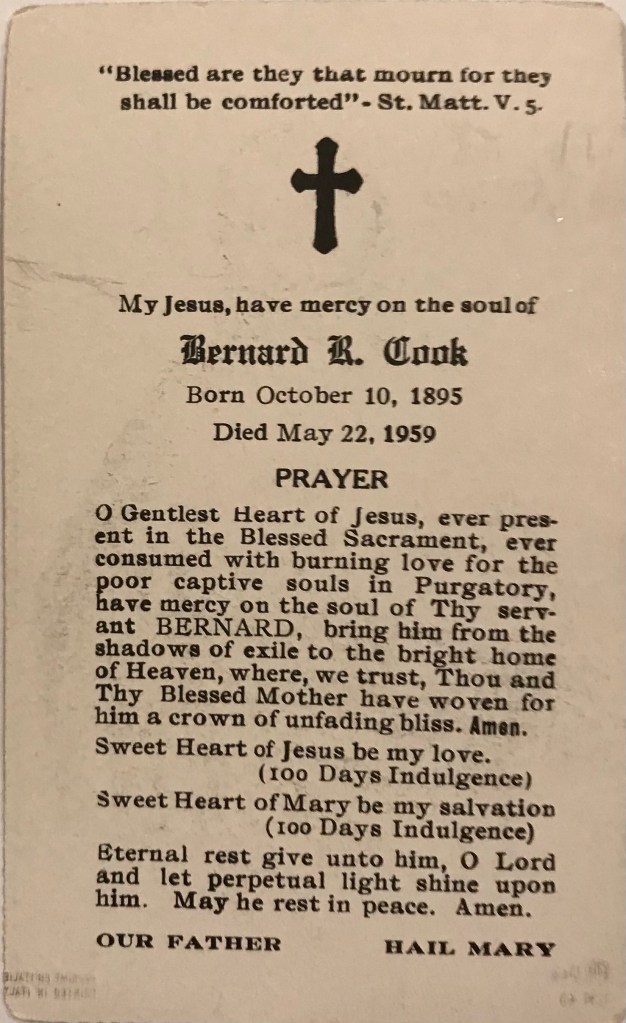
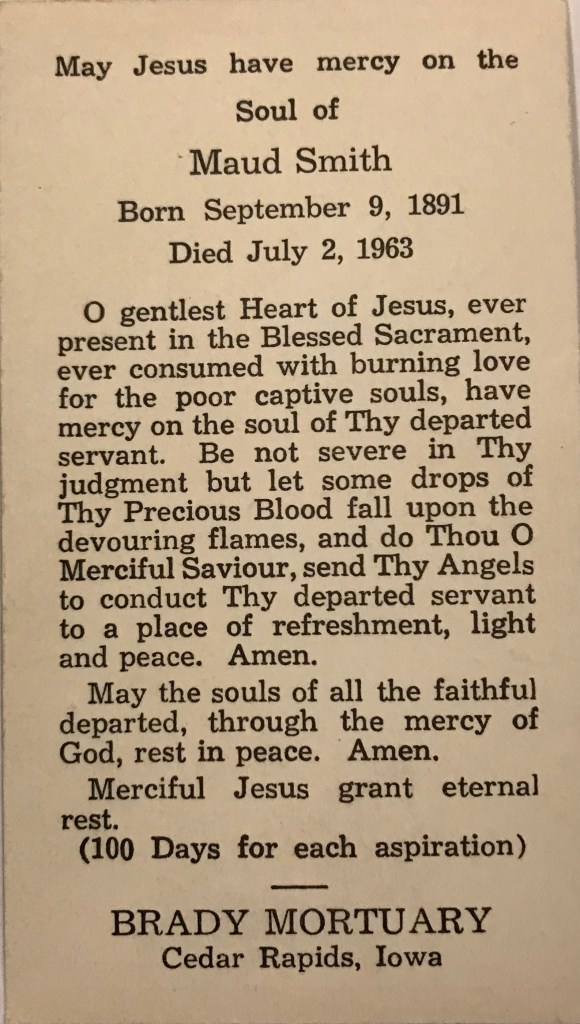
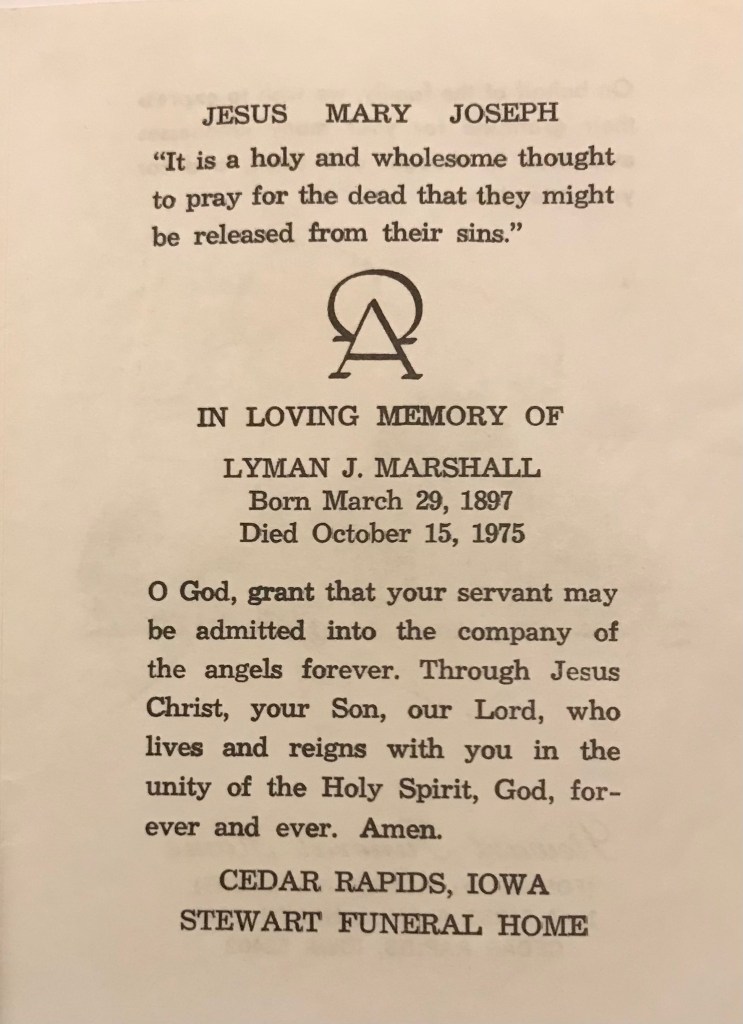
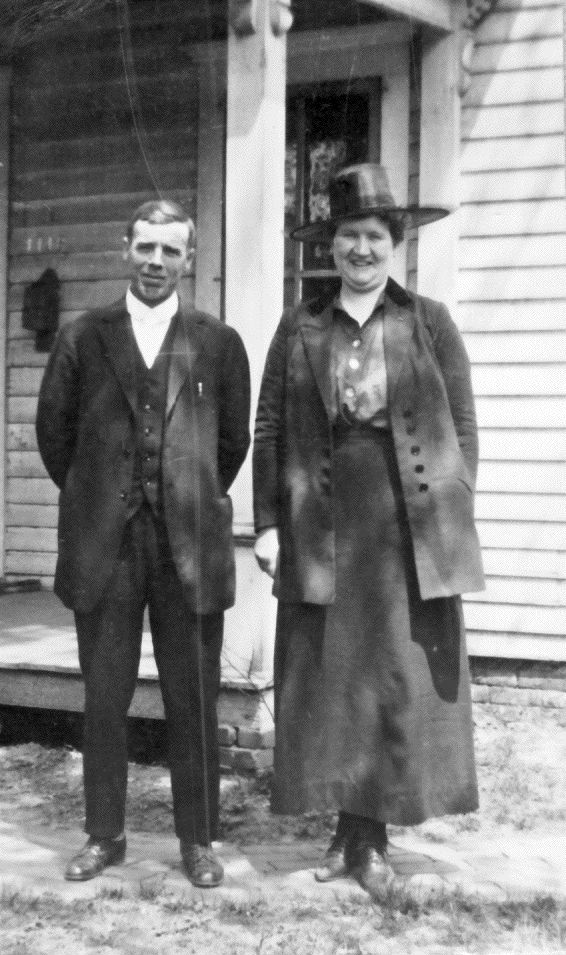
We have many funeral cards that attest to the faith of my ancestors.
my grandmother Cook
my grandfather Cook
grandpa Cook’s sister
grandma Cook’s brother-in-law
Grandma Kirkwood’s sister-in-law
Here is a quote from Gudny Thorfinnsdottir about the family trip from Iceland to America. “Now with a blind husband, a sick child, very little means to meet their needs, they started out on their journey. But after all Mother did not stand alone. She had set her mind on what God would do for her. Father and Mother came through victorious.” Their faith helped them reach their destination to build a better life for their familiy.
John and Myrtle Kirkwood
My grandma and grandpa Kirkwood from what I have learned of their lives not only had faith but exemplified what a life of faith meant to them. They were always helping others. My mom said when they lived near the train tracks the men who road on the trains, hoboes, knew they could come to their house and get some food. She said there was often someone knocking on their backdoor. Even though they didn’t have a lot, they gave what they could.
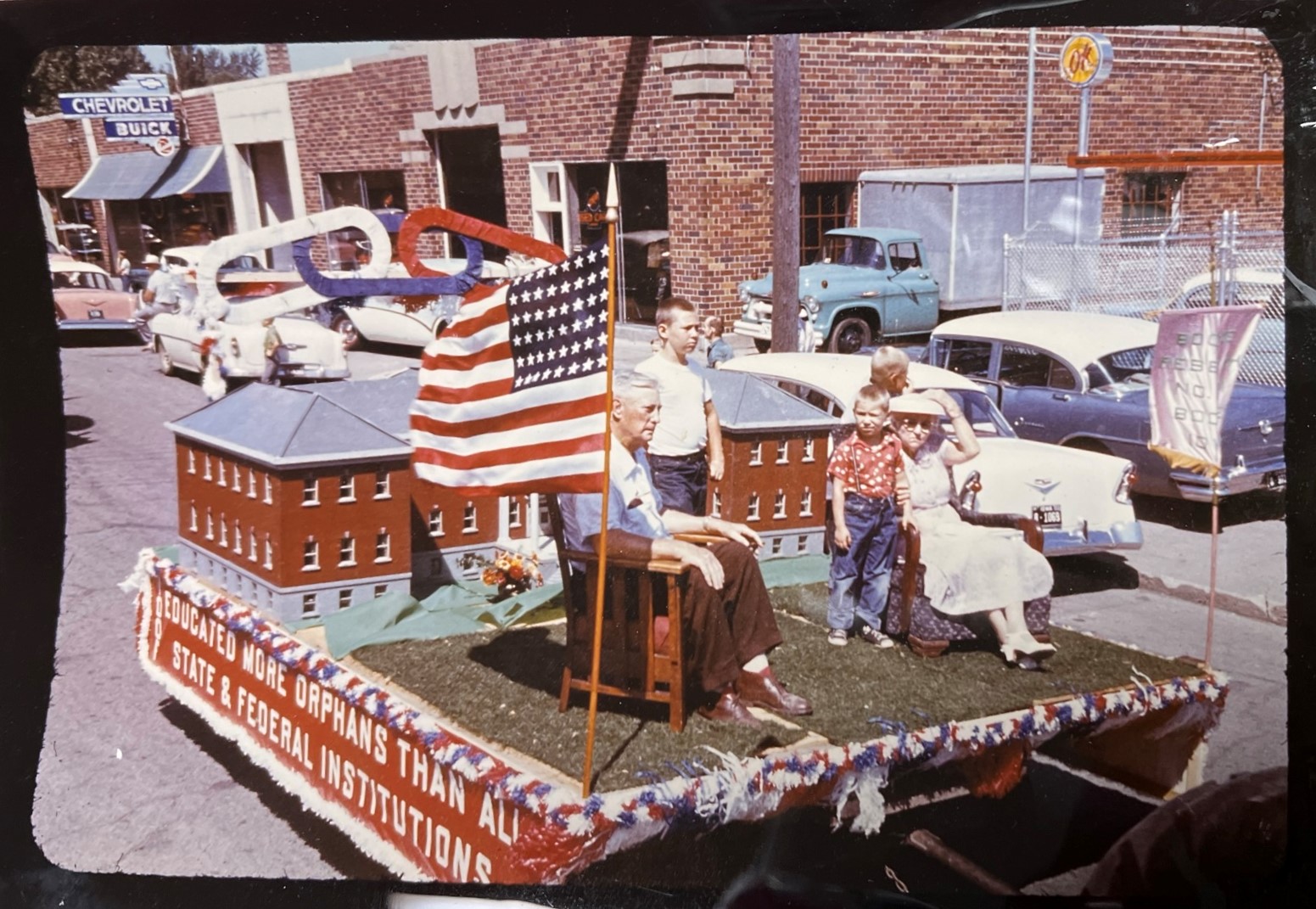
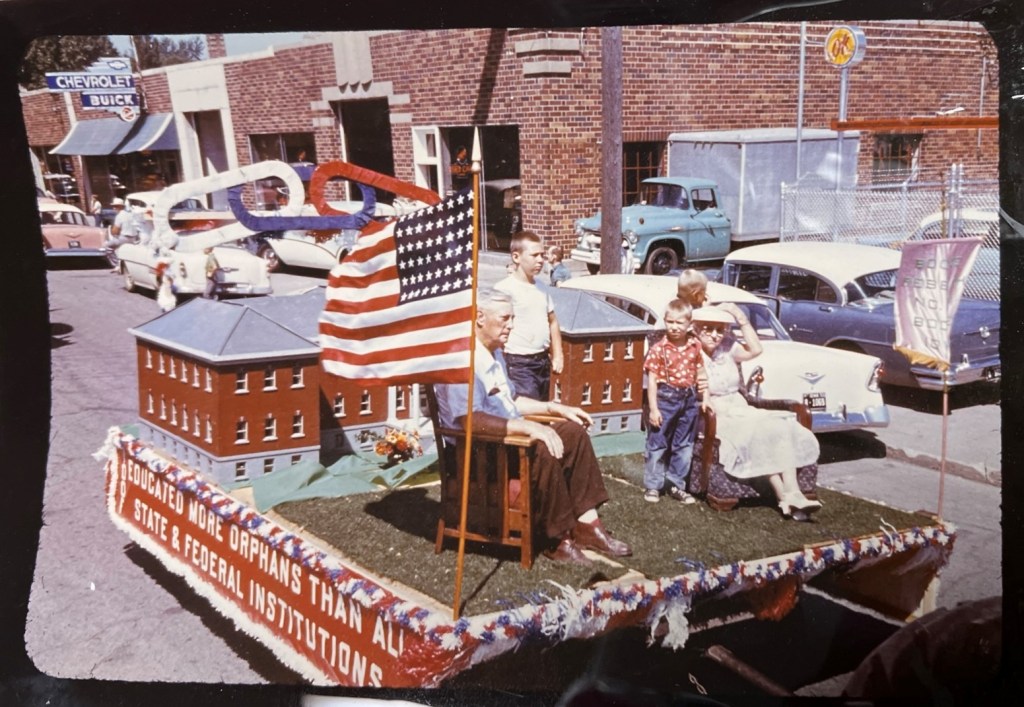
They were both very involved in their church. They also were members of the Iowa Order of Oddfellows and Rebekahs. I don’t know a lot about the organization but they seem to have done a great deal of charitable work. They helped the orphans at Mason City, Iowa. I have a few photos taken from one of their trips to Mason City. We have a scrapbook of certificates my grandfather received while in the organization. There is one photo of a float from a parade. On the side of the float it says “Educated more orphans than all state and federal institutions.”
Oddfellow parade float
orphanage in Mason City, Iowa
My mom and her sister are the two young girls in the front, Myrtle, their mom is the tallest woman in the back. The man is George Kirkwood, my grandfathers brother and the boy is his son. This was taken at the orphanage in Mason City, Iowa.
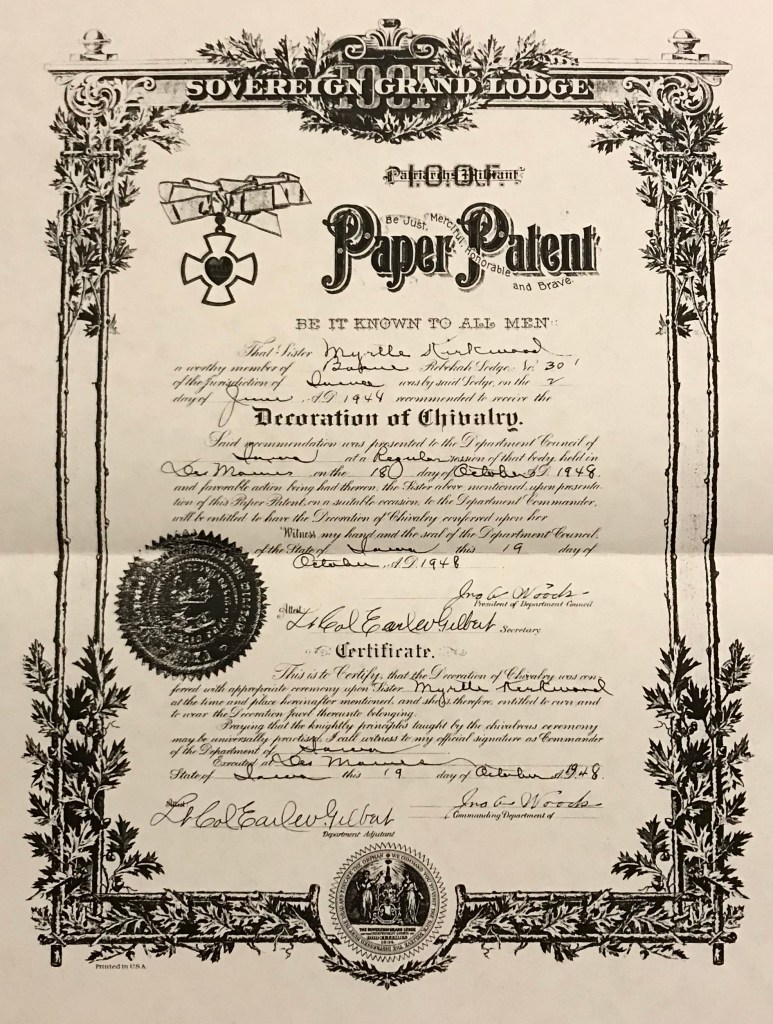
Myrtle received a Decoration of Chivalry. I tried to find out more about why it was given but could only find links to photos of a pin she may have received along with the certificate. This is from 1944.
Grandpa was many years an educator in the Oddfellows. He was also District Deputy Grand Master a number of times. This one is from 1929.
They had different backgrounds for their faith but overall it seems to have helped them through those difficult times in their lives. I guess it gave them strength to endure when they believed in a higher power.
Who is an ancestor who had to persevere? Who is an ancestor you had to persevere in order to find?! Share their story this week. Feel free to leave your links and stories in the comments.
In looking at the stories of my and my husbands ancestors I can’t name one who didn’t have to perservere in the face of adversity. Adversity is what brought them to America and what they faced once they were here. Yet they all persisted to create a better life for their descendants. I have so much admiration for the people who came before me and their work ethic.
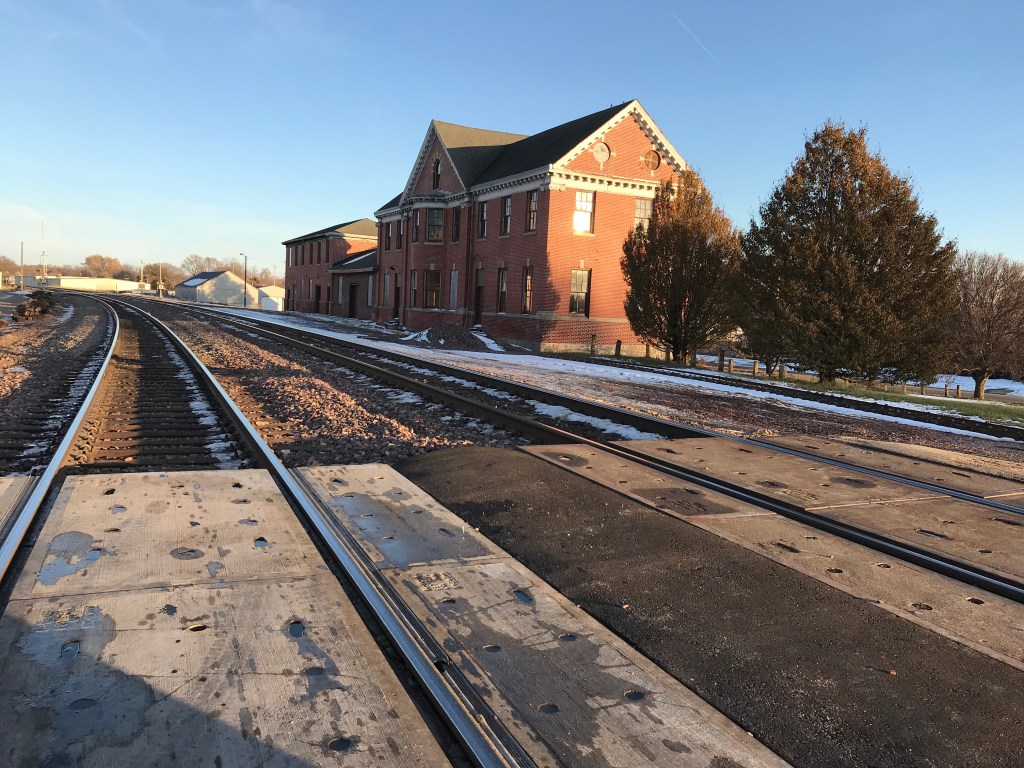
Railroad Depot in Belle Plaine Iowa where my grandfather and great grandfather were employed. Bernard Roy Cook (grandfather) and Benjamin Cook/Bernhard Koch (great grandfather). My great great grandfather was from Germany.
My Scottish ancestors who were mine workers came to America at a time when work was hard to find where they lived. They continued to work in the mines until that was no longer viable and than learned a new skill to support their family. My Irish ancestors left their country at a time when food and work were scarce. I don’t yet know what their occupation was in Ireland but they learned how to work on the railroad in the U.S. There was a lot of upheavel in Germany when my and my husbands German ancestors traveled to America. Our ancestors had enough to purchase farm land when they arrived. It was not as simple as it sounds though because they literally had to create their farms. The land was covered in trees and they first had to build a house. That would all be intimidating to me.
John Robertson Kirkwood on right, streetcar conductor in Boone, Iowa originally from Scotland.
My goal for this next year is to get over my fear of researching in other countries. Well maybe not fear exactly but I do find it intimidating. I’ve learned quite a bit about researching in Scotland but I know almost nothing about Germany, Ireland, and England. I know where to research in Iceland, I just need to make the time to do it. I keep hoping now that my husband is retired he will help out, so far he has been busier than ever with things around the house.
Arni Thorfinnson and Sigrudur Bjornson from Iceland.
I did sign myself up for a class on German research and to learn the important words in German that a genealogist would need to know. I was slowed down in my course by life, surgery and what not. I have a study buddy for after the new year and hopefully we can encourage each other to finish. My goal is to persevere in my studies so I can find my ancestors in Germany. Hartje’s and Koch’s are from Prussia. I’ve learned the area the Hartje’s were from had many bootleggers, so maybe I will have a criminal ancestor to write about the next time that prompt shows up. The Siepmann’s are from Oberhausen, North Rhine-Westphalia, which at this point I’m not even sure where it is on the map.
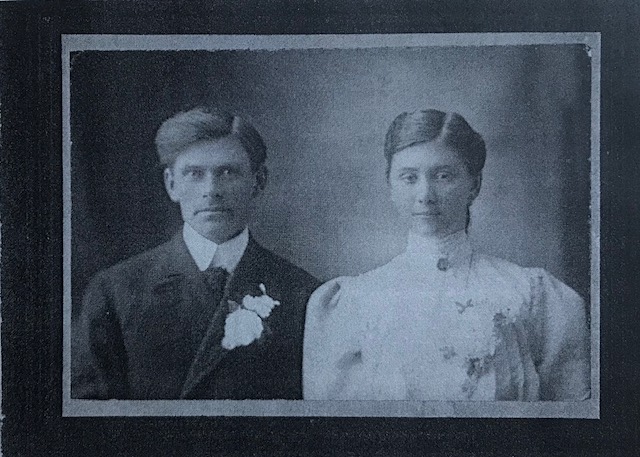
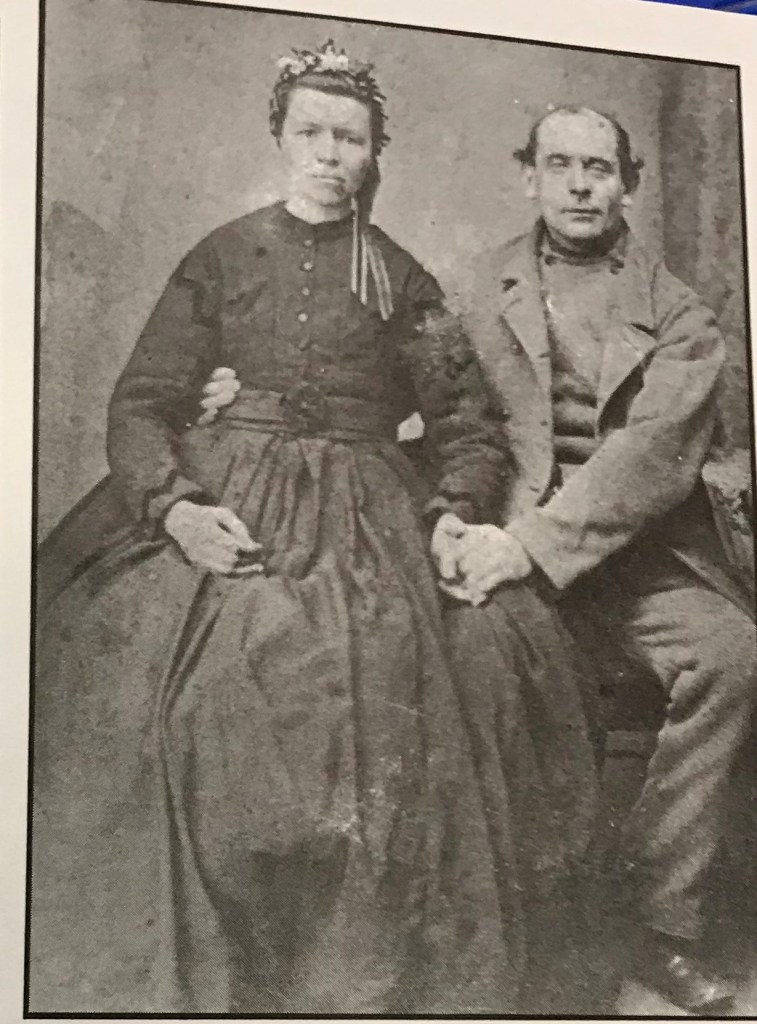
Hein Hartje and Rebecke Schutt from Germany.
After I learn how to research in Germany I plan to work on my husbands Icelandic relatives. Next up is Ireland and England. Eventually I hope to get my Smith and Minson family relatives out of America and figure out where they were from. I’ve found a few records back to the 1770’s for them in Maine. There is a possiblity one branch is from Scotland. It’s exciting to know we had ancestors here at the very beginning of our country.
Martha Lewark and Alex Minson country of origin still unknown.
Genealogy is all about perserverence for myself and those I research. I just signed up for 52 Ancestors in 52 Weeks for 2023. Amy Johnson Crow is a skilled genealogist, she teaches classes, has a blog, writes and leads us through a year of writing stories about our own ancestors. Look her up and find out more. Definitely worth your time. Hopefully I will have enough stories for another year of posts.
Not the best photo, my grandmother Nettie Myrtle (Smith) Kirkwood is most likely in this scene and marched in the parade. Still they persisted!
I have two more posts to finish for this year, Weeks 52 and 10. I skipped past 10 when it came up because I couldn’t decide what to write. I think I am actually going to accomplish this goal of 52 in 52! Knowing I have new stories to write will make it easier to persevere in finding new ancestors in my family for next year. Good luck with your own family stories.
“This week’s theme is “Traditions.” Many families have special traditions for this time of year. This week, write about a tradition that your family enjoys (or doesn’t enjoy!) and the ancestors that it brings to mind. Do you know who started that tradition? Who changed it over the years?” prompt from Amy Johnson Crow for Week 50 of %2 Ancestors in 52 Weeks
We had many traditions in my family when I was growing up. I don’t remember it being mentioned that they originated from any particular ancestor. The exception was oyster stew on Christmas Eve. My mom always made oyster stew on Christmas Eve for my dad. We ate what was in front of us when we were growing up but this was an exception. My dad was the only one who ate oyster stew. I think my mom didn’t like it so she didn’t make any of us eat it. I do remember trying it once and I wasn’t impressed, I have never liked shellfish.
My understanding was this tradition originated with my dad’s German ancestors. His parents were Cook/Koch and Siepmann. It wasn’t until a few years ago that I learned oyster stew was not a German tradition but Irish. Both of my dad’s grandmothers were Irish, Kinney and White. Here I was nearly sixty years old and didn’t know where this tradition began. The Irish Catholics were prohibited from eating meat the night before a religious holiday. Traditionally they used a different fish when they came to America it wasn’t available, but oysters were. Because they had a shell they could keep longer in the cold weather of winter and thus they made their way to the midwestern dinner table by the mid 1800’s. They were hauled long distances on wagons in the winter months. You can find out more here , and there is even a recipe if you want to try it for yourself.
Since this was the only tradition I could remember that was handed down from my ancestors I decided to try to find out what my ancestors may have experienced. We used to make May Day baskets and put little treats in them and leave them on the doorsteps of our friends and neighbors when I was little. I discovered this tradition probably had Irish origins as well. Beltane, the Gaelic May Day festival happened 30 April – 1 May marked the beginning of summer. It was celebrated with bonfires and decorating the home with flowers. We had a lot of fun making our little May baskets from construction paper and sneaking up to each others houses to leave them on the doorstep, ring the doorbell, and quickly run and hide before they saw us. It was all supposed to be anonymous so couldn’t be done today but was a fun tradition at the time.
This is similar to the May baskets we made, usually ours were filled with popcorn and candy. from FunFamilyCrafts.com
The tradition of an Advent calendar may have originated in Germany. I don’t remember a calendar when I was young but I do remember making a paper chain and adding another link for each day leading up to Christmas. I made an advent calendar for my own family the first year my husband and I were married. A couple of years ago my daughter asked for one of her own, so I made her a new one.
A Vogue pattern for an advent Calendar.
We would gather together on Christmas Eve, turn off all lights except the ones on the Christmas tree and sing carols. This was one of my favorite traditions as well as driving around town to see all the houses that were decorated for the season. My sister recorded us singing carols one year and I cherish being able to hear my parents voices once again. Singing carols like this may have been a German tradition as well.
I didn’t find much about Scottish traditions but New Years Eve and singing Auld Lang Syne may be attributed to this country. The text is a poem written by Robert Burns in 1888 which was based on a Scottish folk song. Hogmanay is an important part of the Scottish calendar. The main custom of Hogmanay is celebrating with friends and family as the clock strikes midnight for the New Year.
My third great grandparents Thomas Slater and Mary Mark were from England. Not sure if we have any traditions from them but I do have a platter that is supposed to be from them. I found that roast dinner (classically known as Sunday roast) was an English tradition. My mom would make a Sunday roast dinner and my older brothers and sisters often came home for this generous meal. “The day starts by popping the meat in the oven, adding the veggies and then coming to attend mass.” This is exactly what my mom would do. Just before we left for Mass she would put the roast in the oven so it was almost ready by the time we came home. It smelled so good when we walked in the door after church.
Watching the Horse Racing was also a typical British tradition. My parents would travel to Omaha every year to watch the horse races. It was their anniversary trip each year and gave them a chance to get away on their own. It is the second largest spectator sport in England.
My husband can’t really remember any traditions in particular in his family. He is half German and half Icelandic. I already mentioned some German traditions above. We have adopted the Icelandic tradition of Jolabokaflod or Icelandic book flood. On Christmas Eve everyone recieves a book and some chocolate. They snuggle up with their family before the fire and read their books. I like this tradition. Here are some more that I found. The three day food fest ending in Ash Wednesday sounds like fun. “Icelanders celebrate Bolludagur (Bun Day), Sprengidagur (Shrove Tuesday), and Öskudagur (Ash Wednesday).” It really is non stop eating for three days from the description. The last tradition in this article is about the ability to talk about the weather nonstop. This may be more of a cold weather tradition than just an Icelandic tradition. Minnesotans have this tradition too.
I was often surprised by my own kids if I tried to make a change in what we did, protests would begin. Things I didn’t know they considered tradition were important to them. Sometimes it’s just the little things that can make a big difference. Do you have traditions that you know were handed down from your ancestors?
“Growth often means pushing into unknown territory. Did any of your ancestors push to see new horizons (literally or figuratively)? How about you? Have you pushed your research by stretching into “new-to-you” resources or techniques? Feel free to post your links and stories in the comments below.” prompt by Amy Johnson Crow for 52 Ancestors in 52 Weeks.
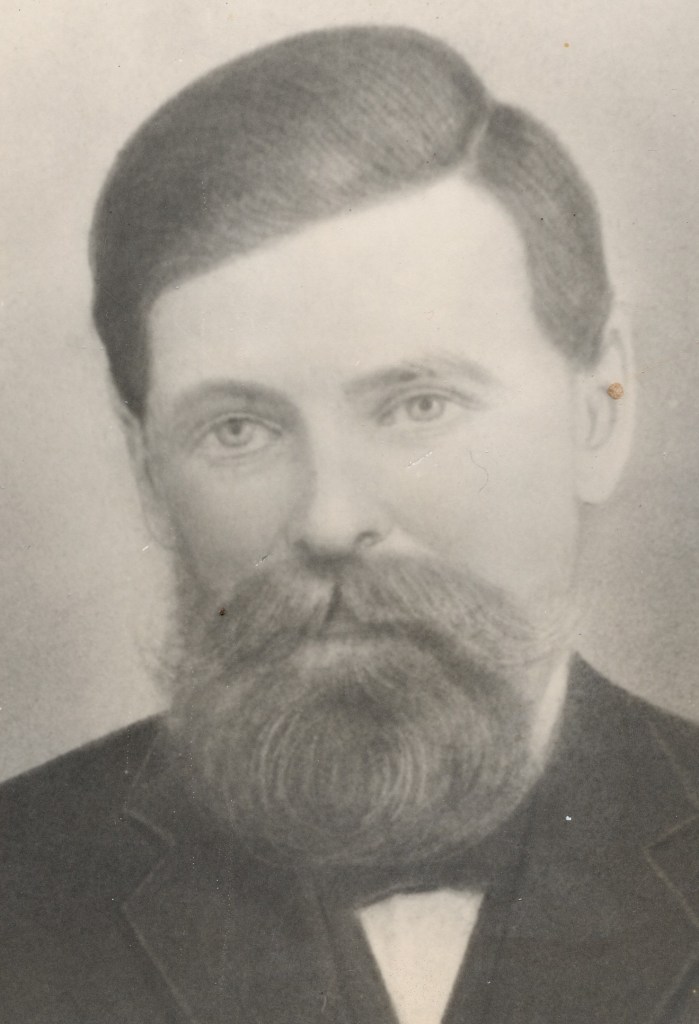
Thorfinnur Johannesson
Thinking of new horizons always brings to mind our ancestors who traveled to America based on a story of hope they had heard from family or friends. Those stories must have been heard at just the right moment, the moment when hope was as necessary as oxygen. To leave so much behind and go to a place you have never seen before would be both exciting and terrifying. So many unknowns were involved and yet they were at a place in their life where making this leap seemed like the next logical step.
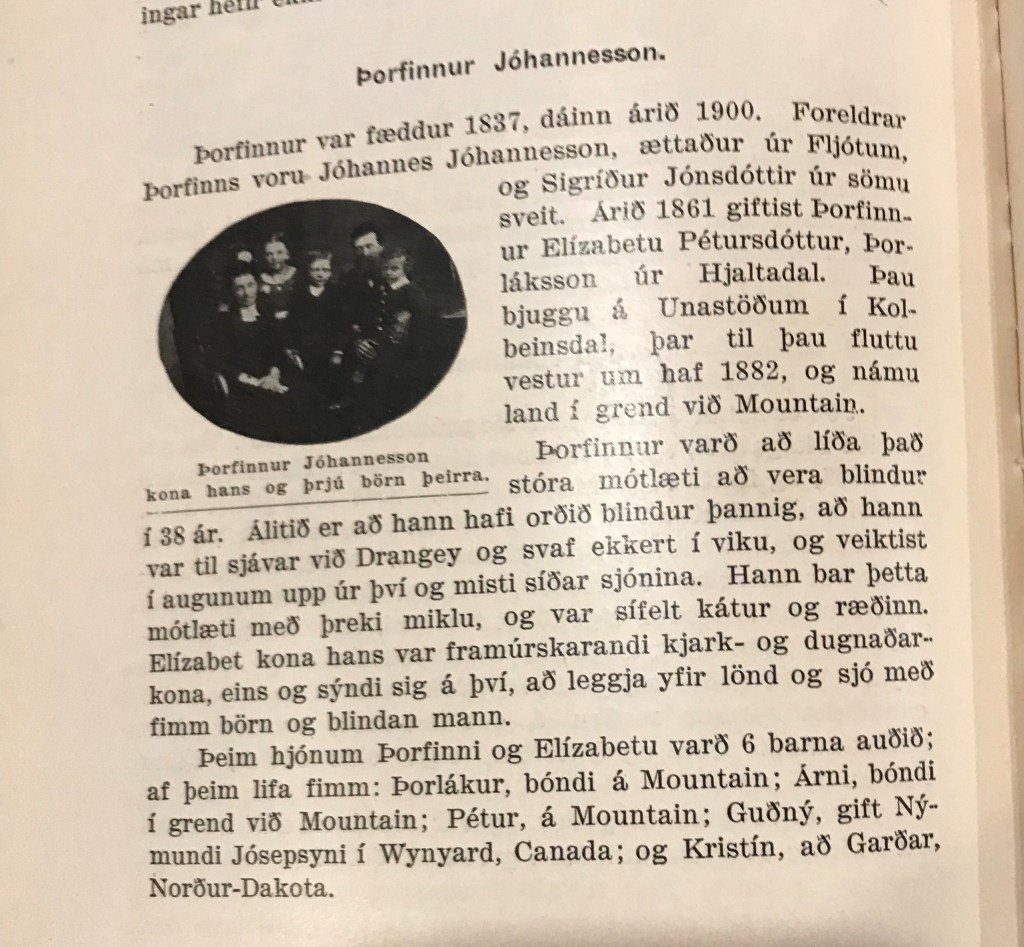
My husbands Icelandic relatives had so much happening in their lives at the time they made this journey. Thorfinnur Johannesson (1838-1900) had been blind for fourteen years when they made the trip. That has to add a little more hesitation in the decision making process. Or maybe it spurred him on even more because he was being held back by those around him. The family was split among several homes. Two of the children were adopted by other relatives, three died young. So they still had five children who were living in various households. They wanted their own home and a place for all of their family to live together.
One of the daughters wrote a little about their trip to America which I found in the book “Pembina County Pioneer Daughters Biographies Akra/Cavalier, Gardar and Mountain” compiled by George Freeman. She was only eight when they made the trip, so I believe it was Gudny who wrote this. Gudny was born in 1874 in Iceland. They came to North Dakota in 1882.
From an Icelandic book at the Pembina County Historical Scoiety This is Thorfinnur and Elisabet and three of their children Gudny, Arni and Fridrik. Arni Thorfinnson in the center is my husbands grandfather.
Thorfinnur Johannesson and his wife Elisabet Pjetursdottir (1839-1911) were the parents in this adventure to a new horizon. Gudny (1874-1933) wrote that there was much talk about how foolish Elisabet was to make this trip with her blind husband and five children they planned to take with them. Two of the children were to be left behind and brought over later when life was more settled. Three of their children had died before they decided to leave Iceland. So Gudny lived in a household with none of her actual family and listening to much criticism of her mom and dad about this trip they were all to take soon. That would be hard for any child to endure, I can just imagine what was also being thrust on her parents at this time. Gudny said one afternoon when she was especially lonely and weary, word came. It was time to get ready for that trip to America. Did she look forward to it, or was she terrified?
They made there way from around Saudharkrokur to Akureyri
At that time the only way to travel was horseback. They traveled two days across rivers and mountains before reaching the village called Akureyri (look north). The harbor was in this city. They unfortunately had to wait a full month in Akureyri as the ship was already gone when they arrived. I wonder how they fared for that month, where they stayed, did they have enough food. As they finally left Iceland behind Gudny remembered the sad faces of the people who left many belongings behind, wondering when they would see land again. They traveled first to Scotland and from Scotland to America. Late in the fall they arrived in Pembina County, North Dakota. They traveled about another fifty miles on a team of oxen to Mountain, North Dakota.
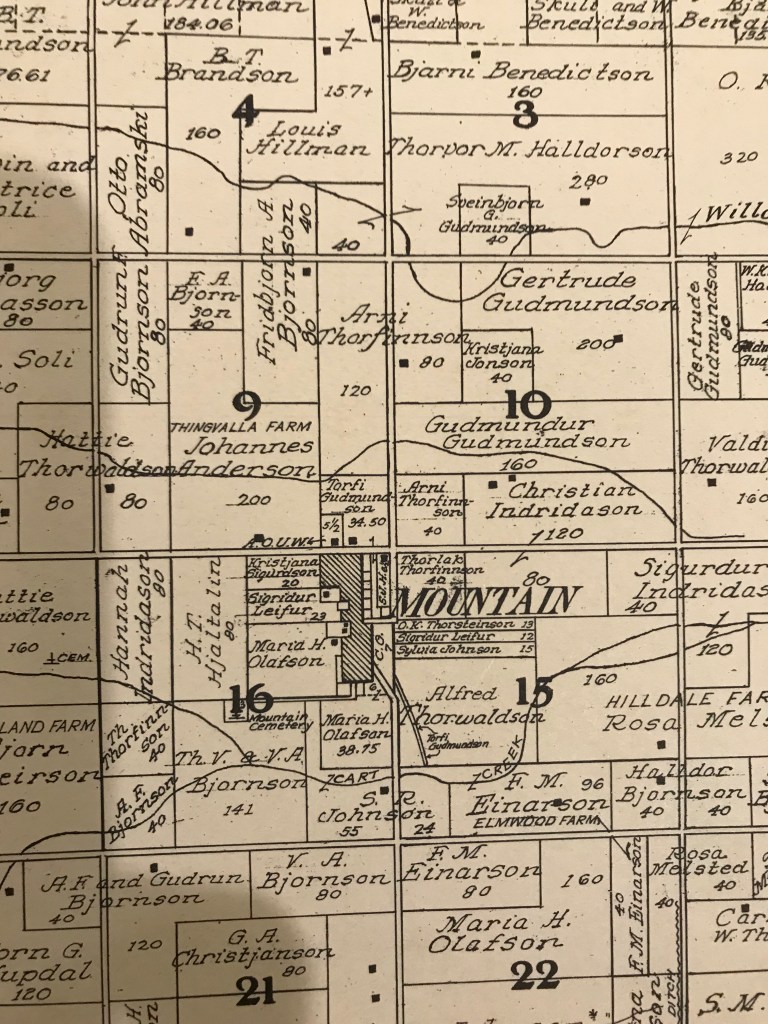
This map is from long after Thorfinnur Johannesson came to America but possibly some of the land owned by Arni Thorfinnson was originally land owned by Thorfinnur.
Elisabet’s brother was already in North Dakota and he met them the first night they arrived. He took them to Hallson for the first night. Elisabet and Thorfinnur and the two youngest boys, Arni who was four and Fred who was eighteen months all returned to Mountain with Elisabet’s brother. The children were again scattered among other relatives. Next spring Thorfinnur filed on some land and he managed to build a log cabin. They moved in the summer of 1883. What a joy that must have been for them. This was their first family home! They still had a lot of work to do. The property was covered in trees. Elisabet and Thorfinnur managed to clear enough to have a garden. The two older children were earning a wage and able to help their parents a little. Gudny worked for her board and clothes until she was twelve. Later they were able to add cows and sheep and chickens. They both worked hard at spinning and knitting. Here is a link to some amazing photos of farms in Iceland.
It wasn’t until the spring of 1899 when they moved to a different location that they were able to bring the two children left behind in Iceland to come and live with them in North Dakota. A joyful family reunion at last.
Gudny married in 1893 to Nimundur Josephson. They had eight children of their own between 1896 and 1917. Gudny died in 1933 in Saskatchewan, Canada where she lived with her family. Her life was so different from mine. I can’t imagine how difficult it would be to shuffle around from household to household. Working for your room and board from the age of eight to twelve knowing your family wasn’t too far away but far enough you couldn’t just walk over to visit.
Arni and his wife Sigridur Bjornson on their wedding day.
Arni, one of the two youngest boys who lived with their parents more than the other children, was my husbands grandfather. His family life was probably a little more normal than his older brothers and sisters. The first winter they were in North Dakota they lived in a dugout. I’m not exactly sure what a dugout is but it doesn’t sound warm enough for a winter thirty miles from the Canadian border. But he did live with his parents.
Vikur Church cemetery in Mountain, North Dakota
Thorfinnur died in 1900 and is believed to be buried in the cemetery at Vikur church in Mountain. Elisabet died in 1911 and is buried in Mountain Cemetery. They were an amazing hard working couple who worked extremely hard to make a better life for their family in this new world. They exemplify the story of many immigrants who came to America from a life of hardship and continued to work hard to build the life they dreamed they could have.
Hoping your family came simply for a new adventure but I imagine there are many stories such as this and many who had it even worse. We all need to give thanks to those brave pioneers who risked everything because they had a tiny spark of hope.














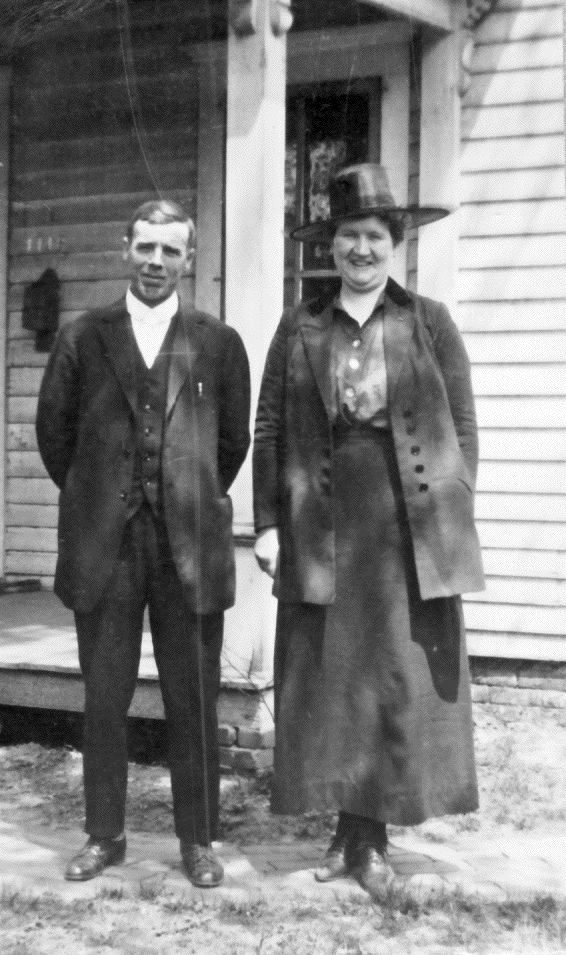

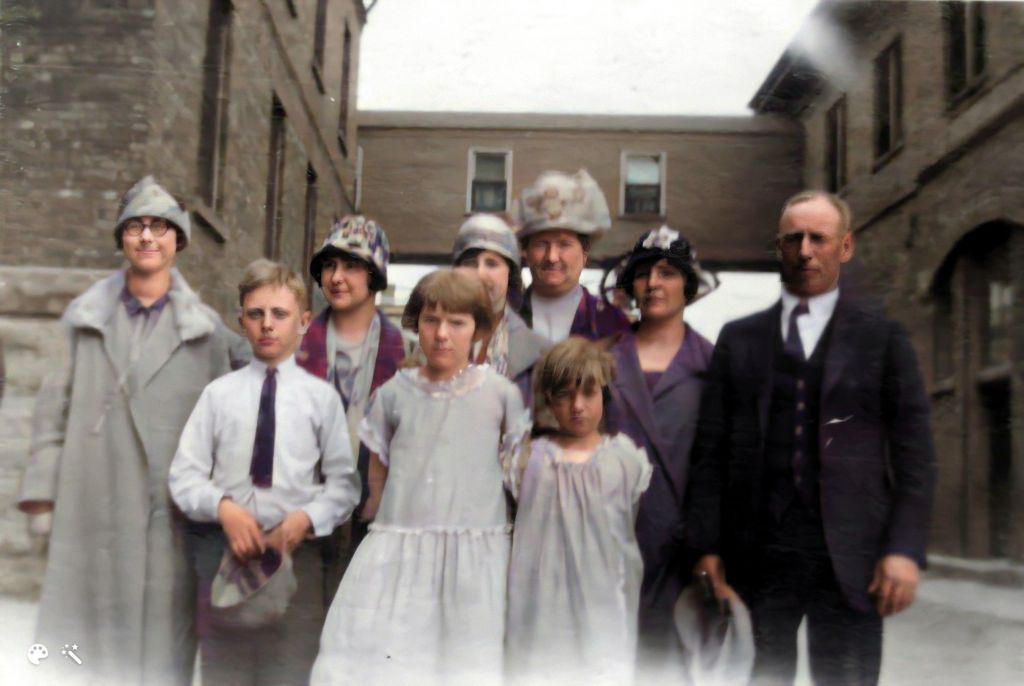
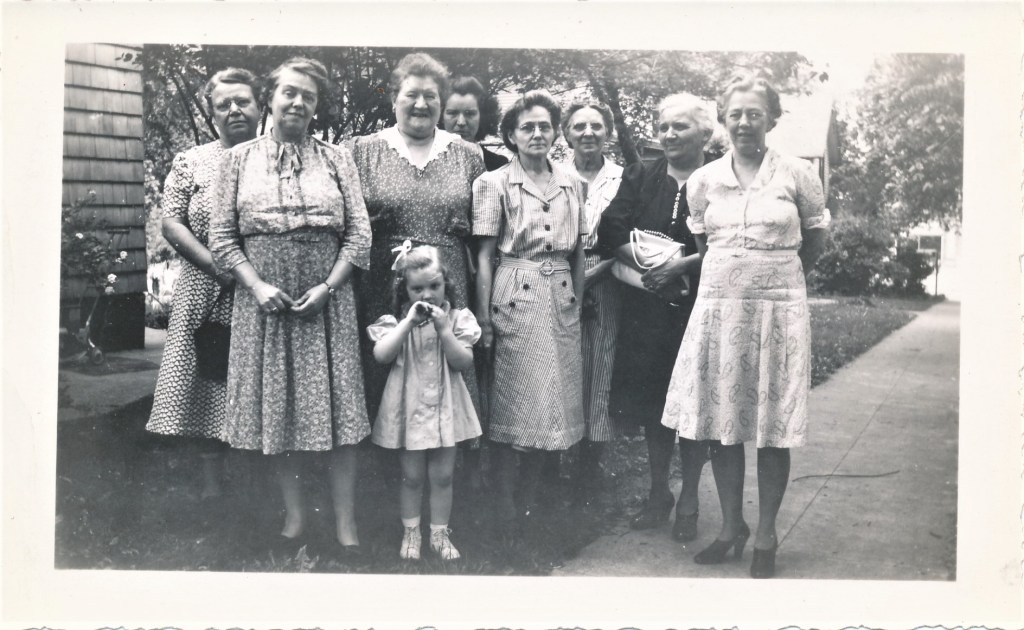
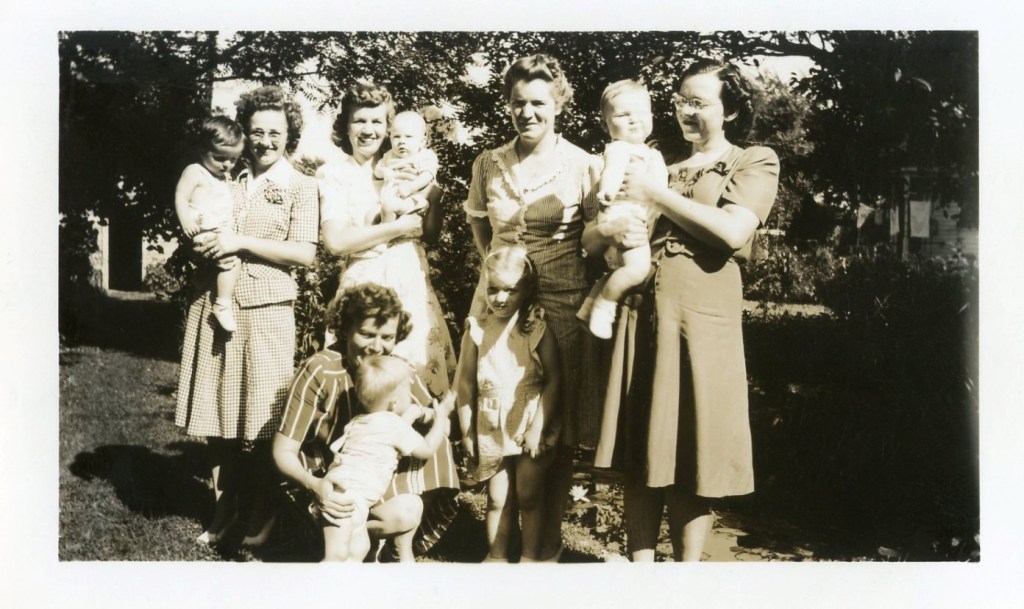

 Who do you want to find more about in 2023? Now would be a good time to write up what you know (or what you think you know!) and consider what your next steps are. (Of course, feel free to interpret the theme in other ways!)














 My Tree in the Forest